


/file/1149/1658d866a902eed53d0aff5fdf67f8a1.jpeg)

RM3.9b spent but Najib-era River of Life project a flop, audit finds
Despite a whopping RM3.915 billion spent on the River of Life project in Kuala Lumpur since 2011, the project is unlikely to be completed this year and has not met its objectives, the Auditor-General’s Department found.
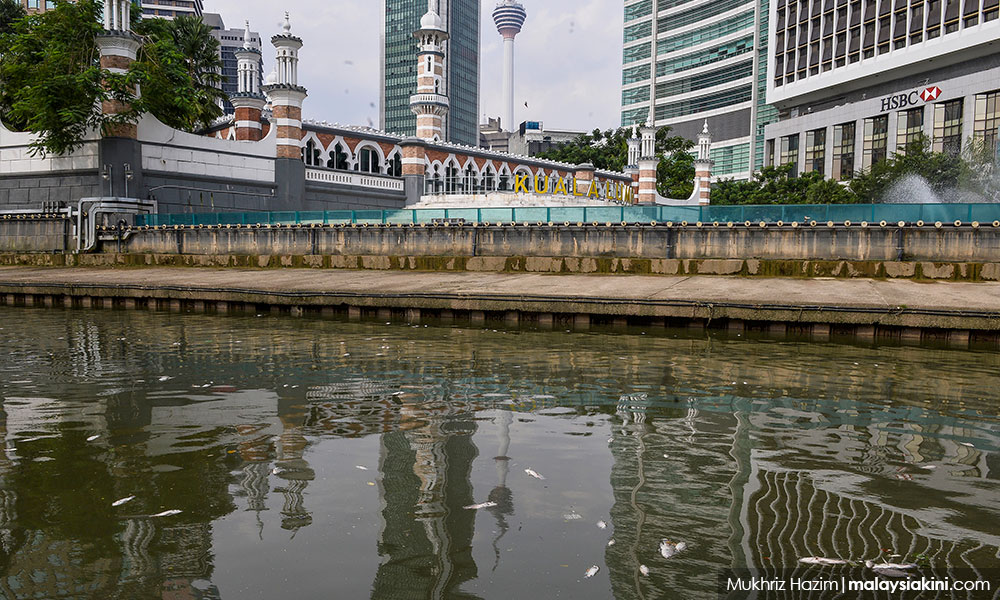
Its auditors found various infrastructures have broken down, while the Klang River has not been cleaned.
UPDATED 3.28PM | Added more details and examples of lapses pointed out in AG’s Report.
Despite a whopping RM3.915 billion spent on the River of Life (ROL) project in Kuala Lumpur since 2011, the project is unlikely to be completed this year and has not met its objectives, the Auditor-General’s Department found.
Its auditors found various infrastructures have broken down, while the Klang River has not been cleaned.
“All objectives of the ROL project have not been achieved, especially the objective to increase the quality of the river to Class IIB, (suitable for recreational purposes),” Auditor-General Wan Soraya Wan Mohd Rodzi said in the report launched this morning.
Launched under then-premier Najib Abdul Razak, some RM4.4 billion was allocated for the redevelopment of 10.7km of the Klang River in central Kuala Lumpur and the clean-up of its waters and shoreline running 110km upriver.
Initiated in July 2011, the project was intended to rejuvenate eight rivers in the Greater Kuala Lumpur/Klang Valley region as part of Najib’s ambitious Economic Transformation Programme to elevate Malaysia to developed nation status by 2020.
Too reliant on govt funding
The AG’s report revealed that a flawed business model resulted in the project’s maintenance and operations continuing to depend entirely on government funding.
“The prepared business model only covered the river beautification area of Precinct 7 and failed to reduce dependence on government financial allocations,” it said.
In the full report, the audit mentioned that ROL’s business model involves using the request for proposal method for renting out open spaces and advertising in Precinct 7 ROL, which will be carried out by Kuala Lumpur City Hall (DBKL) on behalf of the responsible ministry.
Additionally, revenue from implementing this ROL Business Model, including the rental income from ROL assets involved in the Urban Young Entrepreneurs Programme, can be deposited into the ROL Trust Fund to help reduce the maintenance cost burden.
“Audit findings showed that by May 31, 2023, only 30 out of 54 facilities (55.6 percent) had been rented, generating RM1.01 million. However, only RM354,695 (35.1 percent) of this amount had been collected,” it said.
Following the findings, the Federal Territory Department (FTD) responded on Nov 22, 2023, explaining that its director-general had decided on a new approach for the ROL Trust Fund on Sept 22, 2023:
The project trust fund will not be created as rental income from ROL assets is insufficient to cover maintenance costs.
DBKL will manage rental income from ROL assets from the project completion date, following their revenue management procedures.
A special general ledger code or Vot for the project will be established at DBKL to help FTD monitor ROL asset maintenance and ensure transparency in expenses using rental income from ROL assets.
Delays leading to cost overruns
This oversight resulted in poor maintenance of project assets, leaving them neglected, damaged and underutilised.
Delays in several projects have exceeded eight years, escalating government costs, it added.
Specifically, three sewerage projects remain incomplete even though they were granted time extensions ranging from 2,098 to 2,938 days, which amounts to over eight years.
Delays in project completion and contract termination have contributed to estimated cost overruns totalling up to RM234.72 million.
“The river cleaning project’s performance is unsatisfactory, particularly regarding sewerage projects. Delays in completing four sewerage projects have led to estimated cost increases of up to RM234.72 million, with project benefits delayed by more than eight years,” it read
Despite termination notices issued for the Serantau Batu Regional Sewage Treatment Plant, progress remains stalled at 45.8 percent, with no re-tendering of the project.
“A new contractor has not been appointed due to changes in implementation methods from conventional to design and build, as well as unresolved issues regarding design claims from consultants,” it read.
FTD responded on Sept 8 and Nov 22, 2023, saying it would enhance governance and monitoring by increasing on-site visits and having officers attend project meetings to address delays early.
They are preparing a memorandum for new directions and extensions for unfinished ROL packages. This memorandum is in its final stages and will soon be submitted to the Prime Minister’s Department for cabinet approval.
The audits also identified governance weaknesses in planning expenditures, monitoring expenses, design preparation, consultant appointments and project execution.
Incomplete projects
It mentioned that several projects are still ongoing, with varying levels of completion and some significantly delayed beyond the planned timelines.
“As of July 2023, eight projects are ongoing, with progress on site ranging from 21 percent to 97.3 percent.
“Two projects with expired contracts lack appointed contractors and 12 projects have yet to commence. Only 79.4 percent of river beautifying projects and 50 out of 296 sewage treatment plants have been upgraded or rationalised,” read the report.
The audit revealed that river beautification projects were executed and completed under seven contracts amounting to RM900.35 million.
However, only 8.5km (79.4 percent) of the planned 10.7km for river beautification, as outlined in the ROL master plan and memorandum to the cabinet, was completed.
Packages 1E, 1F, and 1G, covering a 2.2km stretch, were also identified as not being implemented during the audit review.
FTD responded on three separate dates, saying that the cabinet had agreed to cancel the KL River City project on Sept 8, 2023.
It said that the 2.2km segment of the original river beautification project along Sungai Gombak (Packages 1E, 1F, and 1G) will be resumed by DBKL using RM187 million from existing development funds via an open tender.
“FTD will work with DBKL on projects focusing solely on river reserves. They will closely monitor the planning and execution of Packages 1E, 1F, and 1G to achieve the beautification goals of the River of Life project along Sungai Gombak and Sungai Klang,” it read.
Overhaul business model
Moving forward, the AG’s office recommends:
Assessing the viability of proceeding with projects in the pre-implementation stage.
Allocating funds appropriately for project implementation and maintenance.
Evaluating how effectively the project contributes to its intended objectives.
All implementing agencies must comprehensively overhaul the existing business model to resolve maintenance issues and address neglected assets.
It added that the FTD and implementing agencies should enhance on-site monitoring to ensure projects meet timelines and specifications, thereby avoiding increased government costs from delays.
It also recommends that other agencies, such as DBKL and the Irrigation and Drainage Department, strengthen project governance to ensure compliance with financial rules, contract terms and conditions.
/file/publisher-c1a3f893382d2b2f8a9aa22a654d9c97/2024/01/aa0b5415f18d6ba99df6d9db129e804c.jpg)
/file/publisher-c1a3f893382d2b2f8a9aa22a654d9c97/2023/11/0fc5c4473a7b2190352de277a9ffcf62.jpg)
/file/publisher-c1a3f893382d2b2f8a9aa22a654d9c97/2023/10/2cc90659e3b5a0b8431a0a74cbd72e46.jpg)
/file/publisher-c1a3f893382d2b2f8a9aa22a654d9c97/2020/04/cf43c6e628934b4d478c7fffa2a039fa.jpg)
/file/publisher-c1a3f893382d2b2f8a9aa22a654d9c97/2023/05/b69781dc2333b28347a2f8aa7c6678bc.jpg)


Report this comment
Are you sure you want to delete this comment?
This action cannot be undone.