


/file/publisher-c1a3f893382d2b2f8a9aa22a654d9c97/2024/11/543fbd7ee0c031707a76510097169ff4.jpg)

Minister: Asean won’t retaliate against US tariffs, engaging Washington
This is in addition to leading them in engaging Washington to potentially reduce retaliatory tariffs on imports into America.
Amir said the Southeast Asian grouping would do so through American institutions to...
Malaysia, as the Asean chair this year, will prioritise the importance of deepening regional economic ties following the announcement of sweeping US tariffs on the bloc’s member nations, said Finance Minister II Amir Hamzah Azizan.
This is in addition to leading them in engaging Washington to potentially reduce retaliatory tariffs on imports into America.
Amir said the Southeast Asian grouping would do so through American institutions to reduce tariffs, which are clearly deterrents to global trade.
Speaking to the media ahead of the AseanFinance Ministers’ and Central Bank Governors’ Meeting (AFMGM) next week, he said while countries are still digesting and understanding the implications of the tariffs on their respective economies, it was clear that Asean members showed they were in unison in adopting as non-retaliatory stance and work towards an amicable solution.
“At the moment, if you look through all the statements that Asean countries have released, the reaction is that we are not looking at retaliation measures (but rather) engaging in discussions to understand what they are trying to imply and the possibility of reduction of the tariff base,” he said.
Amir said the discussion on the US tariffs is expected to take place at the private dialogue session at the 12th AFMGM next week, and Asean will continue to focus on boosting intra-Asean trade to build up resilience in the face of evolving global trade dynamics.
Asean’s Indo-Chinese member states were the hardest hit by the tariffs, with Cambodia slapped with baseline and retaliatory tariffs totalling 49 percent, followed by Laos (48 percent), (Vietnam 46 percent), and Myanmar (44 percent).
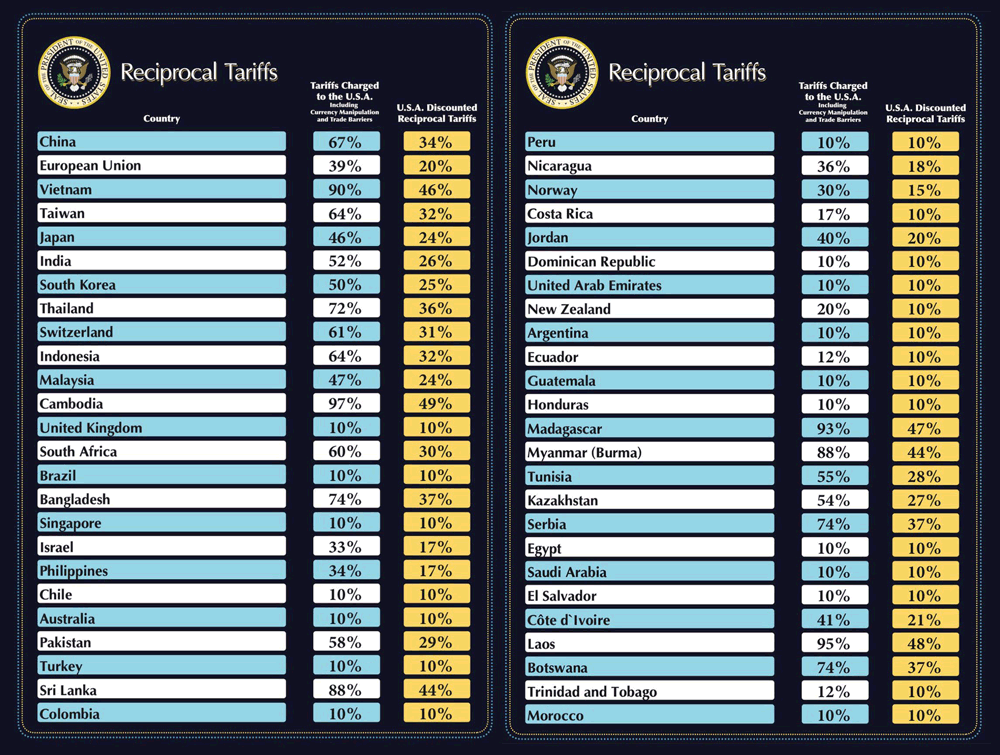
Meanwhile, Thailand was hit with tariffs of 36 percent, Indonesia 32 percent, Brunei and Malaysia both at 24 percent, Philippines 17 percent and Singapore a baseline tariff of 10 percent.
Staying inclusive
Elaborating on Asean’s perspective following the announcement by US President Donald Trump a mere 36 hours ago, Amir said that the 57-year-old bloc in general was through “very consensual engagement” in dealing with issues.
“We try to make sure that they stay inclusive,” he said, adding that it’s important for member states to make “decisions based on a very calm analysis and open dialogue”.
“A reactionary mode based on emotions is a mechanism that doesn’t help along the way,” he said.
Amir said that Malaysia has been very consistent as an open trading economy and a core supporter of free trade.
“We want to promote this (free trade), and we want it to continue.
“This means that in the process of talking to them (the US), we will be able to find another path. Let’s understand the issue, and let us have a dialogue on what we can do, adjust and move on,” he added.
‘Going with single voice’
Asked about the possibility of member countries taking a unilateral approach, Amir said each country would have to look at what they need and find alignment.
But the ultimate goal, he pointed out, should be to look at how Asean as a grouping continue to facilitate trade and go back to its core principle, which is to be heard as a single voice, look at opportunities within the Asean system and promote intra trade.
For instance, Amir said one of the Priority Economic Deliverables (PEDs) at the AFMGM is to promote an instant payment mechanism, and one of the key elements is to ease cross-border payments within Asean for the people, which will highly benefit micro, small and medium enterprises (MSMEs).

He said the Working Committee of the Payment and Settlement Systems (WC-PSS) had put great efforts into preparing the foundation for greater cross-border payment connectivity within the region to support increased trade and economic activity in Asean.
Amir said focus has been put towards adopting international standards to prepare domestic retail payment systems (RPS) and large value payment systems (LVPS), build domestic near real-time RPS capabilities, and promote regulatory frameworks with international standards.
Cooperation in customs
Besides that, the minister said Asean Customs Cooperation involved the collaborative efforts of Asean member states to harmonise customs procedures, reduce trade barriers, and facilitate smoother cross-border trade.
He said this includes standardising customs regulations, simplifying trade processes, and establishing Mutual Recognition Agreements (MRAs) to recognise each other’s customs standards.
Amir elaborated that key initiatives, such as the Asean Customs Transit System (ACTS), aimed to streamline the movement of goods across borders while capacity-building and information-sharing enhance the efficiency of customs authorities.
Additionally, he said Asean Customs Cooperation works to combat illegal trade activities, support regional integration and promote economic growth within the Asean Economic Community (AEC).
He added that Asean has been working over the years to simplify and find common ground, strengthening the bloc’s economy and helping it move forward amid the rapidly changing global economy
- Bernama
/file/publisher-c1a3f893382d2b2f8a9aa22a654d9c97/2025/04/636d6b8ecd5e6c66786a0f9751196c3b.jpg)
/file/publisher-c1a3f893382d2b2f8a9aa22a654d9c97/2025/04/988e71d11110b257c4304c5cd270ffee.jpg)
/file/publisher-c1a3f893382d2b2f8a9aa22a654d9c97/2023/10/12474d65554532806d6d0ef9addb22ac.jpg)
/file/1214/0bf383954dafb7c17e3338903e7f3d8f.jpeg)
/file/publisher-c1a3f893382d2b2f8a9aa22a654d9c97/2024/10/b0604e71c2c76e58ffea999662584609.jpg)
/file/publisher-c1a3f893382d2b2f8a9aa22a654d9c97/2025/04/cd07f3a02d1bacb46c9dc8585ea64fc8.jpg)


Are you sure you want to delete this comment?
This action cannot be undone.