


/file/publisher-c1a3f893382d2b2f8a9aa22a654d9c97/2025/07/fdeb9c388285db814c043184efffef01.jpg)

Home Ministry bans 2 books 'detrimental to public morals'
The Home Ministry has banned two publications, effective from July 1, due to their content allegedly being “detrimental to public morals”.
The books, “Chase Me” by American author Tessa Bailey, and “Ammar Zahrain: The Obsessive Husband” by local author Nssignature, have been banned under Subsection 7(1) of the Printing Presses and Publications Act (PPPA).
The Home Ministry has banned two publications, effective from July 1, due to their content allegedly being “detrimental to public morals”.
The books, “Chase Me” by American author Tessa Bailey, and “Ammar Zahrain: The Obsessive Husband” by local author Nssignature, have been banned under Subsection 7(1) of the Printing Presses and Publications Act (PPPA).
The ministry also invoked Subsections 8(1) and 8(2) to justify the measure.
Under Subsection 8(1) of the Act, any individual in possession of restricted material can be prosecuted and fined with no more than RM5,000.
Under Subsection 8(2) of the law, any parties involved in the printing, importing, production, publication, distribution, etc, of any prohibited content can be prosecuted and imprisoned for no more than three years or fined no more than RM20,000, or both.
“This ban is a preventive measure against social detriment. Likewise, it also helps protect the public from being exposed to indecent content that is not suitable for consumption.
“The government is committed to continuously moderating and enforcing the necessary actions related to printing and publications, especially to prevent elements and understanding of movements and ideologies that can threaten our national safety and harmony,” the Home Ministry said in a press statement today.
Latest in a long list
Earlier this year, the ministry similarly banned seven books over concerns about their impact on public morality and order, including the famous romantic-comedy novel, “Love Theoretically” by American author Ali Hazelwood.
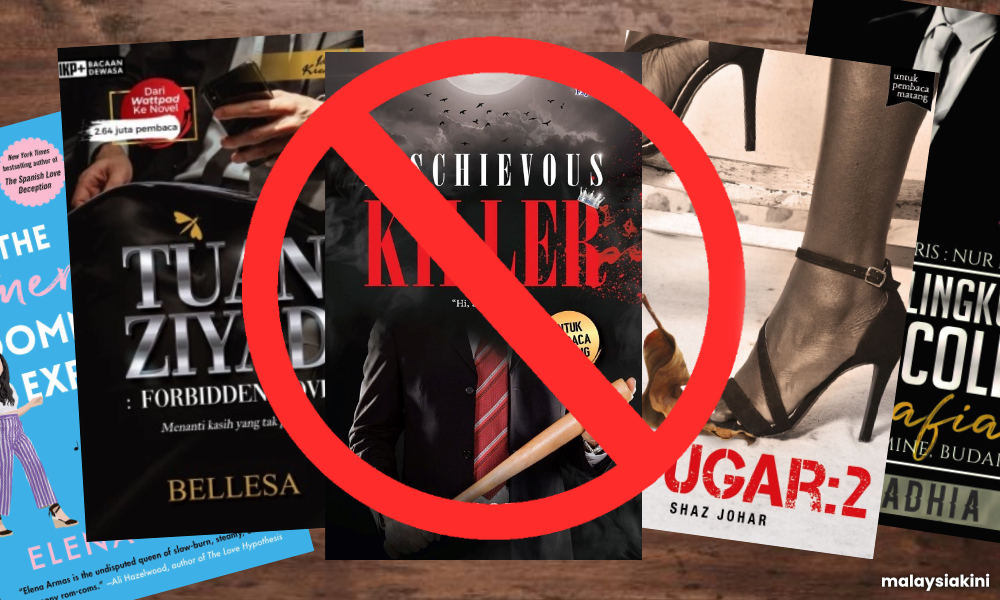
According to a local NGO, nearly half of the banned books under the PPPA from 2020 until May 2025 involved LGBTQ+ and sexuality related content.
A recent report by Justice for Sisters highlighted that bans on local publications have also sharply risen between 2024 and early 2025.
Amnesty International Malaysia’s Kiran Kaur also warned that proposed legislative amendments to expand the Home Ministry’s powers under the PPPA are contradictory to the purpose of the newly established Malaysian Media Council.
Article 19 senior programme officer Nalini Elumalai had also previously labelled the bans as “censorship over diversity”, as they curb the formation of an inclusive society.
/file/publisher-c1a3f893382d2b2f8a9aa22a654d9c97/2019/11/ae272057d31745954e2574d8cb5adb3b.jpg)
/file/publisher-c1a3f893382d2b2f8a9aa22a654d9c97/2025/05/730be1d4e06b1fe035d9529090290c7e.jpg)
/file/publisher-c1a3f893382d2b2f8a9aa22a654d9c97/2019/09/9f61a5f5b42e2b7d6e832c32d298af29.jpg)
/file/publisher-c1a3f893382d2b2f8a9aa22a654d9c97/2020/10/0b58ceb8a0736b50e49b15b5446f4a00.jpg)


Are you sure you want to delete this comment?
This action cannot be undone.