


/file/publisher-c1a3f893382d2b2f8a9aa22a654d9c97/2025/02/b58a49774c1dac1f6e44fab01010cced.jpg)

Don't let AI become 'another illusion or Anwar Ibrahim', Bersatu MP warns
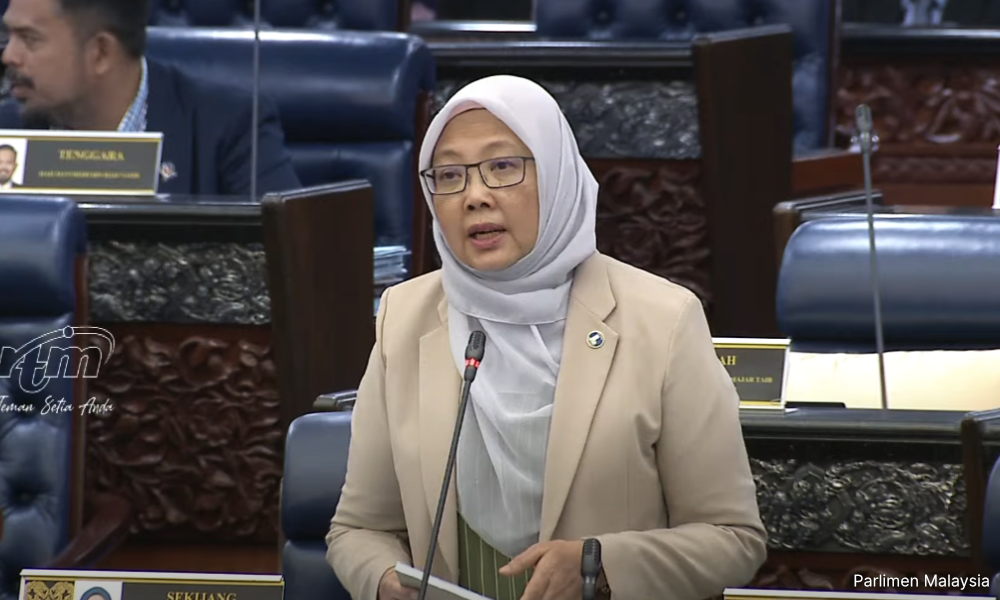
PARLIAMENT | An opposition lawmaker has criticised the Digital Ministry’s supposed lack of direction, sounding the alarm over how a lack of concrete plans for the nation’s digital development could leave Malaysia behind other countries.
Mas Ermieyati Samsudin (PN-Masjid Tanah) asserted that the Digital Ministry, helmed by Gobind Singh Deo (Harapan-Puchong), appears to have a “cloudy narrative”, despite being formed two years ago.
Summary
Opposition MP Mas Ermieyati slams the Digital Ministry for its “cloudy narrative” and lack of a clear digital strategy, warning Malaysia risks falling behind in the global AI race.
She urges the government to relocate digital functions to the Prime Minister’s Department for stronger coordination and authority.
Citing Estonia’s success, she pushes for a National Digital ID Act to unify digital services under one secure identity platform.
PARLIAMENT | An opposition lawmaker has criticised the Digital Ministry’s supposed lack of direction, sounding the alarm over how a lack of concrete plans for the nation’s digital development could leave Malaysia behind other countries.
Mas Ermieyati Samsudin (PN-Masjid Tanah) asserted that the Digital Ministry, helmed by Gobind Singh Deo (Harapan-Puchong), appears to have a “cloudy narrative”, despite being formed two years ago.
“One moment (the ministry) wants to build the largest data centre in Southeast Asia, the next it’s talking about an AI city, then it shifts to digital government empowerment and the digital economy.
“Where is our national digital compass? Has a comprehensive national digital policy been developed? At the very least, have such efforts even begun?” Mas Ermieyati questioned while debating the 13th Malaysia Plan (13MP) in Parliament today.
Urging the ministry to either improve the existing Malaysia Digital Economy Blueprint or develop a new action plan to fulfil Malaysia’s aspirations of becoming a nation at the forefront of artificial intelligence technology, Mas Ermieyati cautioned that a lack of clear leadership could have dire consequences for the nation.
“I don’t want ‘AI’, which is supposed to stand for artificial intelligence, to end up just being another illusion, or Anwar Ibrahim,” she quipped, in reference to the prime minister.
Comparative studies
Earlier in her debate, Mas Ermieyati cited “comparative studies” recording that countries which have successfully driven their digital and AI agendas typically do not place digital transformation initiatives under “minor ministries”.
She pointed out that in the United Kingdom, the Central Digital and Data Office is placed under the Cabinet Office, while in Singapore, the Smart Nation and Digital Government Office is parked under the Prime Minister’s Office.

“But, in Malaysia, we’ve only assigned (digital transformations and developments) to a junior ministry with limited authority and weak cross-agency coordination capacity,” she lamented.
As such, she suggested that the National Digital Department and all digitalisation functions under the Digital Ministry be placed under the Prime Minister’s Department, with a goal of first resolving issues of legal authority, inter-ministerial coordination, and cross-state matters.
She argued that only once such issues have been settled should implementation procedures be distributed to the Digital Ministry and other relevant ministries.
Draft National Digital ID Act
Commenting on the MyDigital ID initiative, Mas Ermieyati called for the drafting of a National Digital ID Act, or amendments to the National Registration Act 1959 and other relevant laws, to ensure that the national identification initiative is up to mark.
Such measures, she said, are necessary to guarantee that the MyDigital ID push is held to high cybersecurity standards with centralised digital identity management and trusted data protection.
“One of Malaysia’s key weaknesses is a fragmented process (as) we still have to register separate accounts for MyJPJ, eCourts, eHasil, the National Registration Department and eTanah.
“Estonia, which is half the size of Kelantan, has introduced a national e-identity since 2001, allowing its citizens access to all government services through a single identity,” Mas Ermieyati added.
Minister in the Prime Minister’s Department (Federal Territories) Dr Zaliha Mustafa previously told the Dewan Rakyat that Putrajaya is weighing the possibility of legally requiring citizens to register for the government’s MyDigital ID initiative.
Zaliha admitted that there are certain “restrictions” faced by the government in its push to encourage uptake for the digital identification platform, including the fact that registrations are voluntary, with no law specifically mandating the use of the platform.
Reporting by Qistina Nadia Dzulqarnain, Alyaa Alhadjri, B Nantha Kumar
/file/publisher-c1a3f893382d2b2f8a9aa22a654d9c97/2025/07/7ef74eb96df51fdcf61b14b6a0deb33f.jpg)
/file/publisher-c1a3f893382d2b2f8a9aa22a654d9c97/2025/07/65ce6b23b0790307524b0b8eb20f2e26.jpg)
/file/publisher-c1a3f893382d2b2f8a9aa22a654d9c97/2025/02/a9c0856153e4adf4af5c9b44cd23b9fa.jpg)
/file/publisher-c1a3f893382d2b2f8a9aa22a654d9c97/2022/10/400819256d52fcfe2afd6bb08c368d44.jpg)
/file/publisher-c1a3f893382d2b2f8a9aa22a654d9c97/2024/10/303c8b2be73f6e30df826eb466bf6240.jpg)


Are you sure you want to delete this comment?
This action cannot be undone.