




Gov't freezes intake of Indian workers
The government has frozen the intake of Indian workers, an official said today, in a decision made as the government cracks down on dissent by ethnic Indians in the multicultural nation.
The government has frozen the intake of Indian workers, an official said today, in a decision made as the government cracks down on dissent by ethnic Indians in the multicultural nation.
A Home Ministry spokesperson refused to confirm whether the move, which is certain to anger India, was linked to unprecedented protests by ethnic Indian Malaysians and the jailing of prominent activists.
"There is a freeze in the intake of Indian foreign workers effective Dec 18," the official told AFP , adding that the move relates mostly to unskilled labourers, not Indian professionals.
"This is a government decision, no reasons were given," he added.
He confirmed the curbs also extend to three other groups of workers from India - priests, sculptors and musicians - a decision which religious leaders condemned earlier today.
The Malaysian Council of Buddhism, Christianity, Hinduism, Sikhism and Taoism said foreign priests already in the country have only been given six-month renewals and told they must leave after expiry.
Foreign priests already in the country have only been given six-month renewals and told they must leave after expiry, said the council's president A Vaithilingam.
We want PM's explanation
Vaithilingam said the restrictions mostly affected ethnic Indian Hindus, who have been at the centre of a discrimination row, and that there would now not be enough priests to conduct prayers.
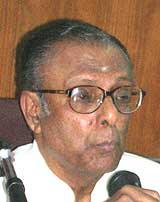 "We are shocked by the announcement," Vaithilingam (
left
) told
AFP
. "We want an explanation from the prime minister and the government on this."
"We are shocked by the announcement," Vaithilingam (
left
) told
AFP
. "We want an explanation from the prime minister and the government on this."
A row over race and religion has gripped Malaysia in recent months, triggered by a mass rally last November when protesters alleged ethnic Indians faced discrimination at the hands of the government.
Parliamentary opposition leader Lim Kit Siang called for the government to give an "immediate and proper explanation" of the move over Indian workers and to state whether it was related to the ongoing ethnic tension.
"It raises public concerns because such a selective targeting of Indians will lead to a new strain in the relations between the two countries," he said.
The labour freeze comes despite a recent warming of ties between the two nations, and a visit this week by Indian Defence Minister AK Antony during which they announced a substantially upgraded defence relationship.
Malaysia said on Monday that the two nations' leaders were keen to complete a fledgling free-trade agreement as soon as possible, with negotiations due to begin this month.
The Malaysian state news agency Bernama reported from New Delhi earlier Tuesday that India was keen to seal a labour agreement to safeguard the welfare of its workers here.
Indian workers are the third largest foreign workforce in Malaysia, numbering almost 140,0000, most of them hired by restaurants, Bernama said.
India's Prime Minister Manmohan Singh caused waves here by voicing concern last year over heavy-handed treatment of ethnic Indian protesters.
In December the government was heavily criticised for using a draconian internal security law to detain five protest leaders, who now face indefinite detention without trial.
Batu Caves temple affected
Vaithilingam, who is also president of the leading Hindu organisation the Malaysian Hindu Sangam, said that about 200 Hindu priests were the majority of foreign clergy here, but that there are also some Buddhists and Taoists.
He said visas for temple musicians have also been reduced from one year to six months while temple sculptors have had their permits reduced from six months to one week.
"I am shocked because normally Immigration has a talk with us before changing any policy and this has happened without any discussion," he said.
Immigration department officials confirmed that the visas issued to priests were being restricted but refused to give details.
Vaithilingam said that major temples like the one at Batu Caves, on the fringes of Kuala Lumpur and a major tourist attraction, would be hard hit.
"These priests are important as they carry out special prayers and rituals and so it will be difficult at places like Batu Caves to have big prayers and people will not be able to pray the way they need to," he said.


Are you sure you want to delete this comment?
This action cannot be undone.