




Penang gov't gets more flak over appointments
The Penang government’s appointment of 36 councillors has been criticised by 55 civil society groups, who described the candidates as “politically-partisan” people without a strong track-record as community leaders.
The Penang government’s appointment of 36 councillors has been criticised by 55 civil society groups, who described the candidates as “politically-partisan” people without a strong track-record as community leaders.
The Coalition for Good Governance (CGG) - whose secretariat is helmed by human rights group Suaram - told a press conference in Petaling Jaya today that the April 16 appointments were “undemocratic, lack public consultations and were non-transparent”.
 “Among the small contingent of seven non-partisan representatives, the over-representation of five members of commercial interests and two members of
vis-a-vis
non-commercial non-governmental organisations is completely unacceptable,” said Suaram executive director Yap Swee Seng, reading from a joint statement.
“There’s also no clear policy on how they made the appointments and decisions. We urge the state governments of Selangor, Perak and Kedah not to follow the example of Penang.”
The Pakatan Rakyat state government has been harping on its intention to ensure competence, accountability and transparency in its administration ever since it took over Penang after the 12th general election.
In the days following their electoral victory, DAP parliamentarians in Kuala Lumpur had pledged their commitment to bringing back local council elections, which had been suspended in 1964.
 The Penang government’s decision had earlier come
under fire
from NGOs in the state.
Yap pointed out that the Penang appointments did not meet “the principles, criteria and processes of political appointment”, as set out in the CGG’s memorandum of March 28.
The guidelines were drawn up as an interim measure pending the promised revival of local council elections - a key plank of the opposition campaign during the elections.
‘Launch road-map’
Calling on the Pakatan state governments to launch their road-map for local government elections, the CGG said the “enabling conditions and structures should be in place no later than 2010", to enable such elections to be conducted in 2011.
“Since they have made a commitment, we are calling them to put up a road-map when they are going to implement this,” said Yap.
“The CGG is concerned with certain statements by some Pakatan politicians that local authority elections can only be held with approval from the federal government.”
State governments, he said, can pass an enactment that would bypass the restrictions of Section 15 of the Local Government Act 1976 and pave the way for election of councillors.
“The federal government should not stand in the way of better, more effective and more accountable representative government at the local authority level,” he added, also urging the eight BN state government to do the same.
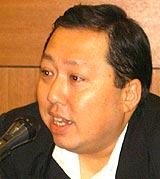 Malaysian Bar human rights committee co-deputy chairperson Andrew Khoo echoed the call, saying that the federal government should share its power with states, as well as the grassroots via local authorities and village development and security committees.
He further suggested that candidates should be local residents so that they are accountable to their voters, and not people who are parachuted into the areas.
“People elected should also be community-centred rather than political-centred in order to serve society,” he said.
“The rakyat are looking for greater accountability and transparency, not for one party to run the government...Citizens would enjoy greater degree of participatory democracy.”
He said that state governments could pass an enactment to identify areas that are exempted from Section 15, publish this in the gazette, set out a road-map and put in place a mechanism for local council elections.
“If the federal government doesn’t agree, is it going to oppose to greater democracy?” he asked.
Civil society groups have been calling on all 12 state governments to restore local council elections by 2010.


Report this comment
Are you sure you want to delete this comment?
This action cannot be undone.