




Suhakam slams electoral process
In a departure from bland observations, the Human Rights Commission of Malaysia (Suhakam) has used its 2007 annual report to deliver a strong indictment of the electoral process.
In a departure from bland observations, the Human Rights Commission of Malaysia (Suhakam) has used its 2007 annual report to deliver a strong indictment of the electoral process.
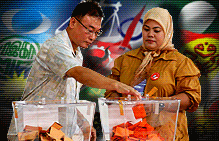 In the 312-page review of the human rights situation, the government-appointed commission pointed out existing flaws and urged the amendment of relevant laws to ensure free and fair elections.
“Suhakam is concerned that certain fundamental rights pertaining to free and fair elections, such as freedom of expression, freedom of association and freedom of assembly, are either curtailed or ignored during election campaigns,” said the report, presented to Parliament on Monday.
“Suhakam observes too that there is no level playing field, particularly in terms of access to the media, permission to hold political rallies, delineation of constituencies and redress in the courts.”
Elaborating, the commission said candidates should not be allowed to resort to “undemocratic means” to win the polls via vote-buying, providing non-cash incentives and using public funds and facilities.
It further said the authorities must immediately address allegations such as the existence of ‘phantom’ voters, as well as the inefficacy and impartiality of the electoral system.
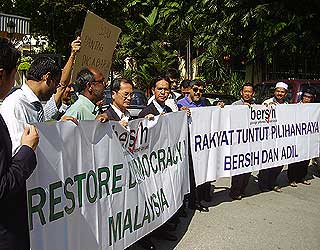 Suhakam said free and fair elections are crucial to lend legitimacy to a democratic society.
“Public confidence in the fairness of the electoral process is far more important than a massive mandate. While elections in Malaysia have been free, it cannot be claimed that the process has been completely fair,” it noted.
These comments acknowledge long-standing complaints from opposition parties and electoral reform groups, which have been demanding the formation of a caretaker government during the poll to prevent an advantage for incumbents in government.
While a sea-change in voter concerns saw an unprecedented number of opposition candidates winning federal and state seats in the 12th general election on March 8, claims of electoral irregularities persisted.
Interestingly, the report did not include the government’s response to issues highlighted by Suhakam in the previous annual report.
 The commission expressed its clear frustration over the government’s continuing lukewarm response to its interventions and proposals.
“Since its inception (in 2000), Suhakam has made numerous suggestions to improve the protection of human rights. The commission hopes that the government will give attention to the recommendations made through various reports to date.
“As a member of the United Nation Human Rights Council, Malaysia should play a leading role in upholding human right.”
Suhakam only serves as an advisory body to the government on matters related to human rights. The government has rejected suggestions for it to be given enforcement powers.
Repeated attempts to get its annual reports debated in Parliament have not succeeded, prompting opposition legislators to question the government’s commitment in upholding human rights.
Other highlights in the report
Freedom of religion
Suhakam said the right to freedom of religion is protected by the Federal Constitution and it is “totally unacceptable to interpret any law relating to religion in any way that leads to injustice”.
It called on judges to be “bold, impartial and unequivocal” in dealing with the complex interfaith cases brought before them, while the police and the local authorities to be more sensitive in law enforcement.
Suhakam lauded a Federal Court decision last December that the (civil) high court has jurisdiction to hear matrimonial disputes, even if one party has converted to Islam.
Preventive detention laws
Suhakam reiterated its call to repeal arbitrary clauses in the Internal Security Act in particular, and other provisions generally, that prevent judicial review of detention orders signed by the Executive. It also wants the government to release current detainees or to prosecute them in court.
 Freedom of assembly
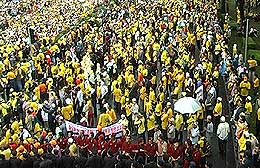
Citing official reaction to various mammoth assemblies held last year, Suhakam said the government should review the Police Act and other preventive legislation which unreasonably restrict the freedoms of assembly and speech.
The commission also said the police should refrain from excessive measures that violate fundamental freedoms and undermine “legitimate disorder”.
Administration of justice
Suhakam expressed concern that judicial review has been ousted in a number of instances, including habeas corpus challenges, which it said will undermine the right to justice and the right to a fair trial.
It also pointed out delays in court proceedings and availability of written judgments,noting that more than 1,000 prisoners are in jail and unable to appeal because judges and magistrates have not provided written judgments early enough.
Rela operations
Suhakam proposed the deployment of professionally-trained law enforcement personnel, from the police and immigration department, to accompany the people’s voluntary corps during future operations. This is in the wake of allegations that Rela personnel have misused their powers.
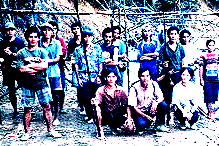 Rights of indigenous peoples
The government has been asked to amend the Sarawak Land Code to include the Penan community’s “unique way of establishing land ownership and stewardship”, to overcome disputes over native customary rights land.
Migrant workers
The government and foreign embassies must thoroughly study the recruitment process and provide adequate monitoring, regulation and punishment of recruiting agencies that violate human rights. Suhakam observed that most of the complaints by migrant workers are largely due to exploitation by agencies in the sending and receiving countries.
Persons with disabilities
Suhakam said it hopes that the drafting of the Persons with Disabilities Bill signals a step toward Malaysia’s ratification of the UN Convention on the Rights of Persons with Disabilities.
Protection of children
More must be done to protect children in view of the increasing number of cases of abuse and violence against very young children.


Are you sure you want to delete this comment?
This action cannot be undone.