




Political meddling spoiling good town planning
Constant political inferences are stopping the execution of well executed townships and its surroundings, claimed a town planner and consultant.
Constant political inferences are stopping the execution of well executed townships and its surroundings, claimed a town planner and consultant.
"There is always potential interference as a town planner when I was a civil servant and even now as a consultant," said Khairiah Talha at a forum last night.
 "I'm always caught. I can tell you, I don't like it. I am not pleased with such interferences because I'm a religious person and I want to be answerable to God one day.
"There are political interferences whether they are from the outside or inside. We can have a perfect plan drawn up but someone with personal interest will call someone with political backing to make us change it," added that secretary-general of an NGO called Eastern Regional Organisation for Planning and Housing.
Khairiah is presently a consultant with the Kuala Lumpur Draft City Plan 2020 (KLDCP). She was a speaker at a public forum on the draft city plan held in KL last night.
When met after the forum to elaborate, she said town-planning was difficult in Malaysia because there were too many ministries involved in dealing with similar matters.
 "It's all political because historically, we have so many ministries, because they were awarded to different parties.
"This is where the people should call for the government to have only one ministry handling larger matters like having one Land Transport Ministry instead of having so many ministries involved in dealing with transportation matters," she said.
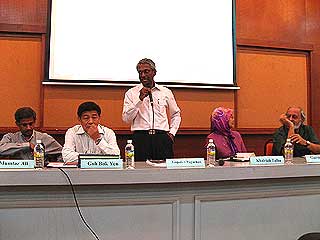
At the forum, Khairiah was speaking alongside Centre for Environment, Technology and Development, Malaysia (Cetdem) chairperson Gurmit Singh, town planner Goh Bok Yen and Bukit Bandaraya Residents' vice president Mumtaz Ali.
The forum was organised by community NGO, Empower and chaired by Empower member P Gopalan ( photo: standing ).
KL Plan under criticism
The KLDCP entitled 'Kuala Lumpur - A World Class City', set out a 13-year guide for decision-makers, city planners, designers and builders on the direction of growth for the city.
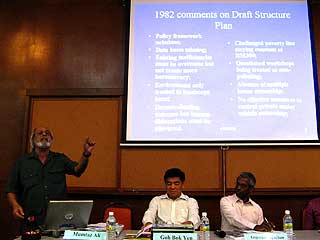 However, civil society groups have said the plan breached provisions of the KL Structure Plan of 1984 as well as the National Physical Plan.
Since its launch, interest groups have launched criticisms ranging from transportation woes to safety and environmental issues.
The bilingual report was also said to be user-unfriendly because of the use of technical jargon together with complicated graphs and charts.
Khairiah, also a Malaysian Institute of Planners council member, was the lone voice in support of the draft city plan at the forum.
"Planning in the late 1970s was highly technical so we wanted to simplify it so people can understand. But then people complained it was too general and they wanted more data and statistics.
"Now we have data and statistics, people don't know how to read it. So we're facing countless of problems here and we cannot please everyone," she said.
Khairiah also explained it was difficult to conduct town planning in Malaysia because most of land is privately-owned.
"If you have your own land, of course you will want to develop it in accordance to what you want whether other people like it not," she told the crowd of about 80 people.
Cheaper alternatives forgotten
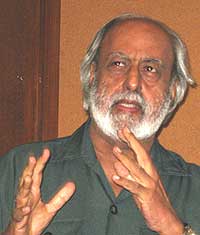 Meanwhile, Gurmit (
right
) opined that the public transport system in the country has failed because of former premier Dr Mahathir Mohamad and the national car policy which promoted Proton.
Meanwhile, Gurmit (
right
) opined that the public transport system in the country has failed because of former premier Dr Mahathir Mohamad and the national car policy which promoted Proton.
According to him, policies passed by the government has prioritised the national car over proper town planning and public transportation system, leaving the country troubled in light of the rising fuel prices.
"The government always go for the expensive solutions and options first. Buses are still the best solutions but yet the draft city plan makes no room for it.
"Why are the buses missing from the plan? Why do they keep creating new infrastructures building rails and tracks which will cause more problems instead of fixing the current system?" he quizzed.
Goh had touched on the lack of legends, descriptions and sources for the statistics found in the public transport portion of the KLDCP while Ali spoke on the over-development occurring in Bangsar.
All the participants were given the KLDCP feedback form and a guide on how to read the plan.


Report this comment
Are you sure you want to delete this comment?
This action cannot be undone.