




Economist: Price hikes not due to only one factor
The recent increases in the cost of petrol and food worldwide are due to a combination of factors including a shift in assets and speculation activities, former University Malaya economics professor Dr Jomo Kwarme Sundaram said.
"In the recent months since the financial crisis in August last year, there has been a flight in securities.
"People are no longer holding many of the old financial assets and they have moved their assets to those based on material goods, especially metals and other minerals like oil," said the current United Nations assistant secretary-general for economics.
The recent increases in the cost of petrol and food worldwide are due to a combination of factors including a shift in assets and speculation activities, former University Malaya economics professor Dr Jomo Kwarme Sundaram said.
"In the recent months since the financial crisis in August last year, there has been a flight in securities.
"People are no longer holding many of the old financial assets and they have moved their assets to those based on material goods, especially metals and other minerals like oil," said the current United Nations assistant secretary-general for economics ( below ).
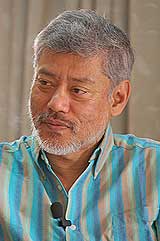 ‘I don’t think that anybody seriously attributes this (fuel hike) to any single factor. There are a number of factors which have contributed to this,’ he added.
The economist also noted what he termed as ‘perverse developments’ in the world markets.
"For example, you have higher future prices than current prices. So it actually makes sense buy food and stock it up and wait for the delivery date to get it. Now that is not the way the futures market is supposed to work."
"So you have very perverse behaviour in the market which has further contributed to the escalating food prices." he said.
Below is an extract of the interview Malaysiakini had with Jomo, 56, when the latter was in Kuala Lumpur recently.
What are the main reasons behind the jump in world oil prices?
Generally, growth requires energy and the world economy has been growing slightly faster in recent years. But its not as if that the world economy has grown so fast.
So I think that nobody can seriously say that the hike is due to simple demand factors.
People also take the view of theory of the big coil hypothesis, which is that we have basically reached the peak of supply. And now the supply has been constrained because we now know of the reserves and so on and so forth. This is another explanation which is being offered for the current situation.
There is of course some basis for any kind of explanation. But I don’t think that anybody seriously attributes this (fuel hike) to any single factor. There are a number of factors which have contributed to this.
Two other factors that I emphasise are certain developments, particularly the invasion of Iraq, which was the second largest producer of oil in the world.
Now it is true that there have been other significant sources which should have compensated for the decline of Iraqi oil ie, Russia and Africa.
But nonetheless, the consequence of the war and the consequence of specific supply factors of Iraq are very much emphasised. Yet another element which has gained a lot of mention is the element of speculation.
It is noted that oil is only one of the commodity for which prices have gone up. Generally speaking, primary commodities have also risen over the last few years. This is especially so for mineral prices, which suggest that there are serious supply constraints.
For example, metal prices have also gone up quite a bit in the recent period. This is less true of agricultural commodities with the exception of food prices.
In the recent months since the financial crisis in August last year, there has been a flight in securities. People are no longer holding many of the old financial assets and they have moved to assets based on material goods, especially metals and other minerals like oil.
So basically the shift of capital into these areas have caused speculation and higher prices. Do you see this trend continuing?
If we look at the 20 th century, there was actually a downward trend in terms of primary commodity prices. However, what happened then doesn’t mean the same will happen in the 21 st century.
But what we also see is that when primary commodity prices have gone up, they have never stayed up for very extended periods of time.
If you look at the previous times oil price has gone up like during 1973-74 when Sheikh Omani organised Opec and reduced supply in ways which allowed prices to go up rapidly.
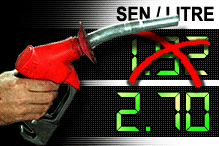 This was repeated in 1978-79 and although it was not as well organised, but it still had its effect.
But in both instances, they were temporary blips and if you think of inflation and so on and so forth, the recent increase is not as great as it might seem if you compare with those in 1973-74 and 1978-79.
These are the only three serious oil increases. So I would see this period as exceptional rather than the rule. There is a tendency to generalise very much from what are short-term trends but the fact that they are short-term doesn’t mean they have very serious consequences.
And Saudi Arabia’s King Abdullah’s agreement with United Nations Secretary-General Ban Ki-moon to increase production basically means a breaking of the ranks in Opec. Indonesia has also withdrawn from Opec.
So the effectiveness of Opec as a cartel, in terms of trying to influence prices, is going to be circumscribed by the weakening of Opec.
Has Opec played a key role in pushing up oil prices currently?
Opec is one of the few producer cartels which actually work. There were many attempts to form such cartels but they have not been as effective.
Even the Thai prime minister wanted to form a rice cartel. But after identifying five countries, he found that only two were net exporters of rice – Vietnam and Thailand. I don’t know what kind of cartel that will be because the other three are net rice importers.
And of course, Malaysia has been trying very hard to form one for rubber for decades without much success or impact.
So the history of cartels are not very good.
But energy is an exceptionally special commodity because it is absolutely essential for most economic activities. So it plays that kind of a role.
How long and to what extent can we expect oil prices to stay high?
I leave prophecy to other people.
Food prices have similarly increased. Do you think it will stay high?
With food there are long and short-term factors involved.
The long-term factors, for example, include after the green revolution which mainly affected rice, wheat and corn. There has been no significant increases in food agriculture products, particularly in developing countries.
This basically means that after the green revolution’s impact, demand for food has outstripped the supply of food. It is not that supply has declined precipitously but its growth has moved more slowly.
Other factors are organisation and the fact that there are very little forests left. It basically means that the possibility for agricultural expansion through cultivating more land is less. So the conversion of land for tourism and mining or urban residential dwelling and golf courses means even less land available for agriculture purposes.
Rising incomes for many people also mean changing diets, much more luxury food and much more meat consumption.
 Of course, different kinds of meat require different kinds of food grown to produce them. Chicken is relatively efficient and beef is probably the least efficient.
When you have a growing middle class consuming meat, a greater proportion of food goes towards producing meat and consequently less (especially cereals) for human consumption.
Yet another factor is the recent subsidy for biofuel production. Corn, for example, in North America is not a very efficient bio-fuel stock but the incentives in the US are very much for using corn.
In other parts of the world, (Brazil produces bio-ethanol from sugar) we do not find any significant increase in the price of sugar. So it’s very difficult to say that it necessarily happens. In the case of palm oil produced in Malaysia for bio-diesel, there seems to be a significant increase in the price of palm oil.
But whether this is due to bio-fuel production has to be examined carefully.
I think that the evidence seems to suggest that there isn’t all that much bio-diesel produced from palm oil. So the rise in palm oil price could be due to increase in demand ie, China etc.
It’s a much more complex picture, and I would not want to throw the bath water of bad bio fuel policy out with the option of using bio-fuels, which may be the significant in the medium-term as an alternative to fossil fuel consumption
Some countries are moving towards food stockpiling. What is your view on this?
International funding for agriculture has also dropped precipitously in the last quarter of a century. This means that after the first three crops of rice, wheat and corn there has not been any significant research effort into increasing agricultural productivity.
Most of the research is going on in the private sector unlike what happened in the green revolution which was a public sector-driven initiative.
When the private sector was involved it was more of a philanthropic basis other than a profit- driven basis.
So even if you do have breakthroughs, for example, in genetic re-modifying crops, there is a lot of resistance to this in Europe and elsewhere.
Even if it is adopted, it is not clear to me if the farmers will necessarily be significant because much of the gain will be gain by the agri-business companies in areas of input, seeds and marketing.
There has been a significant concentration of power in agri-businesses and you have very big companies on the one hand dealing with smallholder farmers with very little market power.
So it’s a very asymmetric situation and that is an important factor.
 Other short term factors include the shift in capital away from traditional financial instruments into food-related commodities.
So what you have is a very perverse developments in the market. For example, you have higher future prices than current prices.
So it actually makes sense buy food and stock it up and wait for the delivery date to get it. Now that is not the way the futures market is supposed to work. So you have very perverse behaviour in the market which has further contributed to the escalating food prices.
There shouldn’t be a price hike this year as there is actually a bumper harvest. You can’t simply explain the hikes with demand and supply factors alone as other factors such as speculation have come into play.
The amount of investment in food production has increased by seven fold over the last 3-4 years.
What measures are United Nations looking to arrest this problem ?
Within the UN system there is a lively debate going on. Everyone is united to ensure that food is delivered on humanitarian grounds. There is absolutely no disagreement on that. The question is what is the quantum we are talking about.
On one hand, the estimate is that up to a billion people go to bed hungry every day. This number is close to the figure of a dollar a day poverty line. It is a crude measure and there will be people who will quibble on it. But by and large, people are talking on that figure.
There are probably another two billion who suffer from nutrient deficiency.
And then you have to factor that this numbers are based on perfect knowledge ie, households know how to spend their money etc. This assumption doesn’t apply and one has to give and take that these figures are underestimates.
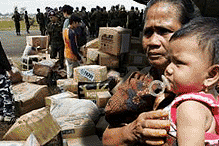
The World Food programme has existing programmes which cover many millions of people. They have appeal for US$700 million of which the Saudi Arabian government has pledged half a billion. The question that arises is how many people are covered by the World Food feeding programmes and what the shortfall is given that these plans were already in place for some time and on the basis of the previously known hungry.
So there is a sense that perhaps the World Food programmes’ shortfall, even with this additional funding, may even be greater.
So the other food aid programmes are expected to play some role but I think that there probably are hundreds of millions of people who are not covered by these efforts.
Now there is sense of urgent need to finance agriculture supplies for the next planting season, build infrastructure and step up research effort,s particularly for crops which have been neglected.
In Africa, for example, particularly in water-stressed areas – crops like sorghum, barley, millet – which require less water and are hardy. How do we increase production for those kinds of crops?
Even for rice, wheat and corn there is a need for renewed research efforts into them. For those associated with the world trade organisations, the answer lies in agricultural trade liberalisation.
The other view – for those with food and agricultural organisations – is about serious food security. This means protecting the domestic market for food. In Malaysia, for instance, we’ve always paid a higher price for rice to keep the rice farmers viable because of the government’s commitment.
 This kind of effort is seen to be necessary in many developing countries but most of them do not have that. Africa, for example, used to be a net food exporter three decades ago. Now it is a net food importer. If you eliminate food subsidies, the price of imported food is going to rise.
You cannot honestly say that agricultural trade liberalisation is going to eliminate that. But the hope is that agricultural trade liberalisation can reduce the entry barriers to the rich countries’ markets.
There are many serious obstacles to it. Part of the reason there is huge Japanese stockpile, which is being called upon to be released, is because they have been importing rice and putting them in warehouses.
So you have all kinds of practices which limit the potential of developing countries especially the poorest ones. So the ones most likely to benefit from increased agricultural exports as a result of agricultural trade liberalisation are those in North America, Australia, New Zealand and some in Southeast Asia.
Many of the poorer ones are not going to benefit from this. So it’s actually a very contentious issue and you need some kind of compensation mechanism to address this.
But, of course, those kind of mechanisms don’t exist. So there is a doubt. The alternative as FAO (UN Food and Agriculture Organisation) says is that you need to do a whole host of things to enhance food security.
Not that every country becomes self-sufficient but that a greater proportion of food is produced domestically. There are a lot of myths out there. For instance, China only imports one percent of what it consumes. It exports a lot of rice and imports a lot of wheat.
Part of the reason for restricting the rice exports in the recent period was to ensure the price of rice was kept reasonably low for the domestic consumer. If you allow the producers to export that rice, it will go to the level of the world price. And the whole purpose of your food security policies will be lost as your own population will be vulnerable too.
Other areas which is a bit of debate is the role of speculation and the switch from other financial asset classes to food classes.
Some people say that rice is not traded in the Chicago Board of Trade. That’s true, of course, and so the factors which contributed to price increase for rice is quite different from the fact that only seven percent of total rice consumed is actually traded internationally.
But by and large there is a broad unity among the immediate humanitarian effort and also broad agreement that there needs to be enhanced effort into infrastructure, research etc.


Report this comment
Are you sure you want to delete this comment?
This action cannot be undone.