




A better way to use God's gift
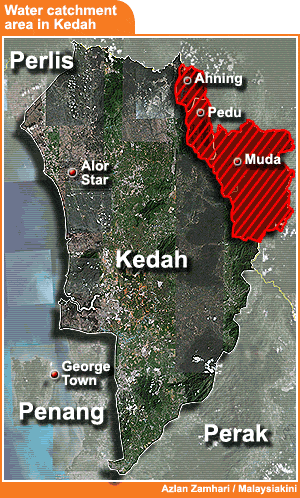
Controversy over the 122,798 hectares of forest reserve in the Ulu Muda Forest Reserve in Kedah can be resolved if we think out of the box. Perhaps we don’t need to choose; it is not an either-or situation, we just need to figure out a new model where trees can stay, and humans get fed too.
In fact, one could go one stage further to suggest how we can develop a management model where we can maximise the value creation of this valuable heritage. It is desirable for Malaysia to keep as much of its natural rainforest. These rainforests reserve are a key remaining source of Malaysia’s competitiveness in the world today.
Indeed, contrary to the conventional thinking, we can devise a solution where we can protect the trees and yet derive income for development. All over the world, environmentalists and natives fight over choices as though there is no way to have the cake and eat it too.
Controversy over the 122,798 hectares of forest reserve in the Ulu Muda Forest Reserve in Kedah can be resolved if we think out of the box. Perhaps we don’t need to choose; it is not an either-or situation, we just need to figure out a new model where trees can stay, and humans get fed too.
In fact, one could go one stage further to suggest how we can develop a management model where we can maximise the value creation of this valuable heritage. It is desirable for Malaysia to keep as much of its natural rainforest. These rainforests reserve are a key remaining source of Malaysia’s competitiveness in the world today.
Indeed, contrary to the conventional thinking, we can devise a solution where we can protect the trees and yet derive income for development. All over the world, environmentalists and natives fight over choices as though there is no way to have the cake and eat it too.
 We acknowledge Kedah Menteri Besar Azizan Abdul Razak’s need to develop and overcome the state’s budget deficit; and the environmentalists’ struggle to preserve biodiversity and an important water catchment - essential to the five million residents living in neighbouring states.
There is indeed a market-based solution available, but first all parties involved must cool their heads and genuinely engage each other for a win-win outcome.
How much is it worth?
What is the value of the forest products if we log all the matured trees in this vast reserve?
Bear in mind, trees take a long time to matured, say 30 years, and if we log them all today, we will get a one-time lump sum value. Assuming that one hectare of virgin forest produces net revenue of RM25,000, the estimated value of the total forest area would be in the region of RM3 billion.
 If we put this lump sum into the bank and say it will earn 6% interest, generating an annual income of RM180 million. This is the worth of the reserve to Kedah in the immediate term, and the state needs to accumulate capita for development. We must respect that. The state’s need for capital to fund its development is perfectly legitimate and Kedahans have every right to use this wealth for today and for their future generation.
However, this one-sided benefit happens to take place at the expense of the interest of the larger interest; we must find a way to resolve the conflict.
Yes, the forest reserve is a vital life-giving catchment for the people living around and those in the nearby neighborhoods. The forest is a both a rain catchment and a filter for precious life-giving water. In the context of today’s global situation, an inch of natural forest preserved is an inch of added security for the survival of the human race.
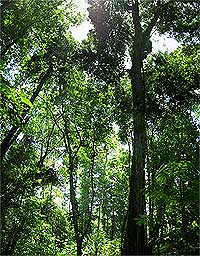 Thus, we must do all we can to preserve the forest, not necessarily keeping it in its natural state - according to forest experts, careful and managed logging help the forest to rejuvenate.
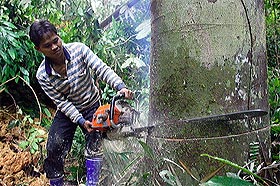
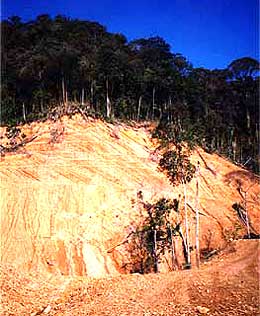
While Azizan wants to open up the reserve for logging, we should be focused on whether those engaged in the activities can do this gently and responsibly; taking out the matured lumber while not disturbing the ecology and sustainability of the forest.
Environmentalists don’t trust commercial operators as their past records do not inspired confidence; we trust the natives who lived within the forest area more as they depended on the forest for their livelihood, they know better how to keep the forest sustainable.
A green business plan
How can we use the forest reserve to generate a revenue stream for the people of Kedah; and while doing that, not compromise and disturb the sustainable existence of the forest?
First we need to fact-find the following:
1. What is the one-time value of logging from the site? Assuming that each acre can yield 18 tons of lumber; and at RM1,200 per ton, after deducting extraction cost; logging the entire area will bring a one-time capital sum of RM3 billion.
 To place the money in no-risk investment, at 6% interest, this would generate an annual income of RM180 million if the state can engage a professional asset management; they can of course bring more income to this fund. There is also the risk of mismanagement, exposure to corruption and lack of discipline resulting in the funds being squandered away.
To use the proceeds to invest in other investments that churn higher income also means higher risk.
The state could consider if the land is suitable to log the forests, and then convert the land into oil palm or other crops. This way the state has the capital sum as well as a new source of income from the land use. At today’s high palm oil prices; and if the land is suitable, this sounds like a good proposition.
But there also exist downsides on converting the area into a mono-culture.
2. If we were to keep the forest intact; can we generate revenue to help develop the state and feed the people? Let’s make a ‘green business plan’ and assess the following value:
What is the value of the carbon credit from this vast expense of forest? If we trade this, how much annual revenue can we get? Each hectare of rainforest will produce 200 tons of carbon credit and at US$10 per ton, this is US$2,000 per hectare. For an area this big; it has a potential
of generating some US$245 million (RM784 million) worth in carbon trading.
 The world would continue to want to keep large expense of forest to absorb the carbon in the atmosphere; and carbon-credit trading is expected to evolve and stay around for a long time.
If the forest reserves sustain lives of the people in the neighborhood; say the entire population of Penang, Butterworth, Kedah and Perlis, a total of five million people derive water from the area.
Can we ask the residents to each contribute a payment to the Kedah Environment Trust, so in addition to the carbon credit, the state government gets another ‘green tax’ from the citizens.
This is a practice employed in many western societies where downstream citizens want their upstream cousins to do nothing about the reserve, so they have to pay to keep the eco-system and to support lives there. The payment is incorporated into the electricity and/or water bill yearly and is practiced commonly.
And while we keep the forest intact, what eco-tourism and education value can we draw from the forest?
Say annually 300,000 people visit the area; and each spend RM300, there are a gross GDP creation of RM90 million to the local economy. We build hotels, restaurants, outward bound and forest-related products and programmes around it; the entire area will end up with employment of 20,000 people. Is this a realistic expectation?
Possible solutions for Azizan
How do we manage this? There exist several ways:
1. The Kedah state government takes stewardship and work with private businesses. To solve the state government’s current liquidity problem, federal assistance of a loan should be sought.
2. The surrounding states form a trust; and issue a green debentures; say RM1,000 per resident; and if we have five million people in the neighborhood; we would get a proceeds of RM5billion. With the handing over of this fund to the Kedah state government, the vast reserve would be owned by the people who hold the debentures.
3. The Kedah state government continues to own the place, and work to generate revenue through the green business model mentioned above.
4. Before any of these solutions are worked out, the federal government provides a loan support to the state to help them ease their current financial difficulties. In fact, the federal government should channel funding to help Kedah upgrade its rice-yielding abilities; that way, income in the state can grow.
So gentlemen, when we put the numbers together; we can find a way to please everyone. It is more fun to be creative and work to bring out the value of the reserve than engaging in energy-draining confrontation.
The rainforest is our common heritage; we should preserve them, and keep them well-managed. Azizan wants to develop Kedah, an act we should applaud. Let’s engage more experts; especially those in the carbon-trading areas to help us to see if it is possible. Good luck.
FOONG WAI FONG is director of Megatrends Asia and best selling author of Megatrends Asia (with John Naisbitt), We have to talk Mr Prime Minister, The New Asian Way , and Culture i s Good Business . Email: waifong@get-ed.com.
Calling all Malaysians: Walk the Talk
ENOUGH, WE WANT GOOD PUBLIC TRANSPORT
Join this campaign at http://www.pahlawan.com.my


