




New lease of life for banned movement?
news analysis The banning of the Hindu Rights Action Force (Hindraf) does not come as a surprise.
The signs had been clear for all to see since the movement’s supporters attended the annual Hari Raya Aidilfitri ‘open house’ hosted by the prime minister and other Muslim cabinet ministers.
news analysis The banning of the Hindu Rights Action Force (Hindraf) does not come as a surprise.
The signs had been clear for all to see since the movement’s supporters attended the annual Hari Raya Aidilfitri ‘open house’ hosted by the prime minister and other Muslim cabinet ministers.
The orange-clad ‘gate-crashers’ were variously described as having been rude and behaving inappropriately, thereby ‘insulting the sensitivities of Muslims’ on a key religious holiday.
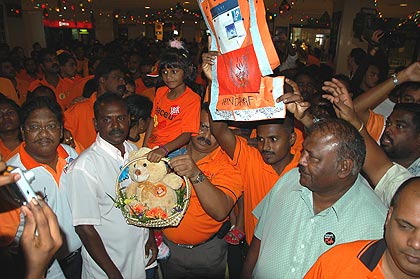
Four of the ‘ring-leaders’ were hauled up by the police for questioning. This was swiftly followed by calls for the movement to be banned and the response was prompt - the ban took effect yesterday.
Home Minister Syed Hamid Albar said it was because “Hindraf had (been) and was being used for unlawful purposes and posed a threat to public order and morality”.
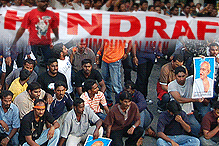 However many supporters and leaders dispute this reasoning and blame the government for once again undermining the sensitivities of the Indian Malaysia community.
“Don’t forget, Hindraf came into being as a result of the government’s failure to address issues (affecting) the community,” said V Murugan, one of many self-claimed Hindraf activists.
Many supporters, including lawyers, argue that the ban is pointless.
“What can the government achieve with the ban? Hindraf activities will go on but of course the police now have a blank cheque to crack down on gatherings,” said Negri Sembilan-based activist Harold Gomez, who has followed Hindraf developments from the start.
So what does the ban mean to a movement that was not registered in the first place?
Lawyers state the obvious - that a banned group will not be able to do things that a registered organisation is permitted to do.
It means no meetings, events, collection of funds or membership drive. It also means no avenue to express opinions and, perhaps more importantly, a perceived loss of legitimacy to represent the community.
“The movement will now be driven underground. And this will make Hindraf more successful. Underground gatherings have traditionally been more successful,” observes a Hindraf leader who wishes to remain anonymous.
“There will be no leadership crisis. There will be no request for public accountability. Monies can be collected with no explanation given on how it is spent.”
His last point is telling given that, just before the ban, Hindraf was seen as slowly drifting towards irrelevance.
 Many had complained that the movement has lacked leadership and direction, especially with the arrest of
five leaders
under the Internal Security Act last December.
Many had complained that the movement has lacked leadership and direction, especially with the arrest of
five leaders
under the Internal Security Act last December.
Chairperson P Waythamoorthy’s decision to operate out of London has not helped Hindraf to carry on with its aims. His reliance on previously unknown coordinators to run the show here has not produced results either.
Thus, after reaching an impressive height of popularity following the Nov 25 rally last year, Hindraf has failed to live up to the expectations of many members of the community.
The biggest complaint is that it has failed to take up core issues and has spent time and resources in seeking the release of the Hindraf 5.
Infighting among original founder-members and supporters has not helped. This has been compounded by complaints that no proper accounting is being done for donations received from the public.
“All this was slowly killing off the impact of Hindraf. It had been the match which sparked awareness among Indians but failed to sustain the (fire),” said M Manimaran, a follower who was attracted to Hindraf after it raised issues relating to a spate of temple demolitions last year.
Regaining relevance
The ban, therefore, could not have come at a more timely point in Hindraf’s existence - it now has a reason to revive itself.
“The government, by banning Hindraf, is only lending more credibility to the organisation and its aspirations,” says observer M Selvaraja.
By outlawing Hindraf, he says, the government is telling Indians that it is not interested in addressing their welfare.
 “The ban will only strengthen the movement, which is likely to emerge in some other form,” says political commentator S Nagarajan.
“It will also help to weed out opportunistic elements who are there for short-term gains and enable a core genuine leadership to chart its course for the betterment of the community.”
However the question remains if the community is prepared to openly back an illegal outfit.
For Gomez, the community’s reaction could come in the form of clear defiance of the government decision.
“Overt backing may reduce, but anger will grow and could be difficult to suppress,” he says.
Public anger is already palpable in the community. Selvaraja points out that the government has seemingly refused to learn from the past and has chosen to remain high-handed in dealing with the situation.
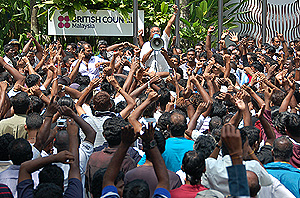 Similarly K Geetha, a participant of the Nov 25 rally, says the ban shows that the government has no regard for the community’s plight or respect for the movement’s attempts to redress these.
It continues to punish the community for adding to BN’s losses in the March general election, she adds.
For Transparency International Malaysia president Ramon Navaratnam, the question is how the government intends to implement the ban.
“It’s a pity. The ban gives wrong signals. They government should address the grievances raised by Hindraf. The ban could be counter-productive,” he cautions.
A Hindraf leader agrees that the ban has given “power” to a movement which was apparently lost for solutions.
Veteran lawyer DP Vijandran says the movement can regroup “under other provisional society or other legal formats”.
‘New’ pro-BN movement?
Still, the Hindraf leaders must be aware that plans are underway - ostensibly with the blessings of MIC - for a ‘new’ Hindraf to be registered and to represent the community as a fire-fighter at the grassroots.
It is learnt that this new movement will be helmed by some original founder-members of Hindraf who no longer agree with the direction taken by current coordinators.
 It is further learnt that this group has met with Prime Minister Abdullah Ahmad Badawi and MIC president S Samy Vellu
(left)
over this project.
It is further learnt that this group has met with Prime Minister Abdullah Ahmad Badawi and MIC president S Samy Vellu
(left)
over this project.
Officially, MIC has no comment on the new grouping or the banning of Hindraf. Unofficially party leaders are quite happy as the ban allows MIC and its affiliated movements, including the ‘new’ Hindraf, to become the community’s representatives again - regardless of what the community itself thinks.
The sentiments are succinctly summed up by V Velupillay, 80, a sundry-shop owner in Sentul.
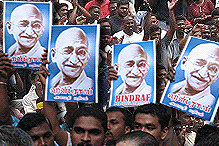 “The ban on Hindraf may well be a good thing for the community. After all, every Indian in this country is now aware of his rights. He is not afraid to ask questions. And he knows that he can force changes.
“Hindraf has given him that awareness, (and we say) thanks to them. But it is time for (the Indian Malaysian) to continue the fight with other members of the community and not rely on any political party or movement.”
Nagarajan agreed, saying that the government cannot ban the spirit of the people.


Report this comment
Are you sure you want to delete this comment?
This action cannot be undone.