




'Censored' campaign to change social attitude on rape
Social attitudes are the main stumbling blocks in the on-going fight against rape and domestic violence. To change these attitudes, the Women's Aid Organisation (WAO) today launched a provocative public education campaign to stimulate public debate on rape and other forms of abuse.
Social attitudes are the main stumbling blocks in the on-going fight against rape and domestic violence. To change these attitudes, the Women's Aid Organisation (WAO) today launched a provocative public education campaign to stimulate public debate on rape and other forms of abuse.
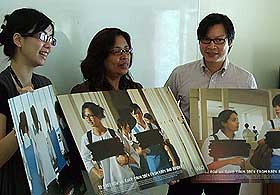 WAO executive director Ivy Josiah (
centre
)explained that the ‘censored' campaign is aimed at challenging politicians and members of the public who want women to be 'censored' from public life in order to protect them.
WAO executive director Ivy Josiah (
centre
)explained that the ‘censored' campaign is aimed at challenging politicians and members of the public who want women to be 'censored' from public life in order to protect them.
WAO stressed that to prevent rape and other abuses, people must be taught to respect women instead of removing them from public life as it will only restrict their freedom.
To the popular belief that women are to be blamed for being raped, Josiah said such attitudes are not only harmful to women but to men as well. "It implies that men have no will and are animals. It is an insult to men."
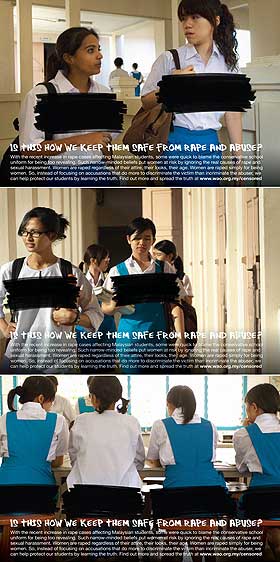
The new posters launched today depict girls in school uniforms with their chests and behinds 'censored' with black marker. The posters were designed by advertising agency Arc Worldwide in collaboration with WAO.
Creative director Theresa Tsang explained that the inspiration for the posters came from the school uniform controversy that erupted last year.
"We came up with this idea and hope to convey to people that at the end of the day, the rape victim is not to be blamed," Tsang said.
Controversial issue
 In May last year, National Islamic Students Association of Malaysia vice president Munirah Bahari said the school uniform was "too
transparent
and encouraged rape and pre-marital sex". The group said the school uniform was "a distraction" to men".
In May last year, National Islamic Students Association of Malaysia vice president Munirah Bahari said the school uniform was "too
transparent
and encouraged rape and pre-marital sex". The group said the school uniform was "a distraction" to men".
At the time, the views were vigorously challenged by the WAO.
The ‘censored' campaign is a marked departure from WAO's previous campaigns which were mainly aimed at law reforms.
With this highly visual campaign, the WAO aims to be "controversial but not confrontational" said Josiah.
"If people are getting upset, that is good so we can start a conversation, a dialogue," she added.
Besides posters which will be displayed in MPH bookstores, WAO will also distribute postcards and draw attention to its 'censored' website which is specifically aimed at reaching out to youngsters.


Are you sure you want to delete this comment?
This action cannot be undone.