




US Airways jet black box points to bird collision
Black box recordings retrieved on Sunday from the crashed US Airways jet strengthened evidence of a catastrophic collision between the plane and a flock of birds.
Black box recordings retrieved on Sunday from the crashed US Airways jet strengthened evidence of a catastrophic collision between the plane and a flock of birds.
Investigators have yet to analyse the wrecked engines and fuselage of the Airbus, but fragments of cockpit recordings released on Sunday strongly supported indications that a collision with birds crippled the engines.
 The voice recording shows that "about 90 seconds after take-off the captain remarks about birds," Kitty Higgins, from the National Transportation Safety Board (NTSB), told a news conference.
"One second later the cockpit voice recorder recorded the sound of thumps and rapid decrease of engine sounds. The captain acknowledges that both engines have lost power and he takes control of the aircraft," Higgins said.
The other black box, which records flight data, also indicates that both engines lost power simultaneously in Thursday's drama.
This sequence was consistent with earlier debriefings of the two pilots who told the NTSB they'd seen large brown birds smash into the plane and had lost power in both engines immediately.
The Airbus, en route from LaGuardia Airport to Charlotte, North Carolina, ditched in New York's Hudson River with no loss of life thanks to a skillful splash-landing and well-oiled rescue operation.
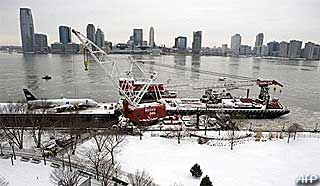
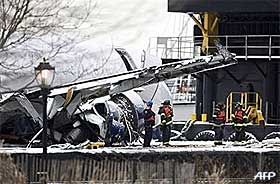
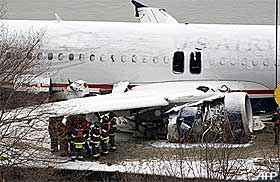
Salvage crews raised the sunken Airbus overnight and were finally able to remove the black boxes. The plane, which is mostly intact, but badly damaged along the underside, was to be taken by barge from New York to a site in New Jersey.
Lost engine found
A police team on Saturday said it believed it had found the location of an engine torn off in the crash and lost in the Hudson.
Higgins said the NTSB might need about a year to complete its report into the accident.
Chief pilot Chesley Sullenberger has been credited with saving the lives of all 155 people aboard with his skillful handling of the plane as it came down.
 On Saturday, he described to NTSB investigators how just after take-off the cockpit windscreen "was literally filled with big, dark brown birds," Higgins recounted. "He said his instinct was to duck, but he didn't."
The pilot and co-pilot reported they "heard booms, felt the impact, the power went down and they smelled - this is the captain saying - they smelled 'burning birds'."
The air intake on passenger jets can easily suck in nearby objects, including birds. Although the turbines are designed to withstand some debris, they are still vulnerable.
With both engines out, the captain decided that the only place he could land without endangering people on the ground was the Hudson.
The captain said he decided against returning to LaGuardia because he was "too low, too slow, they were pointed the wrong way and they had to traverse a populated area," Higgins said.
An alternative airport was also ruled out because as "it was a populated area, the consequences would have been catastrophic."
"While the captain was flying the aircraft, the first officer was trying desperately to restart the engines," Higgins said.
Perfect water landing
After a perfect water landing just off Manhattan, all 150 passengers and five crew were able to walk out of the sinking aircraft and enter rescue boats.
Sullenberger told investigators that in line with standard procedures, he had brought down the plane close to a boat he saw on the river so that help would be near, Higgins said.
 Security camera film footage released on Saturday showed for the first time the moment of impact. Water shoots up as the plane makes a perfectly straight landing - a brilliant piece of handling that experts say prevented a tragic break-up of the plane.
Higgins said that the key to survival was training.
"Everyone's talking about the miracle on the Hudson which is a wonderful image, but in fact ... miracles happen because a lot of everyday things happen," she said.
"These people did their jobs and they were trained to do their jobs. The aircraft did as it was hoped it would perform. Air traffic control did their jobs. Everything happened because people were trained for years," she said.
"I think that is a testament to the system as a whole. For once, it all worked. That's the miracle."


Are you sure you want to delete this comment?
This action cannot be undone.