




Tamil Tigers' chief in M'sia?
Speculation is rife that rebel chief Velupillai Prabhakaran has fled to South-East Asia as Sri Lankan troops close in on the Tamil Tiger's last stronghold, Mullaitivu.
Speculation is rife that rebel chief Velupillai Prabhakaran has fled to South-East Asia as Sri Lankan troops close in on the Tamil Tiger's last stronghold, Mullaitivu.
And a news report stated that Indian analysts believe that he could either be in Malaysia or Thailand.
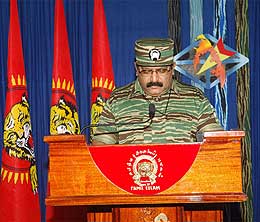 The head of the Liberation Tigers of Tamil Eelam (LTTE) - which is fighting for an independent Tamil state - is wanted by the Interpol for murder, organised crime and terrorism
According to Singapore Straits Times , the Indian analysts noted that the LTTE has had a presence in Phuket, Thailand, since the late 1980s.
And, in 1990, the port authorities in Penang impounded an LTTE commercial vessel, seizing diving and communication equipment and ammunition.
"Both Thailand and Malaysia have large ethnic Tamil communities which have been supportive of his war," retired Indian army major-general Ashok Mehta was quoted as saying.
"It is common for the leaders of insurgent groups to relocate themselves when the going gets tough. Prabhakaran also may have fled to fight another day," he said.
However, former Indian envoy to Colombo NN Jha does not believe that Prabhakaran has fled but added that "anything is possible".
"It would be ironic that a man, who ordered his cadres to swallow cyanide capsules and die rather than surrender, had himself fled," he said.
"I think he is very much there. It is not in his character to flee," said retired Indian army colonel R Hariharan, who headed the military intelligence when Indian troops were deployed on the island.
'Their heart and brain'
Previously, Sri Lanka's army chief Lieutenant-General Sarath Fonseka, dismissed the possibility of the rebel chief fleeing to India.
"He will not be permitted there," Fonseka said in reference to India's request for the extradition of the rebel leader, who is accused of planning the 1991 assassination of former Indian prime minister Rajiv Gandhi.
Agreeing with this, Ashok said it was unlikely that Prabhakaran would cross over to Tamil Nadu, the southern Indian state separated from Sri Lanka by a narrow strip of sea.
Tamil Nadu was the LTTE's main sanctuary before New Delhi, which trained and armed the Tigers in the early 1980s, banned the group following the assassination of Gandhi.
"Unlike Osama bin Laden, who took shelter in the caves of the Tora Bora mountains in Afghanistan's border with Pakistan to escape the US bombings, there are no caves along the southern Indian coast," said the retired army captain.
"Again, India has stepped up its coastal vigil following the Mumbai terror attacks and I don't think he (Prabhakaran) has that kind of support in Tamil Nadu as he used to have," he added.
Many in the military believe that nabbing Prabhakaran – or even forcing him to flee abroad – would crush the Tigers.
The loss of Prabhakaran would be devastating to the group, said Indian journalist MR Narayan Swamy, who wrote a biography of the rebel leader.
"He is their brain. He is their heart. He is their god. He is their soul, and the whole organisation runs around him," he said.


