




'UNHCR unfair to Burmese refugees in M'sia'
The United Nations High Commission for Refugees (UNHCR) office in Kuala Lumpur has come under fire for being “unfair in its treatment of Burmese refugees”.
The United Nations High Commission for Refugees (UNHCR) office in Kuala Lumpur has come under fire for being “unfair in its treatment of Burmese refugees”.
The All-Burma Democratic Force (ABDF) organised a protest march this morning which culminated in a memorandum being submitted, appealing for “equal and ethical treatment”.
The group alleged that the agency has:
- neglected the squalid situation of refugees in Malaysia;
- attempted to cause ethnic tension and internal conflicts among the various refugee communities, and
- previously halted the group’s efforts to organise a peaceful assembly.
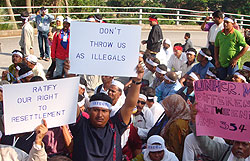 Some 350 refugees marched along Jalan Bukit Petaling, carrying picket signs with slogans such as ‘Don’t throw us as illegals’, ‘Stop isolation to us’ and ‘Ratify our rights to resettlement’.
When they were halfway through, Federal Reserve Unit personnel ordered them to stop in front of a police truck. However, the group marched on and assembled quietly in front of the UNHCR building.
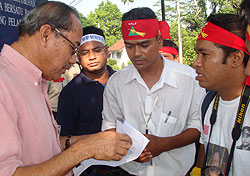 Four representatives - Zaw Min, Habib, N Aziz and Aung Kway Moe - submitted the memorandum to UNHCR chief security officer Abrahim Amin. The group dispersed quietly by 10.30am.
The ABDF also demanded the unconditional review of UNHCR policy towards all Burmese refugees in relation to registration, protection intervention, payment of the stipend and referral for resettlement in other countries.
It called for regular registration for all undocumented refugees in an open-gate system; improved facilities and living conditions for refugees; the immediate release of all Burmese from detention centres; as well as greater protection from human trafficking.
“The Burmese people in Malaysia are caught between two hard rocks as there is no hope for their return home and they are unable to stay in safety and dignity in their country of asylum,” reads the memorandum.
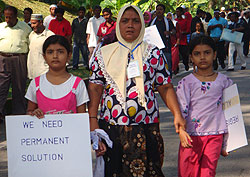 “Therefore, we urge concerned quarters, particularly the UN Refugee Agency to ensure that our rights are protected from unexpected prosecution.”
Habib said the ABDF would hold another peaceful assembly in the near future if UNCHR Malaysia does not respond to the memorandum.
U NHCR response
UNHCR officer Yante Ismail, when contacted, said the agency already meets regularly with representatives of all refugee communities both informally and at formal meetings.
“While this is particularly challenging in an urban setting, given the number of refugee groups and their geographic distribution, this remains the best way that communities can raise their concerns to us,” she said.
“We recognise the frustration felt by refugee communities, in particular the Rohingya community from Myanmar who have been in Malaysia for a long time with little hope of returning to their country of origin.”
Yante also noted that, for most refugees, the best solution to their plight is to be able to return voluntarily to their home country when conditions permit.
When this is not possible, UNHCR seeks other solutions for them including integration into their host country, or finding them a new home in a third country.
According to the UNHCR, there are 45,400 registered refugees and asylum seekers in Malaysia as at last December.
Of these, 40,000 are from Burma, comprising 15,200 Chin, 14,300 Rohingya and 3,400 Muslims, while the rest are from other ethnic minorities.


Report this comment
Are you sure you want to delete this comment?
This action cannot be undone.