




The Debate on Islam amidst the diversity of Farish Noors writings

From Majapahit to Putrajaya
Farish A Noor
Silverfish Books, RM30
 Farish A. Noor is described by some as Malaysia's 'angry young man' (alas, I cannot do the same for fear of inviting such a label to myself as I certainly am younger), but such a tag does not do justice. By his own admission he wears two different hats as a writer: first, a Cartesian rationalist political scientist; and secondly, a Levinasian moralist and a Romantic humanist activist. This undeniably presents a difficult dilemma.
The entire spectrum of Farish's talents and passions is again presented in the sequel to his first anthology of essays, The Other Malaysia ; with the latest publication of From Majapahit to Putrajaya . Included in the book are academic analyses; colourful critiques; and personal obituaries. The above dilemma on the conflict between being an academician and activist is also presented in the book.
Characters as diverse as pop icon Siti Nurhaliza (a product of excellent ASEAN marketing, in Farish's own words); Petronas stalwart the late Tan Sri Azizan Zainul Abidin (his uncle); the doyen of modern Malay literature Munshi Abdullah and the proto-nationalist of Indonesia, Sultan Fatahillah are all weaved into Farish's essays. In fact, the book ends with a very personal obituary (combined with some autobiographical elements) of his father.

From Majapahit to Putrajaya
Farish A Noor
Silverfish Books, RM30
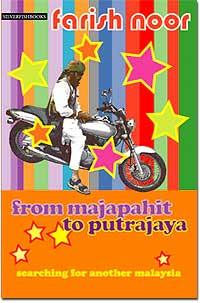 Farish A. Noor is described by some as Malaysia's 'angry young man' (alas, I cannot do the same for fear of inviting such a label to myself as I certainly am younger), but such a tag does not do justice. By his own admission he wears two different hats as a writer: first, a Cartesian rationalist political scientist; and secondly, a Levinasian moralist and a Romantic humanist activist. This undeniably presents a difficult dilemma.
The entire spectrum of Farish's talents and passions is again presented in the sequel to his first anthology of essays, The Other Malaysia ; with the latest publication of From Majapahit to Putrajaya . Included in the book are academic analyses; colourful critiques; and personal obituaries. The above dilemma on the conflict between being an academician and activist is also presented in the book.
Characters as diverse as pop icon Siti Nurhaliza (a product of excellent ASEAN marketing, in Farish's own words); Petronas stalwart the late Tan Sri Azizan Zainul Abidin (his uncle); the doyen of modern Malay literature Munshi Abdullah and the proto-nationalist of Indonesia, Sultan Fatahillah are all weaved into Farish's essays. In fact, the book ends with a very personal obituary (combined with some autobiographical elements) of his father.
Hence this book not only invites us to read about the history and current developments of the region through his eyes; but it also brings us into his mind, sharing his own personal story. Here is a brilliant man who can bring out the most interesting and enthralling analyses from either mundane or obscure personalities.
Strength and weakness
This diversity of subjects, narrative and disciplines is a crucial element in Farish's writings. It can either be his strongest point, or also for some, his weakness. Those with a multidisciplinary interest in philosophy, history, politics and religion will enjoy the depth and breadth of his essays; regardless whether one agrees with his opinions or not.
Farish of course, has never been far from controversy, especially over his interview a few years back in The Edge which caused a stir in the country. Some people might be prejudiced merely upon the mention of his name. For me, however, irrespective of your personal opinions on any of Farish's views, you should give his writings in general and From Majapahit to Putrajaya in particular, a chance. I personally enjoyed the historical bits especially on Munshi Abdullah and Sultan Fatahillah which presented a different perspective on personalities that have at times have been victims of our present prejudices.
Another strong element of Farish's writings is evidenced in a sense of idealism that permeates throughout his writings. His strong commitment against injustice, oppression and racism deserves praise. This is of course an imperative of an activist-academician. Farish draws inspiration from another strong personality included in the book, the late Alijah Gordon, an activist-academician herself, who advised Farish:
"Ideas can't change the world unless we act on them".
Yet some might find it problematic when too many things are included in one book. Those with a weaker grasp on the entire spectrum of subjects covered might find the book lacking focus and tedious. Some find the blurring between popular commentary and academic writing (Farish enjoys the use of footnotes but on the whole I find it useful as further reference for the various subjects of his essays) troubling. Yes, it is possible to be an activist academician but surely there is an important distinction between commentary and academic work?
The Debate on Islam
Amidst the multi dimensional nature of Farish's writings, one consistent theme has been his view on Islam which generally can be regarded as supporting 'progressive', 'modernist' or as some would like to describe it, 'liberal' Muslims. In From Majapahit to Putrajaya , Farish placed a lot of attention especially on the infamous Zouk raid, but also on other issues such as responding to the AIDS / HIV epidemic, etc. This is his battle with what he called 'Religio-Fascists'.
Here I disagree with Farish.
Compartmentalising intellectual and ideological currents can be problematic, and in this instance ever more so but that is the description many use to describe a movement that is especially attracting attention in the United States vis--vis the MuslimWakeUp.com variety (it is a sign of the times that ideological currents can be represented by websites!).
The danger of misrepresentation is especially acute if I just describe the subject of my critique in my own words. Hence, according to the website, the movement advocates:
"...an interpretation of Islam that celebrates the Oneness of God and the Unity of God's creation through the encouragement of the human creative spirit and the free exchange of ideas, in an atmosphere that is filled with compassion and free of intimidation, authoritarianism, and dogmatism."
The objective itself does not appear too problematic. This can be a reminder to those who articulate the ideals of Islam in this day and age to present their views, and subsequently debate, and if the need arise, disagree, in a rational, ethical manner reflecting the adab of intellectual differences of the leading scholars of Islam in the Golden Age of Islam.
Many Muslim personalities then were then renowned for their tolerance and confidence; indeed, living the ideals of Islam while articulating it. Knowledge both from inside and outside of the Muslim lands were enthusiastically absorbed and developed. This exemplary ethics, however, has been largely ignored by many Muslim activists today.
Farish himself underwent a period where he was involved in different groups in the Islamic movement from the Tabligh Jamaat; Sufi circles as well as the literalists Hizbu-Tahrir and Al Muslimoon.
There must also be a greater effort on Islamists to look at their Islamic projects in the context of a modernity, plural society and globalisation. There are literalists who believe in a quick-fix approach to start a global revolution to implement their version of Islam. There is a lack of willingness for dialogue among these activists.
Sadly, many are too arrogant to reject any view from 'the Other' (a recurring subject of Farish's writings) the Other being not only non-Muslims, but also other fellow Muslims from different groups. This exclusivist tendency alienates many people, and ignores the experience of Islam in the past.
Reformation or renaissance?
What requires greater scrutiny is that in effect, 'the progressive Muslims' believe that a rational, humane and open interpretation of Islam can only be achieved outside the established framework of Islam. The framework developed by Muslim scholars from the earliest day of the religion until today, does not need to be discarded in confronting the questions of modernity.
As one Muslim writer in the UK, Dr. Hisham al-Zoubeir puts it the ongoing debate on Islam now is whether Islam needs to undergo a Reformation process (just like medieval Catholicism) which purports to ignore the established framework and promote a 'democratic' interpretation of Islamic sources; or Renaissance, that recognises the weaknesses of present-day Muslims in the context of modernity by utilising the established Islamic framework to promote a rebirth of the enlightened values of Islam.
The former seems appealing yet as the so-called 'liberals' and 'progressives' utilise such an approach to confront the 'literalists' who exemplify the evils of 'intimidation, authoritarianism, and dogmatism' described by MuslimWakeUp.com they will realise the irony. It was through the same process of ignoring the heritage of dynamic scholarship that the literalists and extremists arrived to the state they are in now.
NIK NAZMI NIK AHMAD finds reading books more pleasurable than writing reviews for Rentakini. He blogs at http://www.niknazmi.com .


Report this comment
Are you sure you want to delete this comment?
This action cannot be undone.