


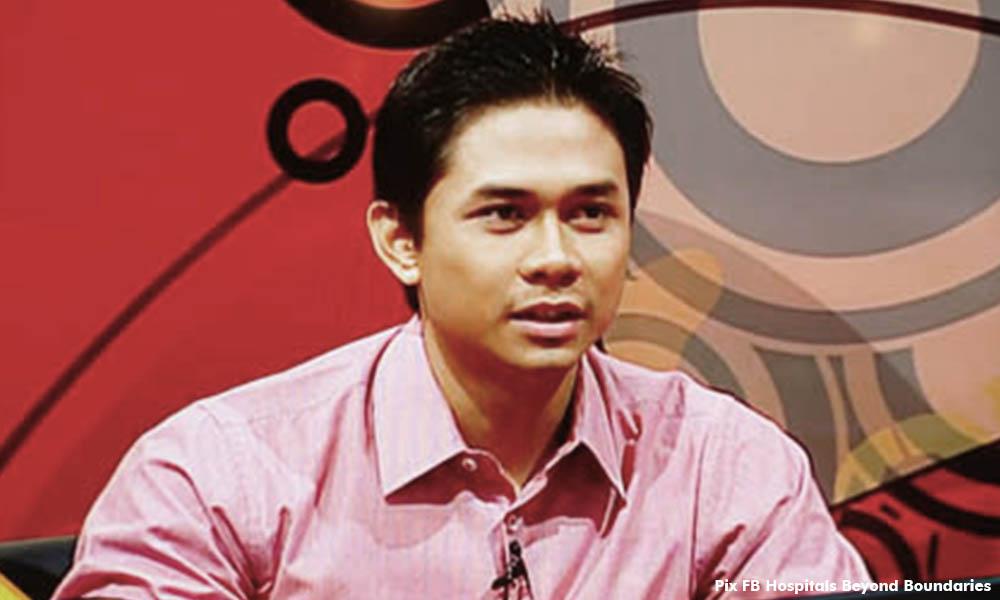

A doctor’s hearing loss spurs a health plan for the poor
MALAYSIANS KINI Since his fledgling days as a medical student, Dr Lutfi Fadil Lokman had been looking for ways not only provide healthcare for the poor, also to keep the effort financially sound.
He co-founded Hospital Beyond Boundaries (HBB) on May 22, 2012 while still studying at Universiti Kebangsaan Malaysia (UKM), and went on to set up a clinic in Cambodia made of repurposed shipping containers. Work is under way to expand it to include a maternal hospital.
HBB also runs a health screening programme for the homeless in the Chow Kit area, Kuala Lumpur.
Little had he known however, his efforts would propel him to international renown on Sept 19, when he was among 17 people given recognition by the UN as Young Leaders for the Sustainable Development Goals during a ceremony at the UN headquarters in New York. They were selected from a pool of 18,000 nominees from all around the world.
His efforts also earned a special mention during Deputy Prime Minister Ahmad Zahid Hamidi’s address to the UN General Assembly that month, and during Prime Minister Najib Abdul Razak’s budget speech on Oct 21.
Lutfi - who had just turned 29-years-old last week - is a medical officer at the government’s Institute of Health Systems Research’s (IHSR) health economics department since April.
He shared his story during an Oct 4 interview with Malaysiakini in Kuala Lumpur:
MOST OF LIFE I HAVE BEEN LIVING AS A ‘SON OF A DOCTOR’ - always seeing my father (an ear-nose-throat surgeon and academician) going on-call, always seeing my mother (a pharmacist) with all the medications and drugs.
That’s how I grew up, seeing nothing more than to be a doctor.
Honestly, now I’ve discovered that my interest is more towards economics, social economics, so that’s what I am growing to specialise in the field of public health.
I am interested in treating patients, but I believe that treating the system is much more interesting for me, and treating the whole community.
I AM IN THE (IHSR) HEALTH ECONOMICS DEPARTMENT. In health economics, we study about the economics of health - how can we finance health, how we can make it sustainable.
For example, under the current system where you pay RM1 for all your medication and you can see a specialist for RM5. It is one of the best in the world actually, but we study how can we maintain that or how can we fund that.
So basically, it is about researching on health systems and advising the government how to proceed with the future of healthcare.
I SPENT MY FIRST THREE YEARS (OF MEDICAL SCHOOL) IN BANDUNG, INDONESIA - Padjadjaran University in Bandung - and the following three years in UKM. It was my first year in Bandung that was the first time I managed to get out of Kuala Lumpur and live among extreme poverty in Indonesia.
When I lived among the poor, I realised that in Indonesia, I like their system because although as a country, their economy is not that good, but they still try and strive to give treatment to the rural and to the poor people.
It was in Indonesia, actually, that I discovered this field of public health, where... all these things lah, like how you finance the poor, how you treat the whole community by creating a system that works, by community empowerment.
All these things got me interested in the field of public health.
MALAYSIANS KINI Since his fledgling days as a medical student, Dr Lutfi Fadil Lokman had been looking for ways not only provide healthcare for the poor, also to keep the effort financially sound.
He co-founded Hospital Beyond Boundaries (HBB) on May 22, 2012 while still studying at Universiti Kebangsaan Malaysia (UKM), and went on to set up a clinic in Cambodia made of repurposed shipping containers. Work is under way to expand it to include a maternal hospital.
HBB also runs a health screening programme for the homeless in the Chow Kit area, Kuala Lumpur.
Little had he known however, his efforts would propel him to international renown on Sept 19, when he was among 17 people given recognition by the UN as Young Leaders for the Sustainable Development Goals during a ceremony at the UN headquarters in New York. They were selected from a pool of 18,000 nominees from all around the world.
His efforts also earned a special mention during Deputy Prime Minister Ahmad Zahid Hamidi’s address to the UN General Assembly that month, and during Prime Minister Najib Abdul Razak’s budget speech on Oct 21.
Lutfi - who had just turned 29-years-old last week - is a medical officer at the government’s Institute of Health Systems Research’s (IHSR) health economics department since April.
He shared his story during an Oct 4 interview with Malaysiakini in Kuala Lumpur:
MOST OF LIFE I HAVE BEEN LIVING AS A ‘SON OF A DOCTOR’ - always seeing my father (an ear-nose-throat surgeon and academician) going on-call, always seeing my mother (a pharmacist) with all the medications and drugs.
That’s how I grew up, seeing nothing more than to be a doctor.
Honestly, now I’ve discovered that my interest is more towards economics, social economics, so that’s what I am growing to specialise in the field of public health.
I am interested in treating patients, but I believe that treating the system is much more interesting for me, and treating the whole community.
I AM IN THE (IHSR) HEALTH ECONOMICS DEPARTMENT. In health economics, we study about the economics of health - how can we finance health, how we can make it sustainable.
For example, under the current system where you pay RM1 for all your medication and you can see a specialist for RM5. It is one of the best in the world actually, but we study how can we maintain that or how can we fund that.
So basically, it is about researching on health systems and advising the government how to proceed with the future of healthcare.
I SPENT MY FIRST THREE YEARS (OF MEDICAL SCHOOL) IN BANDUNG, INDONESIA - Padjadjaran University in Bandung - and the following three years in UKM. It was my first year in Bandung that was the first time I managed to get out of Kuala Lumpur and live among extreme poverty in Indonesia.
When I lived among the poor, I realised that in Indonesia, I like their system because although as a country, their economy is not that good, but they still try and strive to give treatment to the rural and to the poor people.
It was in Indonesia, actually, that I discovered this field of public health, where... all these things lah, like how you finance the poor, how you treat the whole community by creating a system that works, by community empowerment.
All these things got me interested in the field of public health.
COINCIDENTALLY THERE WAS THIS COMPETITION. It was a public speaking competition.
One of the topics that you can choose is about the healthcare in Indonesia, and if you win this competition, you will get to represent Indonesia in the Harvard Model UN conference.
It was very interesting because I am not an Indonesian, but I had to pretend to become an Indonesian, so I just went ahead. The contest was in English, so nobody knew that I am a Malaysian. I went in, presented, and I won, so I got a ticket to Harvard University for this Model UN (in 2009).
It perpetuated my interest because there were powerful people like the president of the World Bank. I met Dr Jim Yong Khim who is the current president of the World Bank, but at the time he was just a dean of some medical school, if I’m not mistaken.
HIS SPEECH REALLY INSPIRED ME, and that’s when I was introduced to the field of public health globally - global public health - and about international relations, how economics affect you, how poverty affects health, how the economics of a country affects health, so it became very interesting to me.
If you look around South-East Asia, you would see there are a lot of medical NGOs, but a lot of them focus on humanitarian work, which is - if there is disaster, they will come and they will provide acute treatment, or then if there is a flood or a famine.
But there are not many NGOs that strive to be there for the long-term. Be there forever. Be there to empower the community, to make them sustainable. So, this the kind of NGO that I want to start.
I HAD THIS DREAM OF STARTING THIS ORGANISATION, but I never had the courage to start because I was just a medical student. Just first year kan? What can I do?
So, I just kept it in mind, kept it at the back of my mind, until I came back to UKM in my fourth year. That was in 2011. In 2011, I went back to UKM and I joined one of those orientation days. We went for a camp in Janda Baik.
Unfortunately at the time, it was a blessing in disguise lah. I had an accident where we played a war game, using ‘bullets’ made of water filled in plastic bags [...]
THAT NIGHT, I GOT HIT REALLY, REALLY HARD IN THE EAR by this guy who threw it directly into my ear. It destroyed not only my outer ear - our ear is consisted of two parts and the inner ear is connected directly to our brain - so what happened is that it directly affected the inner ear and there was a fracture. My brain fluid was leaking out of my ear.
It was quite a serious condition if I let it flow out until I dry out, so I had to be warded for two weeks, and I had to be on antibiotics because if I get an infection, I’m dead.
It also functions for balance - our ear - so I couldn’t walk for a few weeks. I lost my hearing, and there is a permanent tinnitus – permanent buzzing in my left ear.
IT GOT ME REALLY DEPRESSED AT THE TIME and I almost gave up on being a doctor. Even my lecturers also said maybe I should take one year off. I almost gave up, and then there was one night, because I always had this dream to start my own NGO, so I thought that, you know, even though at that time I was 25, but life can be really short. What happens if...
The thing is, my father is an ear surgeon, so he knows what to do with my ear. What if the treatment was delayed, or if my father was a nobody? I could get an infection in my brain, and life can be really short for me. I thought that, maybe I don’t have to wait until I become a doctor, just start while you are still young and get the support of the people and just learn along the way.
So, after a few weeks, I was discharged and I managed to start class again. That’s when I met with my co-founder of HBB. His name is Dr Wan Abdul Hannan Wan Ibadullah. At the time, he was the batch leader for 4th year UKM.
He has been very helpful. He knows that I have this disability, so he helped me with all my registration, with all my study notes, and all, and exams.
So, he helped me, and I have this dream of starting my own NGO and I cannot do this alone, so I think he is a reliable person whom I can depend on if I want to start something.
That’s when I talked to him about this dream, so he agreed, and we registered HBB with the Registrar of Societies Malaysia on May 22, 2012.
I HAVE ALWAYS BEEN MOVING PLACES. I don’t sit still, that that lets me know a lot of people. A lot of different people, live in new places. During my medical school days, I often travel overseas, I attended a lot of conferences, and I was very active in the Medical Student Council.
When I was in Indonesia, I was the president of the Bandung Student Society, and when I went back to UKM, I was the president of the student college, and I was also the president of the Malaysian Medical Association (MMA) medical student association. So a lot of things, and these make it easy to get contacts.
So, when I started HBB, I took my secretary from the MMA medical student society, and some of the members also, I know from societies. Some of the members whom I trust are those who had worked with me before.
It really helps a lot. It gets me where I am today.
WE STARTED THIS IN 2012 and we only started our clinic (in Cambodia) June last year. For the first three years - 2012, 2013, 2014, and half of 2015 - it was just fundraising, fundraising, and awareness, awareness, awareness.
It took three long years to convince the public, because we were a bunch of medical students, and half of us are accounting students. We had five doctors, four accountants, two dentists, and one who was in the business field. When we started this, all of us were still students. It was very hard to convince the public to donate, to invest in us.
In the beginning, even when we want to open a booth at a conference, we don’t have money. We talked to the organisers and they’d give us a booth between booths - no table, no chairs, no nothing. We’d just bring ourselves, and that was our first fundraising.
We started with RM300. Okay lah, for us. Not bad.
Then we started more campaigning, more talks. After three long years, we managed to get enough to buy a piece of land and start with a small clinic.
THERE IS THIS ETHNIC MINORITY CALLED THE CHAM PEOPLE OF CAMBODIA, so these people live in closed communities. During the Pol Pot era, there were massacres for five year and millions of people were killed, and he wanted a totally agrarian and homogenous society.
So, what is happening to the Rohingyas today in Myanmar, happened to them 30 years ago. Around 500,000 of them were killed, and most of them are men and boys. They were forced to work as labourers.
What happens today is that most of them are single mothers, and young children without any leaders - without any leaders academically, or religiously, or politically - so they are lagging behind compared to the general population of Cambodia.
So even in healthcare, they prefer to go to the traditional healers, the homeopathy treatments, instead of going to the doctor. So, that was one of the reason we started to build a hospital, a clinic, in Cambodia to cater towards the community.
THE GAP BETWEEN THE RICH AND THE POOR IS VERY HUGE. You have the super-rich living side-by-side with the super-poor, but there is no health institution that combines them. The rich will always go to the proper, big hospitals, and the poor will always go to the witchdoctors, so why don’t we create a clinic or hospital that caters for both?
You treat both the same, whether you are rich, whether you are poor, you’d get the same kind of treatment, but for those who are rich and those who can afford, you’d pay the normal fees. But the profit will always go back to subsidise the poor and to build more facilities, so the profit will never be taken back by our administration.
AT FIRST PEOPLE WERE SCEPTICAL. If you are rich, why would you go to this clinic when you have the chance to go to a bigger and more comfortable hospital?
But it seems that the community factor is the magnet, because when they come, they feel that whatever they are paying is going to contribute towards their own community, so it becomes a magnet that keeps them coming instead of going to a much more comfortable hospital.
So right now, the paying patients are around 60 percent, and 40 percent who are covered are the poor people. We want this model to be replicable anywhere around the world, so we want it to be solid for at least two years, and then we will expand and scale.
I’M LOOKING FORWARD TO, as I’ve said, to specialise in the field of public health, and to subspecialise in the field of health economics, because I am very interested in healthcare financing for the poor.
Like what I am doing in Cambodia, maybe it can be one of my theses. I am planning to become a specialist in that, and expert subject matter in health financing for the poor.
Hopefully. That will take another four, five years. I don’t know.
Malaysians Kini is a series on Malaysians you should know.
Previously featured:
Aida Redza dances to connect with communities
The brains and brawn behind M’sia’s pro wrestling scene
Meet Adam, a star in M’sia rising breed of professional gamers
Passion to preserve Malaysia's visual history
'Osama sent me his regards, but I wasn't interested'
Struck with hot steel, jailed under EO, PSM's Saras defines resilience
Meet Anis Syafiqah, the ordinary student who wants to catch MO1
How one Malaysian bagged seven journalism awards in the US
Beat me on the track, Supermoto champ Husna tells haters
How arguing on drying laundry led to Science Cafe KL
Bringing student activism to Malaysians abroad
Ramli Ibrahim has a reason to dance for joy
Denounced by relatives, ex-engineer battles for indigenous Sarawakians


Are you sure you want to delete this comment?
This action cannot be undone.