




Cheras toll: Still in the dark after 15 years
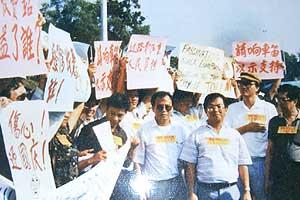
special report Cheras MP Tan Kok Wai clearly remembers the night when 10,000 people protested the opening of the Cheras toll plaza, although it happened 15 years ago.
special report Cheras MP Tan Kok Wai clearly remembers the night when 10,000 people protested the opening of the Cheras toll plaza, although it happened 15 years ago.
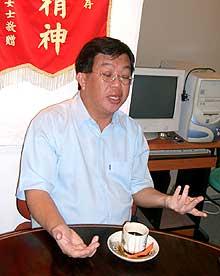 "What happen is still vivid in my memory. I will never forget it," said the four-term MP from 1986.
He provided details in an interview, based on revived interest in the issue from the widely-publicised outcome of a legal suit between Fawziah Holding Sdn Bhd and Metramac Corporation Sdn Bhd.
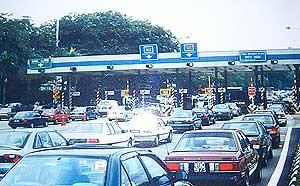
The toll plaza, which came into operation on Sept 1, 1990, was situated within the city centre, adjacent to several densely-populated housing estates. Residents were virtually forced to pay toll every time they left home.
The rationale for the toll-road project was that the government did not have enough funds to build several traffic interchanges to overcome severe traffic congestion in the fast-growing Cheras area. Privatisation was seen as an option in reducing the financial burden and getting the work done.
Roadworks began in 1988. The massive traffic realignment project involved not only the Cheras toll plaza, but also those along Jalan Pahang, the East-West link between Petaling Jaya and Cheras, and roads from Kuala Lumpur towards Sungai Besi.
Long before the roadworks were completed, Tan had gone on a campaign against the Cheras toll-plaza. Despite lukewarm public response, he led a survey and memorandum campaign to abolish toll, to be presented to then premier Dr Mahathir Mohamad.
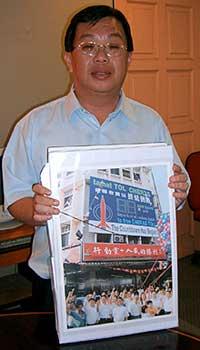 But protests grew as soon as the toll plaza began operations, with many people not even bothering to pay the toll.
Tan said: "Back then, the penalty for not paying the toll was not severe, it was not even considered a criminal case as now. The concessionaire could only invoke civil law to claim the toll charge from motorists.
"Today, if you don't pay 50 sen even once, you will be fined between RM2,000 and RM5,000, as well as face up to two years in jail. An MP who does not pay would be stripped of his post, so no one can afford to be a hero now."
The law was amended during the 1993-1994 parliamentary session, mainly to target Tan and fellow-campaigners who had refused to pay toll. Tan has kept a bunch of letters he received from toll operator's lawyers.
Alternative route
When toll collection began, the campaigners decided to clear part of vacant land nearby for a mud track that could be used to bypass the toll plaza and reach a traffic interchange. It was informally named Jalan Tan Kok Wai.
"To use that road, you had to take a few turns but people thought it was worth the effort. This quickly led to massive traffic jams towards Jalan Tan Kok Wai as nobody wanted to use the toll-road. Those who did were criticised by others," said Tan.
The toll operator soon felt uneasy, as it came under constant pressure from the protests that campaigners mounted in front of the toll plaza.
Around dawn on Sept 7, the toll operator dispatched a contractor to close off Jalan Tan Kok Wai - two huge holes were excavated.
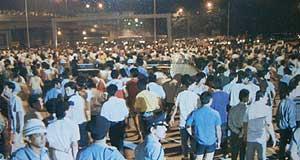 Public sentiment boiled over, with several thousand protesters gathering of their own accord at the toll plaza. The Cheras OCPD sought Tan's assistance in dispersing the crowd, but the people refused to leave.
While holding an emergency meeting with the anti-toll committee members, Tan was informed that the situation was getting out of hand. The police started to disperse the crowd by firing tear gas. Some FRU personnel were seen chasing and beating protesters.
Before the incident, the anti-toll committee had been planning a boycott on Sept 15, by seeking the closure of all business premises in surrounding areas for the day, and gathering 20,000 people to protest against the toll. However, the clashes changed the plan.
Arrest under ISA
At the early morning on Sept 8, Tan went to the police station to bail out those who had been detained. To his surprise, the OCPD greeted him with enthusiasm.
As he walked into the OCPD's office, he saw four or five high-ranking police officers waiting but could not identify them. The OCPD then informed Tan that he was being detained under the Internal Security Act (ISA).
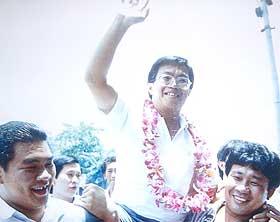 Tan was taken away in a Black Maria, forced to put on a pair of dark glasses to ensure that he was not recognised. Fortunately, a China Press reporter, who had accompanied him to the police station, spotted him and spread out the news.
Tan was detained for a week at a detention centre near Jalan Ipoh. He said he was questioned at least 21 times by a group of Special Branch officers who were well-versed in psy-war.
"I was asked about everything and everyone, including my grandfather. I felt completely alienated...even the newspaper used to pack my food was in Tamil or another language that I could not read," he recalled.
After two days, officers told him that he was innocent and that they knew he had merely been fulfilling his duties as a MP.
They said, however, that protests had continued after his detention and many police vehicles had been damaged. As a result the public was angry with the DAP and party leader Lim Kit Siang had apologised.
 The officers suggested that Tan should admit his part in the incident and apologise for it, but he was aware of tricks that Special Branch personnel had applied on detained party colleagues during Operasi Lalang in 1987. He stood his ground and was released on Sept 15.
It was only then that he realised that toll collection had already been suspended since Sept 13.
Overpayment by 230 percent?
Looking back, Tan said he believed that the main reason for his release was the impending 1990 general election, held two weeks later.
A year later, the toll plaza was reopened in Sept 15, 1991 but the charges went down by 50 percent - from RM1 to 50 sen.
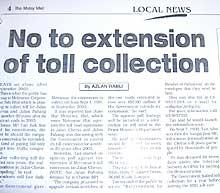 Up to Sept 14, 2003, where toll operations ended, the concessionaire was known to have collected RM200 million.
Tan suggested that the pressure caused by the protests had led to motorists "saving RM200 million over the 12 years".
He questioned the compensation of RM750 million that the government had awarded to Metramac Corporation Sdn Bhd for suspended toll collection, saying this was not justified.
"Then deputy prime minister Ghafar Baba said the government had to pay the company RM50,000 per day. Based on this, the actual sum paid should have been only RM219 million.
"If calculated on the reduced rate, compensation should have been only RM110 million. The government therefore overpaid by 230 percent, if we add the RM110 million to actual toll collection."
Heavy price paid
Tan also said the entire issue is still surrounded by secrecy even though the toll plaza has long been closed.
 "The contract was classified as an official secret and the public still do not have access to the records. From 1990 to now, people have remained suspicious and many question have remained unanswered. We only began getting a glimpse of what's involved after the recent court ruling."
Tan said the background of Fauziah Holdings was not widely known, but that STKG was understood to be in deep trouble when toll collection was suspended.
He said Metramac contacted him once to request him to give away gifts during Chinese New Year "but of course I refused...how silly that would have looked!"
"My feelings after 15 years? Not only have people paid a heavy price, but the government has been misled as well," he summed up.
"The government has to shoulder the blame because it made a bad decision in planning. The culprit is 'money politics'. Some people took advantage of the protests, but everyone has since claimed innocence."
Three-part special report on Metramac
Part 1: Unravelling the Cheras toll dispute


Report this comment
Are you sure you want to delete this comment?
This action cannot be undone.