




The digital future of books
The other day, out of the blue, I got a call from a journalist from a local newspaper who was doing an article about how Borders in the US had filed for bankruptcy and what that portends for the printed book industry.
The other day, out of the blue, I got a call from a journalist from a local newspaper who was doing an article about how Borders in the US had filed for bankruptcy and what that portends for the printed book industry.
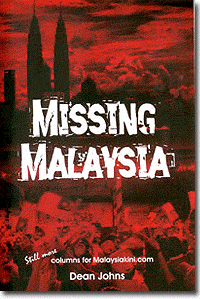 I told her point blank that the printing of books is a sunset industry and it's just a matter of time before printed books go the way of the Dodo bird.
Whenever you say things like that, you're bound to have sceptics who will say things like "print will never die".
Those very same people said cassette tapes and vinyl records won't die. Or that VHS won't die. Or that camera film won't die.
Well, all those things are gone now. Well, you might be able to find some in pawn shops, antique shops and really niche specialty dealers. But by and large those old analogue formats are no longer in the marketplace.
And so it will be with books, which is about as analogue as you can get. It might take some time. Perhaps 10 years or maybe 15 (I doubt it'd take more than that) but die it will.
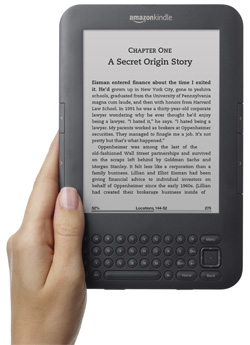 Already, some people are reading their books on Kindles (
right
) and iPads. Some are doing on their iPhones. Others are reading off their laptops.
Already, some people are reading their books on Kindles (
right
) and iPads. Some are doing on their iPhones. Others are reading off their laptops.
The future of publishing is clearly digital.
It makes all the sense in the world. By releasing books in digital format, publishers are able to save on paper.
Not only will this save them money, it's also good for the environment as fewer trees have to be cut down to produce paper.
For the consumer it makes sense too. You get your books instantly. And instead of having to store them on a bookshelf which takes up space, you can keep literally thousands of titles in your Kindle or iPad.
I mention Kindle and iPad because these are the two main devices for displaying e-books for now. Kindle has its Kindle books while iPad has iBooks (which also works on iPhones but phones really aren't ideal devices for reading books).
A natural question is, which of the two formats is better? There are of course pros and cons to each from a consumer's standpoint. I wrote about this in a recent column .
Selling to the world
In this column, I will look at it from a publisher or author's perspective.
The journalist who interviewed me asked me whether as an author I'm dismayed at the decline of printed books. I told her I'm delighted because with that demise comes the acceleration of e-books in the form of Kindle books and iBooks.
And these are great because they allow me to sell to the world. Because printed books are physical goods, they are neither easy nor cheap to transport abroad. So, if a local author is published locally, his or her reach is very limited.
That's not the case with e-books. Once you publish on Amazon.com or Apple's iBook store, you can target a global audience.
Kindle is in many ways better for aspiring authors than iBooks at the moment. There are many reasons for this.
Firstly, Amazon.com has decided that Kindle will be device agnostic (although there is a native Kindle device).
Today, Kindle content can run on PCs and Macs, iPad and Android tablets, iPhone and Android phones and even Blackberry phones.
You'll have to download an app to run Kindle content but the point is, if your book is in Kindle format, it can be read anywhere.
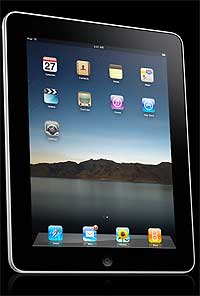 That's not the case with iBooks. They only work on iPads (
left
) and iPhones. No other phones. No other tablets. Not even on a Mac or PC. So, it's far from a device agnostic format.
That's not the case with iBooks. They only work on iPads (
left
) and iPhones. No other phones. No other tablets. Not even on a Mac or PC. So, it's far from a device agnostic format.
Secondly, it's much easier to publish on Kindle. You can just create a book on Microsoft Word and submit to Amazon.com for conversion into Kindle format.
Amazon.com will do it for you at no charge but bear in mind that as the publisher it keeps a whopping 65% commission and gives you, the author, 35 percent.
The natural reaction that people have when they hear this is that it's rip-off but if you think about it, with printed book, authors usually get 10 percent royalty, not 35 percent.
With iBooks Apple keeps 30 percent and gives 70 percent, which is almost the opposite of how Amazon.com does it.
But bear in mind it's a lot harder to create iBooks. You can't just submit a Microsoft Word document and expect Apple to convert it for you. You need to design it yourself. A popular tool is InDesign by Adobe.
The important thing to remember, for authors, is that with these formats, you are reaching a global audience in a way that was not possible before.
So, printed books are dying. Who cares when you've got Kindle books and iBooks to take its place!
OON YEOH's new social media book 'Like Me, Follow Me' is published by MPH. You can connect with him via Facebook and Twitter .


