




Pakistani paradox
Former Pakistan premier Benazir Bhutto is currently touring the US, being ever-so-careful to say nothing to offend President Pervez Murarraf, his army, or the US government.
She's even talking about how a woman in office should be 'nurturing'. None of this makes her party or the Islamic fundamentalists happy, but it might soon put her back in power.
It's the first time in 60 years that Washington has weighed in to support democratic institutions in its ally.
Former Pakistan premier Benazir Bhutto is currently touring the US, being ever-so-careful to say nothing to offend President Pervez Murarraf, his army, or the US government.
She's even talking about how a woman in office should be 'nurturing'. None of this makes her party or the Islamic fundamentalists happy, but it might soon put her back in power.
It's the first time in 60 years that Washington has weighed in to support democratic institutions in its ally.
The Pakistani army presents two current paradoxes. The first is that because of the strategic location of the country just south of the old Soviet Union and now west of Afghanistan, America has had unlimited motive to support the military to satisfy its own agenda.
Washington was so generous during the Cold War that the military didn't need to compromise with any democratic government in power, since it got enough armaments directly from Washington. As a rule, it got so used to these dispensations that it always got tired of the political antics, not to mention corruption, of democratic politicians and threw them out of office. Washington always acquiesced.
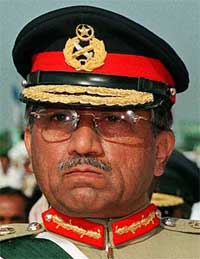 In 2001, Washington desperately needed a base to operate against al Qaeda and demanded the co-operation of Musharraf, who came to power in 1999 in a coup, and got it. About US$10 billion is currently committed to Pakistan, most of it for military purposes.
Washington has since then always seen Musharraf as its best choice for stability - and for fighting al Qaeda - weighing in as needed to back him up. But the jig is up with support for his regime crumbling.
The Bhutto family was never America's favourite; Zulfiqar Ali Bhutto was hanged not just for corruption but for his geo-strategic left-ward swing. Benazir despite her Harvard and Oxford education would dearly love an independent stance for her country, but she wants power more - if only to stanch the blood flowing from various international cases against her for corruption, on a scale that would have made her father blush.
The other strategic problem with Pakistan is that the intelligence services, particularly the ISI, and the army, are at best ambivalent about pursuing Osama bin Laden, to the enduring frustration of Washington. Couldn't they clean up the provinces where he hides and draws his support?
 The problem is a simple one. At Washington's bidding, and with ample US support, both institutions were cajoled into supporting the
jihad
against the Soviet occupation, starting at Christmas 1979, next door in Afghanistan.
The problem is a simple one. At Washington's bidding, and with ample US support, both institutions were cajoled into supporting the
jihad
against the Soviet occupation, starting at Christmas 1979, next door in Afghanistan.
For almost a decade they worked hand-in-glove with what became al Qaeda. For a generation these links and ties developed without hindrance, until 9/11. Now the very co-operation which was pressed upon them is the source of the problem. Full co-operation is unlikely and foot-dragging is inevitable.
Skilled handling
Benazir and her very controversial husband - he spent his time when she was in power dredging the country for their fortune - have been in exile since, yes, the military overthrew them in 1996. Arrest warrants are even out for them.
In her talk at the prestigious Council on Foreign Relations in New York earlier this week, she played her hand with customary skill, expressing regret that she had permitted the co-operation with the Taliban when it came to power in Kabul, and that she hadn't seen the necessity for burying the hatchet with India.
 Benazir only admitted continued consultations with Musharraf, far short of what the American media have revealed. In fact she's probably got her bags packed for Islamabad, to assume power on the basis of the mandate she has already received.
Musharraf's opponents have found his weak spot. He doesn't have legitimacy, at least not enough to mobilise the population to support his foreign policies. His opponents even forced the return of the chief justice to office after the president sacked him.
Bhutto admits she would require his and the army's co-operation to govern (well, that's a fair recognition of reality; he doesn't have his bags packed!). But she demands he keep his promises for democratic reform, not to mention civic and economic development.
His choices at this point are narrow. Either he breaks with Washington and sides with the Islamic fundamentalists, who are veritably a state-within-a-state in several provinces, but that unleashes threats from the American-funded wings of the army and concedes failure for his entire presidency. The other choice is to accept Benazir back and co-operate with her, at least to the extent of permitting her to rebuild her party and its networks throughout the country, for a long-term stay.
 The deal is she'd have to stick to his foreign strategic policies and let him continue to hang on to the thick links with Washington, which are so basic to his continuation in office. Washington is literally demanding a power-sharing agreement between the general and the lady. She has real strength in the country and her party is strong enough to yield up to him powerful support in all but the most fundamentalist regions.
But will she resist the temptations of office this time around? She is now rich enough that no more should be needed, but once at the trough few leaders resist temptation.
She spoke of the need for more transparency, less corruption. She says she needs to be a real woman leader, not needing to show how much a 'man' she is (she was the first woman head of a Muslim country). But in this case, will she be strong enough to resist the worst temptation of office - standing up to her husband? That will be the sword Musharraf hangs over her.
But with Pakistan being already declared a 'failed state' by some, a Musharaff-Bhutto alliance may just be Pakistan's last chance for coherence. Its economy is booming. Pakistan as a failed state would have devastating consequences for the region. One can only wish the eloquent Benazir luck.
W SCOTT THOMPSON, a presidential appointee in four American presidencies, is the author of 11 books on politics. He is adjunct professor at The Fletcher School of Law and Diplomacy, Massachusetts.


