


/file/publisher-c1a3f893382d2b2f8a9aa22a654d9c97/2023/08/4f0c290f9e66d90d4602f7673fda071b.jpg)

COMMENT | Malacca's 'vote transfer' war: Who wins, who bleeds?
COMMENT | The outcome of the upcoming Malacca state election may not hinge solely on each party’s raw vote tally but on how effectively votes shift among Pakatan Harapan, BN, Perikatan Nasional, and new contenders like Bersama.
If an electoral pact is forged to minimise vote-splitting, the key question is: who gains the most? Conversely, if three- or four-cornered fights persist, which bloc stands to lose the most ground?
Malacca’s political landscape today differs starkly from 2021, when BN swept 21 out of 28 seats, with Harapan taking five, and PN securing just two.
However, the popular vote showed a much tighter race: BN garnered 38.4 percent, Harapan 35.8 percent, and PN 24.3 percent.
This underscores...
COMMENT | The outcome of the upcoming Malacca state election may not hinge solely on each party’s raw vote tally but on how effectively votes shift among Pakatan Harapan, BN, Perikatan Nasional, and new contenders like Bersama.
If an electoral pact is forged to minimise vote-splitting, the key question is: who gains the most? Conversely, if three- or four-cornered fights persist, which bloc stands to lose the most ground?
Malacca’s political landscape today differs starkly from 2021, when BN swept 21 out of 28 seats, with Harapan taking five, and PN securing just two.
However, the popular vote showed a much tighter race: BN garnered 38.4 percent, Harapan 35.8 percent, and PN 24.3 percent.
This underscores a vital point: a comfortable seat majority does not imply a landslide in popular support. Under the first-past-the-post system, minor swings in marginal seats can radically alter the assembly’s composition.
The 2021 state poll offers a clear case in point. BN clinched Serkam with a razor-thin majority of just 79 votes, and Pengkalan Batu by 131 votes. Hence, the upcoming battle is best framed as a war for shifting votes in key marginal seats.
/file/publisher-c1a3f893382d2b2f8a9aa22a654d9c97/2025/11/8eb2168ca597b88b71b881330724ce3a.jpg "Sabah State Election 2025 voting polling day 291125 vote voting generic")
Losing a few hundred votes in tightly contested areas will prove far more decisive than shifts involving thousands of votes in safe seats.
Bersama’s entry adds another layer of complexity. Having opted to go solo, the party is contesting 15 seats: Kuala Linggi, Rembia, Gadek, Machap Jaya, Sungai Udang, Paya Rumput, Kelebang, Pengkalan Batu, Ayer Keroh, Bukit Katil, Kesidang, Kota Laksamana, Telok Mas, Bemban, and Serkam.
Bersama’s presence offers an alternative for voters disillusioned with the incumbents.
However, it is premature to assume it will automatically siphon Harapan’s votes. The party has maintained its stance to run independently.
Not a true gauge of BN’s strength
The core question remains: how many new votes can Bersama generate on its own, and how many will it pull away from established parties?
/file/publisher-c1a3f893382d2b2f8a9aa22a654d9c97/2026/07/6a7e3777902a1d8a5dffe75e2e2c23f5.jpg "Bersama party flag logo generic election johor 020726")
This dynamic must be distinguished from any prospective cooperation between Harapan and other parties sharing similar goals.
It remains to be seen whether Bersama can build a distinct, loyal voter base.
Votes are not transferable assets that automatically shift just because party leaders shake hands on a pact.
BN enters the fray with a psychological edge, anchored by its 2021 sweep of 21 seats. Yet, that figure may not reflect the coalition’s actual ground strength today.
Political realignments post-2021 and the results of the 15th general election demonstrate that voter sentiment in Malacca is highly fluid. Consequently, those 21 seats should not be viewed as a definitive gauge of political clout.
The “BN Plus” concept highlights its willingness to collaborate with external parties. Yet the real hurdle goes beyond picking partners or carving up seats.
/file/publisher-c1a3f893382d2b2f8a9aa22a654d9c97/2026/07/85065c87f22896e6b118299f08677db2.jpg "Johor State election 2026 PRN pilihan raya negeri campaign wars flags and party banners 030726 BN barisan nasional flag generic")
The crux of the matter is how many votes from electoral allies can actually be delivered to agreed candidates. A PAS loyalist, for instance, will not automatically back an Umno candidate simply because the two parties reached an understanding.
The same rule applies if BN and PN clash. In multi-cornered contests, votes among factions with similar political bases will split, opening doors for a third party.
Conversely, if both sides forge an understanding, vote-splitting can theoretically be kept to a minimum.
Ultimately, local dynamics, candidate appeal, and grassroots acceptance will decide whether top-level agreements translate into actual votes.
Where Harapan-BN relations are concerned, the question of trust is even more critical. While they partner at the federal level, local voters may still vote along party lines, candidate performance, and localised issues.
If Harapan loses votes to Bersama, it does not automatically translate into a win for BN. Likewise, if BN bleeds votes to PN, Harapan will not necessarily benefit.
Uncommitted voters may opt for a third party, back independent candidates, or choose to sit out the election entirely.
Small shifts, seismic impacts
This is why the concept of “vote transfer” is far more instructive than simply declaring whether a party’s popularity is rising or falling. The real question is: which bloc are the votes migrating from, where are they landing, and in which specific constituencies?
/file/publisher-c1a3f893382d2b2f8a9aa22a654d9c97/2022/11/106c5bc0f9475aca56a25300b7cad73b.jpg "Tambun Perak p063 polling day ge15 general election candidates and public casting votes voting vote 191122 generic")
These dynamics will vary significantly from one state constituency to another.
Government performance will also play a pivotal role. A Merdeka Center survey conducted between March and April indicated that 50 percent of respondents were satisfied with the federal government, while 48 percent expressed dissatisfaction.
While these figures cannot be directly read as solid support for Harapan or BN, they highlight that public sentiment toward the administration remains tightly divided.
Cost-of-living concerns, economic pressures, state government delivery, and candidate credibility will heavily shape voter choices.
In the end, all eyes must remain on the marginal seats.
A swing of two to three percent in popular vote statewide may look minor on paper, but if concentrated in marginal seats with razor-thin majorities, it can completely overturn the balance of power.
Losing 2,000 votes in a safe seat carries little consequence; losing that same number across two or three marginal seats will decide who forms the next state government.
Moving forward, three primary voter dynamics warrant close tracking in Malacca: Harapan-Bersama, BN-PN, and Harapan-BN.
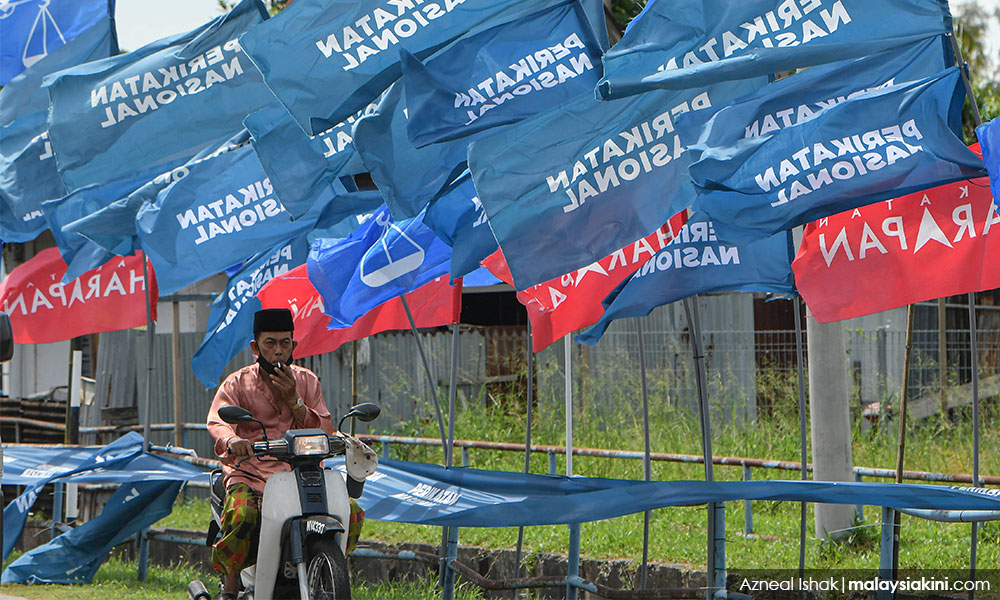
Will Bersama siphon votes previously aligned with Harapan, or forge a new voting bloc entirely? Will a BN-PN pact truly consolidate their combined base? And to what extent will voters view Harapan and BN as a unified government rather than voting purely on individual party identity?
Ultimately, the Malacca state election will serve as a trial of how effectively political coalitions can channel voter movements on the ground, rather than merely merging political logos.
Pacts can prevent friendly fire, but they cannot guarantee a seamless 100 percent transfer of votes. Meanwhile, new parties can reshape the electoral math long before they win a single seat.
Thus, the decisive question is not merely “who will win?”, but who will bleed votes, who will capture those floating votes, and where those shifts will be severe enough to flip the outcome.
AZRIE AZEH is a prominent political analyst who actively comments on national political dynamics, electoral trends, and structural shifts in the country's political landscape. He also serves as the secretary of Pertubuhan Muafakat Terengganu Baru.
This commentary was translated from the original Malay article and does not necessarily reflect the views of Malaysiakini.
/file/attachments/orphans/afsdasdasdsad_147644.png)
/file/attachments/orphans/SPR1_363894.png)
/file/publisher-c1a3f893382d2b2f8a9aa22a654d9c97/2026/09/4bacd777cad3028fd6500daedae3d709.jpg)
/file/attachments/orphans/test1_716667.png)


Many are hoping Bersama wins 2 to 3 seats & be a harbinger to GE 17. GE 16 will essentially be a springboard & positioning for Bersama.
Report this comment
Are you sure you want to delete this comment?
This action cannot be undone.