




No improvement for M'sia in global graft index
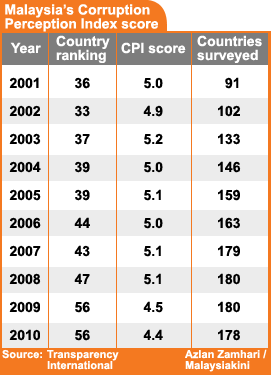
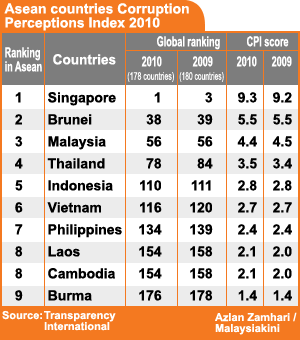
Malaysia remains in 56th place in Transparency International's (TI) latest Corruption Perceptions Index, but its score has dropped from 4.5 to 4.4.
Malaysia remains in 56th place in Transparency International's (TI) latest Corruption Perceptions Index, but its score has dropped from 4.5 to 4.4.
The score also indicates that the country has failed to meet the National Key Result Area in the Government Transformation Programme, which targets an improvement from 4.5 to 4.9 out of the maximum 10 points.
This ranking follows a plunge of 0.6 points and a massive slide of nine places in country ranking in 2009 compared with the year before.
Singapore drew with New Zealand and Denmark in top spot among the 178 countries surveyed.
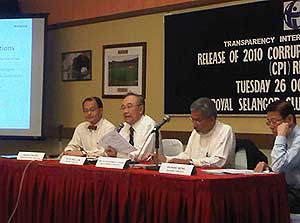 Releasing the index this afternoon, TI Malaysia said that while some steps have been taken in the right direction, problems still arose in implementation.
TI Malaysia president Paul Low described the drop in the score as “statistically not significant”.
Secretary-general Ngooi Chu-Ing said the most glaring was the general perception of a lack of political will to fight corruption.
"For example, there are glaring items of grave concern, such as generally no ‘big fish’ being bought to book, and poor progress in identifying and prosecuting those responsible for the Port Klang Free Zone fiasco," Ngooi noted.
He also cited the ‘no further action’ decision of the Attorney-General against those allegedly implicated in tampering with judicial appointments, and the "continuing and snowballing practice" of awarding mega projects without open tenders.
As 40 percent of the index is drawn from perceptions of local residents and the business community, the CPI also correlates to foreign direct investment performance.
 To improve Malaysia's standing, TI Malaysia recommended that the Malaysian Anti-Corruption Commission be given powers to prosecute, and for the commission to report to parliamentary committees.
It also recommended that political party funding be regulated, and for the public disclosure of the assets of politicians.
"At present, cabinet minister declare their assets to the prime minister but the information is not made public.
"We also urge for freedom of information (with) the repeal of the Official Secrets Act and the Printing Presses and Publications Act," Ngooi said.
New Zealand model
Low said failure to address corruption would halt the government's efforts to move up the ladder to a high income nation, as there was a direct link between corruption and per capita income.
Efforts through the Government Transformation Programme, he said, have not yet borne fruit as "it will take some time before the benefits are translated so that people will begin to feel them".
 The index, which is based on external surveys by several organisations, including the Asian Development Bank and the World Economic Forum, has a two-year lag.
Low pointed out that Malaysia would do well to follow Indonesia's lead in terms of political will against corruption, as was evident from the prosecution of many top officials in that country.
The effectiveness of the Indonesian equivalent of MACC has had much impact on public perception, he said, while MACC's prosecution success rate was only 68 percent.
Comparatively, Singapore and Hong Kong's anti-graft units have a 90 percent success rate, while New Zealand does not even have an such a body.
"I was told that (NZ topped the list) because the society itself sanctions corrupt people. This is something the Malaysian society needs to learn," he added.


Are you sure you want to delete this comment?
This action cannot be undone.