




'Unit Amal pulled back when protesters turned defiant'
INTERVIEW As a sea of yellow flooded the streets of Kuala Lumpur on April 28, several phalanxes clad in maroon T-shirts and berets stood at the forefront of the Bersih 3.0 protest.
To a rookie protester, these men may have looked like commandos in a Hollywood movie, but this small force numbering about 2,000 was tasked with crowd control that day.
INTERVIEW As a sea of yellow flooded the streets of Kuala Lumpur on April 28, several phalanxes clad in maroon T-shirts and berets stood at the forefront of the Bersih 3.0 protest.
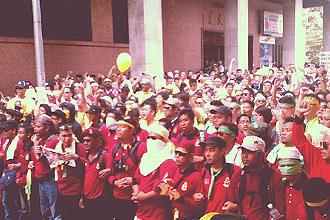 To a novice protester, these men may have looked like commandos in a Hollywood movie, but this small force numbering about 2,000 was tasked with crowd control that day.
The Unit Amal, a volunteer corps attached to PAS, was largely successful in directing the massive crowd and traffic throughout that morning, in addition to providing protection for Pakatan Rakyat and Bersih leaders.
However, when demonstrators and police began to clash - just as the leaders told the crowd to disperse at 3pm - the situation headed into a downward spiral, as a police car was overturned and some people were severely beaten by police.
The Bar Council in its preliminary observation report on the protest, while noting that police brutality was more serious this time around, pointed out that those providing security - including Unit Amal - should have stayed on until all the people had dispersed.
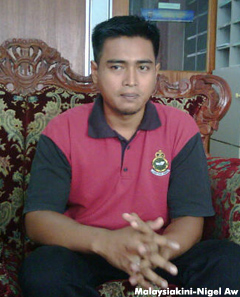
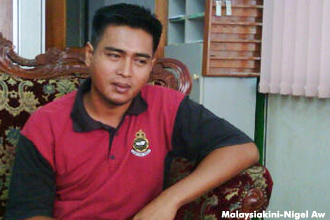 Unit Amal chief Johari Osman, 37, defended his decision to withdraw the volunteer corps about 4pm, saying the remaining protesters could not be controlled as they had refused to obey instructions.
"When participants refuse to listen to us, there is nothing we can do. Some were acting wild. I'm not sure if they were protesters or if there was provocation by other parties,” he said in an interview at the Malacca PAS headquarters last week.
"Those remaining there, not everyone, but most of them did not want to follow our instructions."
Johari, who works full time with PAS, said all Unit Amal members were clear on the instructions issued by PAS and had entered Kuala Lumpur the night before the rally.
 "They stayed in hotels near their assigned location and everyone made their way to their respective locations on their own that morning," he said.
Johari said he was tasked with escorting top Pakatan leaders at Masjid Negara.
"We marched from Masjid Negara to Dataran Merdeka where our leaders made speeches. After that, instructions to disperse were given, so we left for the PAS headquarters.”
About 3pm, however, Johari said he received reports from ground leaders about clashes at Dataran Merdeka and that the Unit Amal could no longer control protesters who were refusing to obey orders. So he pulled back the volunteer corps at 4pm.
“Some from our party leadership witnessed what was happening and asked for the Unit Amal to be re-deployed, but considering the risk, we did not do it.”
He said the unit did not want to clash with the police as it had been given specific instructions not to enter into confrontation with the force.
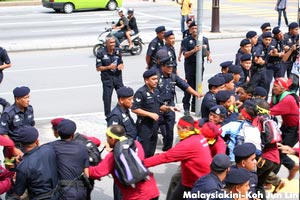 Johari defended the Unit Amal’s action of breaching a police line at the protest site in KLCC, footage of which was widely circulated on television.
“When the protesters there began to move to Dataran Merdeka,
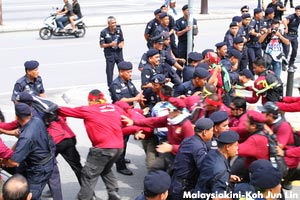 the police formed a human barrier.
“We wanted to open a path as the protesters were approaching. The ground leader informed me that he was worried if we did not open a way, then the protesters would breach the line themselves.”
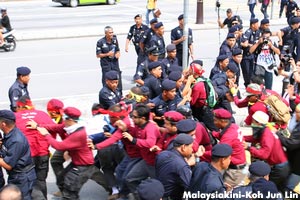
More than 10 Unit Amal personnel were arrested that day, with some claiming to have been beaten by police. The photographs of another 25 members have been published in newspapers as among those wanted by police.
However, Johari described the witch hunt as “arbitrary”, pointing out that one member had four of his photographs published as separate ‘wanted persons’, while another had two photos published.
‘Goal is welfare, not security’
Pointing out that Unit Amal is a volunteer corps, Johari conceded that his men had to first consider their own safety before trying to protect Bersih 3.0 protesters.
"When the Unit Amal is deployed in rallies, it is actually to take care of the welfare of participants, not for security or to confront opponents. So the public perception of us (compared to what we actually do) is quite different.”
The corps mobilised 2,500 members to help out during the Johor floods in 2006 and in April this year, it was deployed in Perak when parts of the state was affected by severe flooding.
The unit, founded in 1991 under PAS Youth, has about 3,000 members aged above 18 who receive training from leaders within its own ranks, including teachers and ex-soldiers.
Those aged 13-17 may join the Amal Brigade, while those aged 7-12 can be members of the Amal Cadet group.
"We focus on schools controlled by PAS such as the Yayasan Islam schools in Kelantan - of the 28 schools, 24 have their own Amal Brigade.”
These two branches, he said, receive training similar to other uniformed units in schools such as the scouts or Red Crescent Society.
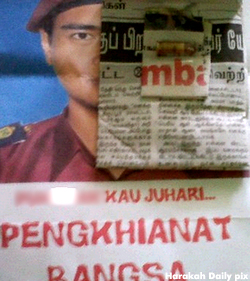 Despite the Unit Amal’s welfare activities, the spotlight often falls on them during public rallies.
The attention may not always be positive, as Johari would testify, for he received a death threat last Tuesday in the form of a bullet sent to his home in Malacca ( left ).
“My family, even though they support me, are reluctant to allow me to be involved in politics, as they worry that something like this would happen. But they have given me great support over this incident. I do not feel threatened,” said Johari.
Asked if he was anxious about his four children, aged between two and 10, he replied: “Everyone is worried, but we need to get rid of such concerns and be calm. To date, none of my children know about this (death threat), and they shouldn’t know.”


Are you sure you want to delete this comment?
This action cannot be undone.