




No Australian guarantee to take back Lynas' waste
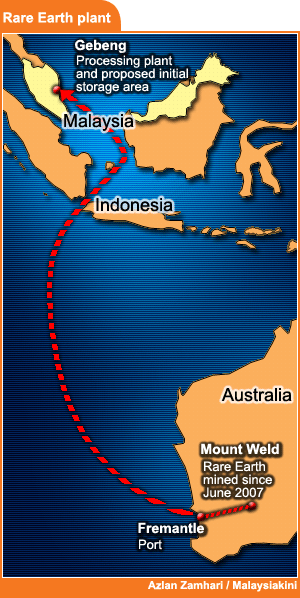
Parliamentary select committee on the Lynas Advanced Material Plant (Lamp) chief Mohamed Khaled Nordin today said there is no guarantee by the Australian government to take back the residue produced by Lynas' RM700 million Gebeng plant.
Parliamentary select committee on the Lynas Advanced Material Plant (Lamp) chief Mohamed Khaled Nordin today said there is no guarantee by the Australian government to take back the residue produced by Lynas' RM700 million Gebeng plant.
He added that it would be pointless to seek such a guarantee from the Australian government as Malaysia would never be able to obtain such a commitment from its government.
"The Atomic Energy Licencing Board has met officers from the West Australian government responsible on this matter and have received explanation on their rules and laws.
"But there is no commitment from the Australian government (to take back the residue), the commitment that we have is from Lynas. It does not make sense to get a commitment (from Australia) because until whatever time, we will never get it," said Mohamed Khaled who is also Higher Education Minister.
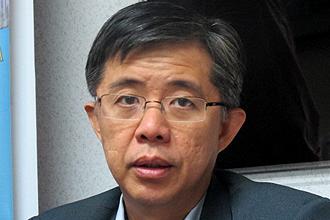 Mohamed Khaled was earlier grilled by Tian Chua (PKR-Batu) (
right
), Fong Poh Kuan (DAP-Batu Gajah) and Sim Tong Him (DAP-Kota Melaka) over whether it had a legally binding requirement for Lynas' waste to be sent back to Australia should it fail to comply with its licence rules.
Mohamed Khaled was earlier grilled by Tian Chua (PKR-Batu) (
right
), Fong Poh Kuan (DAP-Batu Gajah) and Sim Tong Him (DAP-Kota Melaka) over whether it had a legally binding requirement for Lynas' waste to be sent back to Australia should it fail to comply with its licence rules.
"Lynas has only given two letters of undertaking (that it would transport its residue out of the country if necessary) and the government is so confident that they will keep to their word," said Fong.
Responding to this, Mohamed Khaled said Australian law states that if the residue does not exceed 1Bq/g then it is not considered radioactive.
"The residue produced by Lynas is under 1Bq/g therefore it is not considered radioactive waste, it is not impossible that the residue can be shipped out," he said.
He added Australia had accepted fly ash, which is a residue produced from coal combustion and contains naturally occuring radioactive isotopes similar to Lynas' Gebeng plant's residue.
Despite being pressed, Mohamed Khaled did not respond to where the residue would be transported should Australia refuse to accept it.
According to the PSC report, if Lynas is unable to present its residue recycling research report or determine the plan and location of a permanent disposal facility within 10 months, it would be required to ship its waste produced during the TOL period overseas.
Negative views
He added that the negative views levelled against the plant has thus far all been a matter of perception that had been sensationalised.
 "The report produced by this PSC is not propaganda from Lynas, it is a product of cooperation with several experts and academicians," he said.
Addressing criticism that the panel failed to consider the risk posed by the project, Mohamed Khaled said this had already been included during the radiology impact assessment.
In the worst case scenario, workers are expected to be exposed an average radiation dose of 2mSv a year, far lower than the international threshold of 20mSv while the local population would only be exposed to average of 0.02mSv compared to the limit of 1mSv a year," he said.
He added that AELB will consider monitoring the radiation levels around the Lynas plant and should it exceed 1mSv, the plant will be ordered closed.
Khaled said this in wrapping up the debate on the PSC report which extended close to eight hours.
The PSC report which comprised 31 recommendations for Lamp, was passed after the debate.


Are you sure you want to delete this comment?
This action cannot be undone.