
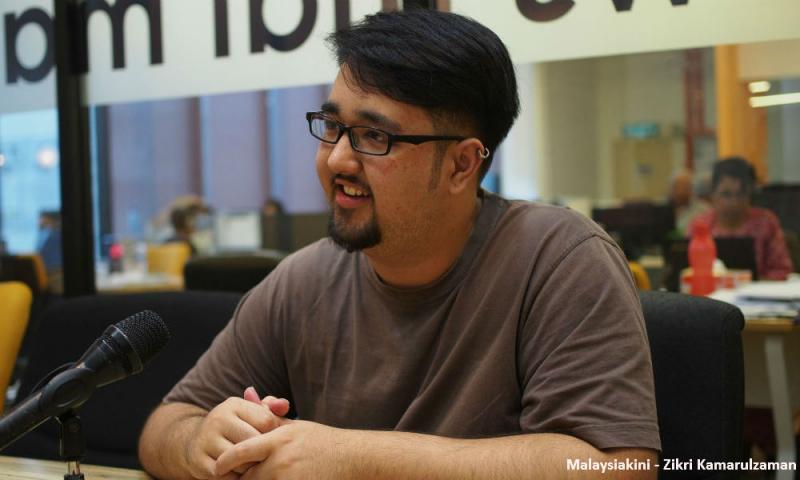
Meet Adam, a star in M'sia's rising breed of professional gamers
MALAYSIANS KINI Meet Adam Erwann Shah. The 22-year-old, like many his age, is a gamer and an avid Defense of the Ancients (Dota 2) player.
Dota 2, to the uninitiated, is that loathsome computer game that makes your friends or loved ones ignore you.
To fans, it is a game of teamwork, strategy and intuition. To Adam, it's a job.
Sceptics may frown at the idea of a gaming career, but this is the same Adam whose team of five last month, bagged RM5.6 million at The International 2016, the world's biggest Dota 2 tournament.
Adam, a soft-spoken, bespectacled psychology student, has no intention of wasting his winnings, and plans to invest in business.
He started off like many primary school students who frequented cyber cafes, and was 11 when he was introduced to Dota by a friend.
"I got thrashed very badly, I still remember that," Adam recalled his first game in an interview with Malaysiakini.
Beyond the virtual arena, Adam plays basketball, where he also picked up Mandarin.
"My teammates couldn't speak English very well so I picked up Chinese from them and spoke to them in that language," he said, who also conversed in some Mandarin during the interview.
Meet Adam Erwann Shah. The 22-year-old, like many his age, is a gamer and an avid Defense of the Ancients (Dota 2) player.
Dota 2, to the uninitiated, is that loathsome computer game that makes your friends or loved ones ignore you.
To fans, it is a game of teamwork, strategy and intuition. To Adam, it's a job.
Sceptics may frown at the idea of a gaming career, but this is the same Adam whose team of five last month, bagged RM5.6 million at The International 2016, the world's biggest Dota 2 tournament.
The team, Fnatic, comprised four Malaysians including Adam, whose game name is 343, with Chai Yee Fung (Mushi), Yeik Zheng Nai (MidOne), and Khoo Chong Xin (Ohaiyo), as well as Filipino Djardel Jicko Mampusti (DJ).
After taxation and sponsorship deductions, the remaining 60 percent of the winnings was divided between the five players.
Adam, a soft-spoken, bespectacled psychology student, has no intention of wasting his winnings, and plans to invest in business.
He started off like many primary school students who frequented cyber cafes, and was 11 when he was introduced to Dota by a friend.
"I got thrashed very badly, I still remember that," Adam recalled his first game in an interview with Malaysiakini.
"I just got hooked even though I didn't know how to play... The game is so complex. There are so many minor details that can change the game and there is always more to learn and think about", he added.
By 15, the he was already participating in Dota tournaments.
Beyond the virtual arena, Adam plays basketball, where he also picked up Mandarin.
"My teammates couldn't speak English very well so I picked up Chinese from them and spoke to them in that language," he said, who also conversed in some Mandarin during the interview.
For now, Adam's life, at least the typical one expected of him, is on hold.
He deferred his studies to participate in the International 2016, and despite his parents' initial doubts about the path he was taking, Adam has already achieved great things.
This is his story, in his own words:
IN SCHOOL, MY MOM WAS OKAY WITH ME PLAYING GAMES. As long as my results were not bad, if they were good, she'd just let me go play. Maybe, at the start, she was kind of 50-50. She was not stopping me but at the same time, she wasn't like "yeah go!"
MOST OF MY FRIENDS SUPPORTED ME. They also play Dota and even before I joined Team Fnatic, they were really happy I played competitively.
ITS SCARY FOR ANYONE WHO DOESN'T KNOW ESPORTS TO SUPPORT IT. I had trouble deferring my semester at university. It was hard to talk to my college and tell them what I'm doing.
MY FAMILY WAS JUST SHOCKED AT FIRST. They were like "Oh, you're going to defer your semester to play games? But Mushi (team mate) and my manager came and explained properly what we're doing, why it was a stable job and why it was okay to do this.
When I joined Fnatic, it was different, I was getting a stable income, we were going to tournaments and constantly our results were good. It kind of changed the perspective.
MY GRANDMOTHER WATCHES MY GAMES. She is 84. She watches it like how my family watches it, even though they don't understand so well. They'll be shouting at the television. She is just really happy it's working out really well for me. My uncle and cousins, they all also support me a lot.
I think it's really touching. You know when you lose, you feel like you let them down. So it just makes you want to work harder for it. I think it's really helpful, it's a source of motivation for ourselves.
BEING A PROFESSIONAL DOTA PLAYER IS A FULL TIME JOB. We play eight to 10 hours a day. We pick players in the region and work it out to form a team. we get salaries, we have a gaming house, we live together and we travel together.
Our boot camp was in Malaysia, in the runup to The International, before we left (for Seattle, US) We woke up at 10am. We had a chef at the house. What happens is, we come down and eat, then discuss, watch game replays and play public games.
You don't go on Facebook. Dota is the only thing on your computer. We usually start training around 1 or 2pm because (international) teams don't play before that.
The place we stay has a pool and a gym. In between, we usually have an hour and a half (break). Some of us swim, some of us go to the gym and some of us will just relax. It's tiring if you don't exercise. You feel like your body is not up to it. We come back (to the game) after dinner and it's the next series of games. We end the day just talking about the game.
We don't get weekly offs. Of course, if someone wanted to have a family dinner or it's someone's birthday, we would see the situation and let them go. Usually, it's fine for family, but not friends.
SOME PROFESSIONAL PLAYERS DON'T GET TO SEE THEIR FAMILY MUCH. I know DJ (team mate) spends so much time away from his family because he's from the Philippines. Maybe, after a big tournament, we will let him go back for a week just to spend time with his family. But recently, we didn't get the opportunity because there were tournaments back-to-back, and they were all overseas.
IT'S QUITE EXHAUSTING TO BE FIXATED ON YOUR ROUTINE. Your whole year is just like that. But I guess we get to travel and see a lot of things. So it kinds of balances out.
After playing in The International, when I come back, I just don't want to play Dota. I just want to be away from it. I want to do stuff I haven't done in a while. I want to see my friends, I want to go to the mamak. Maybe after a week, then I will play Dota. I still enjoy the game.
I THINK PLAYERS SHOULD MAINTAIN A BALANCE. You shouldn't give up your life for gaming, until the opportunity comes up. For me, I did it when Fnatic came to me - that was my opportunity to put everything down and put 100 percent into this.
It's kind of unstable in the sense that you can put in 200 percent every day, and you still might not make it.
MALAYSIANS KINI is a series on Malaysians you should know.
Previously featured:
Passion to preserve Malaysia's visual history
'Osama sent me his regards, but I wasn't interested'
Struck with hot steel, jailed under EO, PSM's Saras defines resilience
Meet Anis Syafiqah, the ordinary student who wants to catch MO1
How one Malaysian bagged seven journalism awards in the US
Beat me on the track, Supermoto champ Husna tells haters
How arguing on drying laundry led to Science Cafe KL
Bringing student activism to Malaysians abroad
Ramli Ibrahim has a reason to dance for joy
Denounced by relatives, ex-engineer battles for indigenous Sarawakians


Are you sure you want to delete this comment?
This action cannot be undone.