


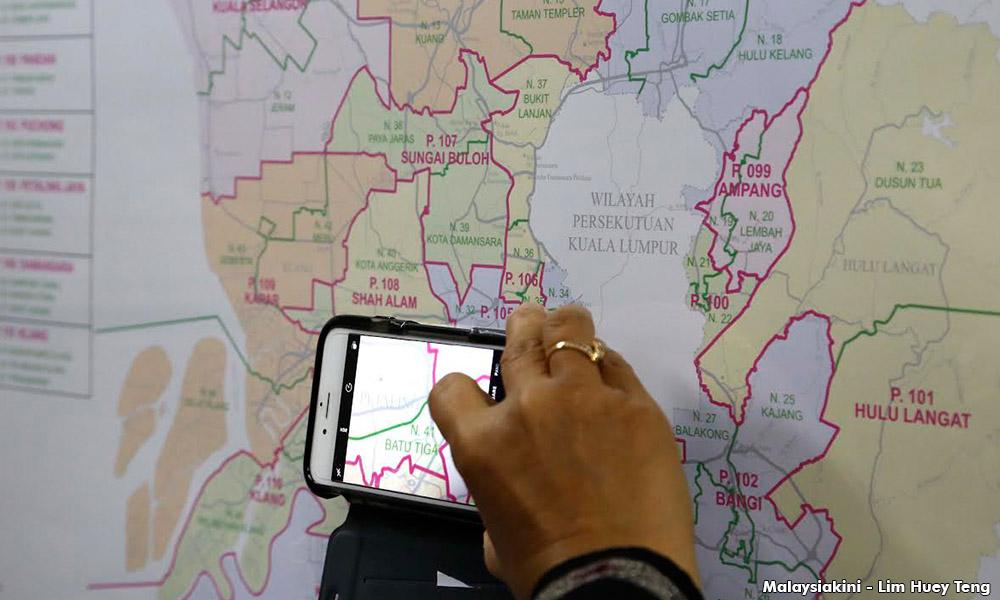

S'gor's challenge not academic even after EC report tabled - lawyers
The Selangor government's challenge against the Election Commission over its redelineation exercise would not be academic even after the report is tabled in Parliament tomorrow, the state's lawyers argued today.
Senior lawyers, Cyrus Das and Ambiga Sreenevasan, who described the process taken by the EC as "unconstitutional," said that even if the report is passed it is still subject to a judicial review...
The Selangor government's challenge against the Election Commission over its redelineation exercise would not be academic even after the report is tabled in Parliament tomorrow, the state's lawyers argued today.
Senior lawyers, Cyrus Das and Ambiga Sreenevasan, who described the process taken by the EC as "unconstitutional," said that even if the report is passed it is still subject to a judicial review.
"It would not be academic merely by tabling as we are challenging the whole process (of redelineation) and even once the report is passed, it can be challenged in courts just like any other legislation if it is unconstitutional."
A three-member Court of Appeal bench led by Justice Ahmadi Asnawi heard the Selangor government's appeal today, and the hearing of the submissions went on from morning until late afternoon.
Ahmadi, who sat together with Justice Vernon Ong and Justice Abdul Karim Abdul Jalil, deferred the delivering its decision to Thursday morning.
It was previously reported that the EC report had been given to Prime Minister Najib Abdul Razak and is scheduled to be tabled in Parliament tomorrow.
Senior federal counsel Amarjeet Singh submitted that Selangor's challenge is academic, as the EC had done its constitutional duty and submitted the report to the prime minister on March 9.
"It is now for the Parliament to decide," he added.
The Selangor government argued that the EC had failed in its constitutional duty under the 13th Schedule of the Federal Constitution, to provide an approximately equal number of voters in each constituency and each constituency should be of about equal in size.
This, they claimed, had resulted in gerrymandering and malapportionment towards the creation of super constituencies, as seen in the parliamentary and state constituencies in Selangor.
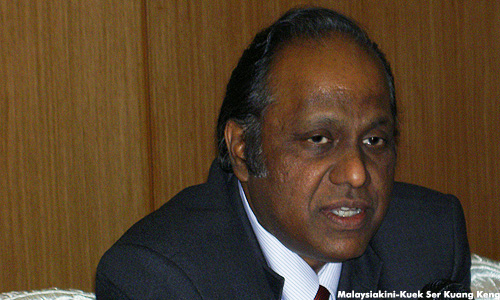
Cyrus (photo) in his submission said even the trial judge recognised that there were malapportionment and gerrymandering, in non-compliance with Part II of the constitution's 13th Schedule.
He cited that in the EC's first recommended redelineation of electoral boundaries, the Petaling Jaya Utara parliamentary seat, with around 84,000 voters, was to be renamed to Damansara and would contain about 150,000 voters.
For the state seats, Cyrus said there are 66,000 voters in Subang Jaya while Ayer Tawar only has 15,000 voters.
The malapportionment, he added, violated the principle of local ties where some voters within the constituency would be under different local councils.
"That is why the local authority is also challenging the redelineation."
Cyrus said the present redelineation exercise resulted in the creation of more Malay-majority and Chinese-majority areas, and this goes against the constitution, as the constituencies should not be divided based on communal lines.
He argued that the challenge is justiciable as legal and constitutional matters cannot be decided on majority votes in Parliament, and it is the function of the courts to provide the "check and balance" based on the Semenyih Jaya Sdn Bhd case.
In a landmark decision made in the Semenyih Jaya case last year, the Federal Court ruled that that the court's power for judicial review is essential to the constitutional role of the courts, and inherent in the basic structure of the Federal Constitution.
In court today, Ambiga also noted concerns over the presence of 136,272 voters in Selangor without known addresses.
She added that the Selangor government is not challenging the electoral roll per se, but the process by which it used the electoral roll to perform the redelineation.
Amarjeet then submitted that the issue cannot be challenged as the EC is only tabling a proposal for the redelineation.
"It is not the final decision. We do not know whether the Parliament will accept it or otherwise," he added.
He said the Selangor government has 22 parliamentary constituencies, and changes were made to 18.
"However after the local inquiries were conducted, this was further reduced to 15," he disclosed.


