


Why politicians from Najib to Dr M share their lives on Instagram
SPECIAL REPORT|In one of his Instagram photos, Bersatu Youth chief Syed Saddiq Syed Abdul Rahman is shown sitting on the bank of a river near a mosque, wearing traditional Malay clothes and reading a book.
He captioned the shot: “One of the best places to go for a read. Behind Masjid Jamek Sultan Ibrahim. Read a book every week and life will be a lot more colourful.”
More than 5,500 people have tapped the heart icon - the equivalent of Facebook’s “Like” button - below Syed Saddiq’s photo.
When Syed Saddiq mentioned that he was in Muar, his followers replied happily, with comments such as “Oh, that’s my hometown”, and “This is where I grew up”.
Meanwhile, fellow Instagram user Umno Youth chief Khairy Jamaluddin appears in a flower-patterned shirt, accompanying his child who is riding a white pony. This photo received a more enthusiastic response, with over 36,500 likes.
Another politician, PKR vice-president Nurul Izzah, posts a photo of her mother Dr Wan Azizah Wan Ismail crouching in front of an open cage, playing with a cat. The PKR president looks lovable, and Instagram users respond by liking the photo over 5,300 times.

Revealing a different side
While some politicians are still uploading formal work photos (for example, such as event launches, shaking hands with constituents) on Facebook or Instagram, some have begun to share posts about their daily lives to attract the...
SPECIAL REPORT|In one of his Instagram photos, Bersatu Youth chief Syed Saddiq Syed Abdul Rahman is shown sitting on the bank of a river near a mosque, wearing traditional Malay clothes and reading a book.
He captioned the shot: “One of the best places to go for a read. Behind Masjid Jamek Sultan Ibrahim. Read a book every week and life will be a lot more colourful.”
More than 5,500 people have tapped the heart icon - the equivalent of Facebook’s “Like” button - below Syed Saddiq’s photo.
When Syed Saddiq mentioned that he was in Muar, his followers replied happily, with comments such as “Oh, that’s my hometown”, and “This is where I grew up”.
Meanwhile, fellow Instagram user Umno Youth chief Khairy Jamaluddin appears in a flower-patterned shirt, accompanying his child who is riding a white pony. This photo received a more enthusiastic response, with over 36,500 likes.
Another politician, PKR vice-president Nurul Izzah, posts a photo of her mother Dr Wan Azizah Wan Ismail crouching in front of an open cage, playing with a cat. The PKR president looks lovable, and Instagram users respond by liking the photo over 5,300 times.
Revealing a different side
While some politicians are still uploading formal work photos (for example, such as event launches, shaking hands with constituents) on Facebook or Instagram, some have begun to share posts about their daily lives to attract the “digital native” generation.
This non-political style of posting and interacting with the public has attracted a huge number of young people to follow their social media accounts.
A study by Kantar TNS, a market research agency, pointed out that Malaysians are the most active Instagram users in the Asia Pacific. 52 percent of Malaysian youths aged from 16 to 24 are Instagram users, while only 19 percent of Malaysians aged 55 to 65 use the app.
Therefore, the majority of Instagram users in Malaysia are young people, many of whom are first-time or potential first-time voters in the coming general election.
Some political figures have already noticed this and actively created a new image on this platform to attract a younger demographic.
Different apps, different content
Prime Minister Najib Abdul Razak has openly admitted that he hired a team to help him maintain his social media accounts.
Besides of the photos of Najib shaking hands with foreign leaders or attending events, some “soft” messages featuring food, grandchildren, and cats also appear frequently on Najib’s Facebook and Instagram.
While former US President Barack Obama had a “First Dog” named Bo in the White House, Najib often shares photos of his Persian cat, Kiky, online – even setting up an Instagram account ("KikySeriPerdana") for his pet.

Unlike Facebook, Instagram is more focused on photos and visuals. The interface design is clean and simple and it is not suitable for long textual discussions.
However, Najib's team does not seem to make obvious content distinctions based on the characteristics of different platforms. Instead, the same message tends to be posted across different social media apps.
In contrast, PKR vice-president Rafizi Ramli and DAP secretary-general Lim Guan Eng tend to distinguish their content for Facebook and Instagram based on the feature of each platform.
For example, most of the posts on Rafizi’s Facebook page are videos or messages about political talks. However, on Instagram, he often shares his daily interactions with his son, shaping the image of being a kind and loving father.

As for Lim, he often shares news reports by the state government’s media outlet Buletin Mutiara, media statements, and photos of events on his Facebook page.
Meanwhile, he tends to share more personal photos that portray a healthy and energetic lifestyle on Instagram, such as pictures of him hiking or eating cendol.

Election strategy of the Taipei mayor
Based on the fact that some young people are not interested in politics, both the government and the opposition are now trying to find new ways to reach out and attract the attention and support of the youth.

This is also true in foreign countries. In Taiwan, independent Taipei mayoral candidate Ko Wen-je (centre in photo) was a doctor with poor social skills, but his campaign team used data analysis to understand youth trends and helped him win the victory in the election in Taiwan four years ago.
After he became the mayor of Taipei, Ko wrote a book and disclosed that his team had not been campaigning aimlessly, but rather, had studied the trends of different audiences based on the analysis of big data, and gained support from different minority groups with different methods.
At that time, they targeted a group of young people who had no interest in elections. After the campaign team found that the keywords “youth” and “street dance” had a high correlation based on big data, they arranged for Ko to visit a popular gathering place for youths and chat with dancers there, and made a short video to attract young voters who had no clear political inclination.
Besides launching the manifesto and voicing out his political views, Ko also accumulated the attention and support of different niche groups through this kind of non-political soft propaganda.
Eventually, he beat the Nationalist Party of China candidate Lien Sheng-wen with a majority of 240,000 votes.
“The idea of my thinktank is to distinguish with what was already presented in the mainstream media. We only focus on the niche issues. Assuming that there are 5,000 individuals who are concerned about an issue, I can influence 100,000 people by doing 20 topics,” said Ko in his book, “White Power III.”
Shaping a ‘cute’ image of Mahathir
In Malaysia, although Pakatan Harapan’s prime ministerial candidate Dr Mahathir Mohamad will be turning 93 in July this year, he has a young campaign team which keenly understands how social media works.
The team is now creating a new image for the controversial former prime minister by highlighting his funny and amusing stories.
For instance, during his wife Dr Siti Hasmah Ali’s birthday celebrations last year, there were no candles but a “firework stick” on the cake. Mahathir widened his eyes and pouted his mouth to blow the fireworks, and a reporter captured the funny scene.
The photo was later published on Mahathir’s Facebook page, captioned: “Blowing candles is an easy thing before, but now it’s different. Nowadays, people are blowing fireworks! True love is letting your husband blows candles for your birthday, even when he is 92 years old.”
The Facebook post received an overwhelming responses, with 34,000 likes and over 1,500 shares.
Besides this, Mahathir has also begun using Instagram. He started his Instagram account earlier this month, and shared a photo of him and Siti Hasmah engaging in a “public display of affection” (PDA) as his first post.

Hannatul Alia Ahmad, 22, is one of Mahathir’s Instagram followers. She told Malaysiakini that Mahathir “looks cute” in the eyes of the youth.
Attracting apolitical youths
Hannatul is a student of Film Directing in UiTM. Besides her school friends and acquaintances, there are also some politicians and social activists amongst the hundreds of people she follows on Instagram.
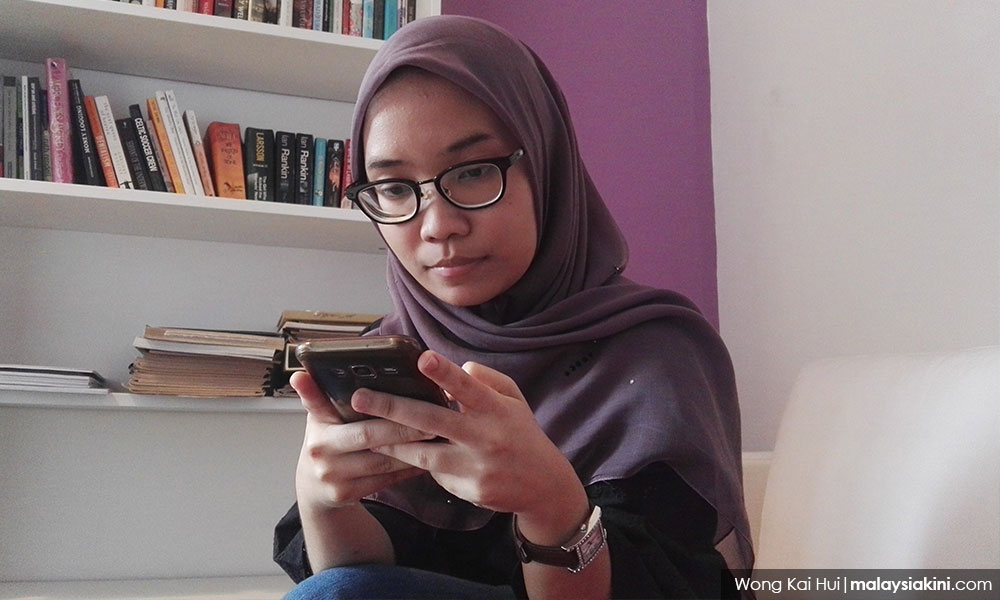
However, Hannatul did not experience the leadership of Mahathir. When Mahathir resigned as prime minister in 2003, she was in her first year of primary school.
The youths her age also didn’t experience the Reformasi movement. Hannatul was a year old when the Reformasi movement was initiated after Anwar was dismissed as deputy prime minister by the then prime minister Mahathir.
Even though Mahathir’s time in government still stirs controversy until today, the post-90s generation did not live under his leadership. They can only learn about him by reading or listening to somebody else after they grow up. In addition, they are re-recognising Mahathir via social media.
“People will think, ‘They are so cute!’ when they see Mahathir sharing his life with his wife. They will think they are a golden couple, a sweet couple,” said Hannatul.
Hannatul pointed that a nearly century-old man like Mahathir showing his relationship through social media will make young people feel that he is “cute”.

Therefore, she believed that politicians can attract the apolitical youth by sharing non-political posts online.
“They can target those who don’t know about politics and those who like this kind of ‘sweet’ things.”
The facts echo her argument. A few days after Mahathir’s first Instagram post, more than 74,000 people started following him on the social media app.
Perception vs reality
Ideally, voters should make a choice in an election after obtaining sufficient information and rational thinking and analysis.
Unfortunately, sometimes the voters are not completely rational, as impressions and perceptions often affect polling.

Sunway University communication lecturer Dr Pauline Leong pointed out that the Instagram is a useful tool for politicians to build their own image and connect with people by sharing their daily lives.
“Instagram is a platform that focuses more on lifestyle. There are not many political things, most of the users are sharing what I ate or what clothes I am wearing. For politicians who are on Instagram, I think that it is useful to create a persona and political image.”
However, Leong expressed reservations about whether social media followings would translate into more votes or political influence in reality.
“For example, maybe I always see this candidate on Facebook and Instagram and I hit ‘like’ for him, but when the opponent shakes my hand or comes to my house and drinks the tea I offered, then I vote for the latter. ”
In any case, Leong believes that political candidates should never rely on any single strategy. Besides visiting the constituencies and communicating with voters in person, social media is also a tool that can’t be neglected, said Leong.
“For those voters who you can’t connect with on the ground, you have to reach them through social media. In any election campaign, candidates can’t just rely on one strategy, they need a multipronged approach.”


举报这则留言
确定要删除留言?
此后将无法恢复