


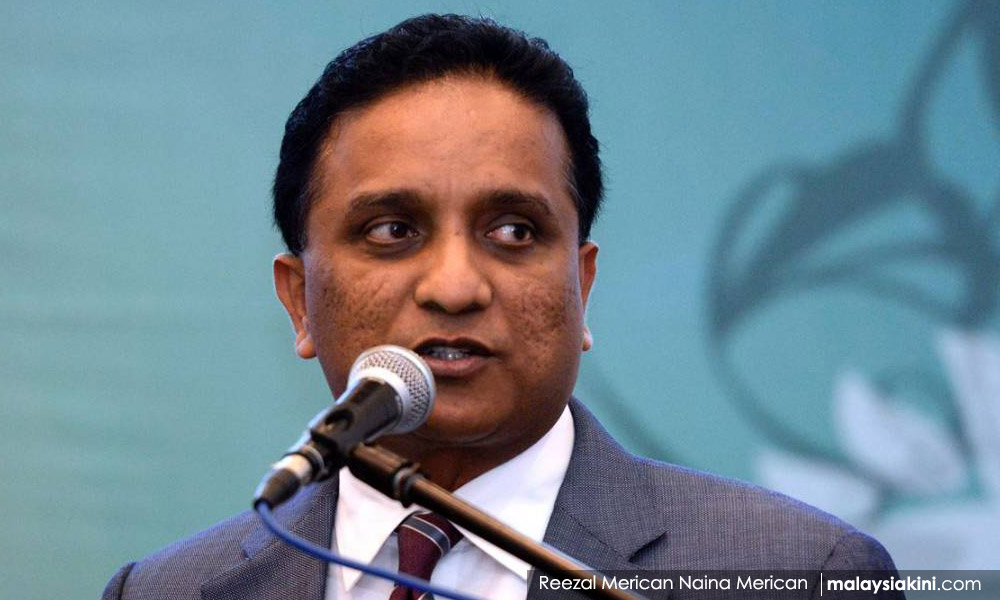

Opposition MP insists royal consent needed for Rome Statute
Kepala Batas MP Reezal Merican Naina Merican today insisted that Putrajaya should have sought consent from the Yang di-Pertuan Agong before acceding to the Rome Statute.
"In the Federal Constitution... it states that the Agong and the Conference of Rulers should be consulted first, because the Rome Statute involves issues of the rights and liabilities of the Agong, the country's leader," he told reporters in a press conference outside the Dewan Rakyat...
Kepala Batas MP Reezal Merican Naina Merican today insisted that Putrajaya should have sought consent from the Yang di-Pertuan Agong before acceding to the Rome Statute.
"In the Federal Constitution... it states that the Agong and the Conference of Rulers should be consulted first, because the Rome Statute involves issues of the rights and liabilities of the Agong, the country's leader," he told reporters in a press conference outside the Dewan Rakyat.
The BN lawmaker was reiterating points he had earlier raised in the Dewan Rakyat, where he asked Foreign Minister Saifuddin Abdullah if Putrajaya had sought the king's consent before acceding to the Rome Statute.
Saifuddin said that under Article 159(5) of the Federal Constitution, only nine matters required the consent of the Conference of Rulers.
He added that the Rome Statute, which governs the International Criminal Court (ICC), is not one of the nine matters.
"Under the Federal Constitution, the consent of the Conference of Rulers is needed to amend the constitution and this involves nine matters.
"But in the context of the ICC, it is not included in the nine matters which involves the amendment of the constitution," he noted.
Policy matter
However, Reezal pointed out that the Rome Statute is a matter of policy, not a constitutional amendment.
"If we invoke Article 38, which explains that the Conference of Rulers can deliberate on questions of national policy, such as immigration policies, this (Rome Statute) is also a policy, what more when it involves the liability and rights of the Agong," he said to Saifuddin in the Dewan.

He pressed Saifuddin for a "yes or no" answer to his question on whether Putrajaya had received the Agong's consent to accede to the Rome Statute, but the minister insisted he had answered the question.
In his press conference, Reezal said Saifuddin's answer makes it seem as though the government did not get the king's consent to accede to the Rome Statute.
Saifuddin had previously explained on March 13 that Article 80 of the Federal Constitution, read together with Articles 39 and 74, says that matters pertaining to signing and implementing international instruments which concern foreign affairs come under the federal government's executive powers.
He also said that he had met with Yang di-Pertuan Agong Sultan Abdullah Sultan Ahmad Shah to explain Putrajaya's ratification of the Rome Statute, and the king had, in turn, decreed the publication of the pertinent issues.
The ICC tries four core international crimes, namely genocide, crimes against humanity, war crimes and crimes of aggression.
Malaysia acceded to the Rome Statute on March 4. To date, 124 countries have become signatories.
RELATED REPORTS
Hadi sees no issue with ratifying Rome Statute, invokes Dr M
Special court will deal with Agong, not ICC: lawyer
BN MPs protest after ex-ally says sultan's remarks off-limits


Report this comment
Are you sure you want to delete this comment?
This action cannot be undone.