


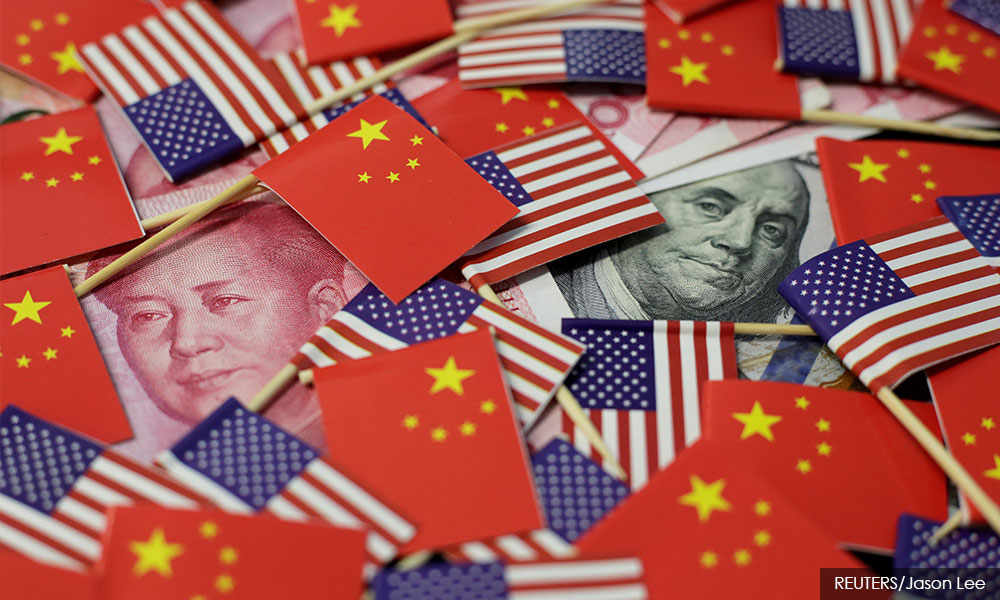

New US initiatives seen amid rising Chinese dominance in Asian industry
The US has for decades been a significant ally and trading partner for Asean nations, including Malaysia, but this has changed in the last decade with the rise of China.
In 2008, the US was Malaysia’s second-largest trade partner with an export value of RM82.74 billion, while China was fourth – behind even Japan – with an export value of RM63.21 billion...
The US has for decades been a significant ally and trading partner for Asean nations, including Malaysia, but this has changed in the last decade with the rise of China.
In 2008, the US was Malaysia’s second-largest trade partner with an export value of RM82.74 billion, while China was fourth – behind even Japan – with an export value of RM63.21 billion.
However, within a decade, China became Malaysia’s second-largest trading partner with an export value of about RM143 billion, while the US fell to third with RM94 billion.
Realising this, Washington is now saying it wants to refocus efforts on expanding its presence in the Indo-Pacific.
Despite the push, however, US government officials admit they cannot provide the total amount of infrastructure investments needed by the region.
“The Asian Development Bank estimates that you need US$1.7 trillion (RM7.11 trillion) in infrastructure investment alone in the Indo-Pacific," said US Department of State Bureau for East Asian and Pacific Affairs deputy assistant secretary Walter Douglas.
“It is not being met at all. No government has that kind of money, only the private sector does, and that’s why you need to bring the private sector in.
“We support private sector initiatives in the region and we do that because that is how the US approaches the region."
Douglas was speaking in Washington DC to a focus group of Southeast Asian journalists, including from Malaysiakini, on a recent state-organised media reporting tour themed 'The US vision on the Indo-Pacific'.
East-West Center fellow Christopher McNally (centre in photo), in a separate briefing, said the US was also incapable of matching the infrastructure investments made by the Chinese government in the region.
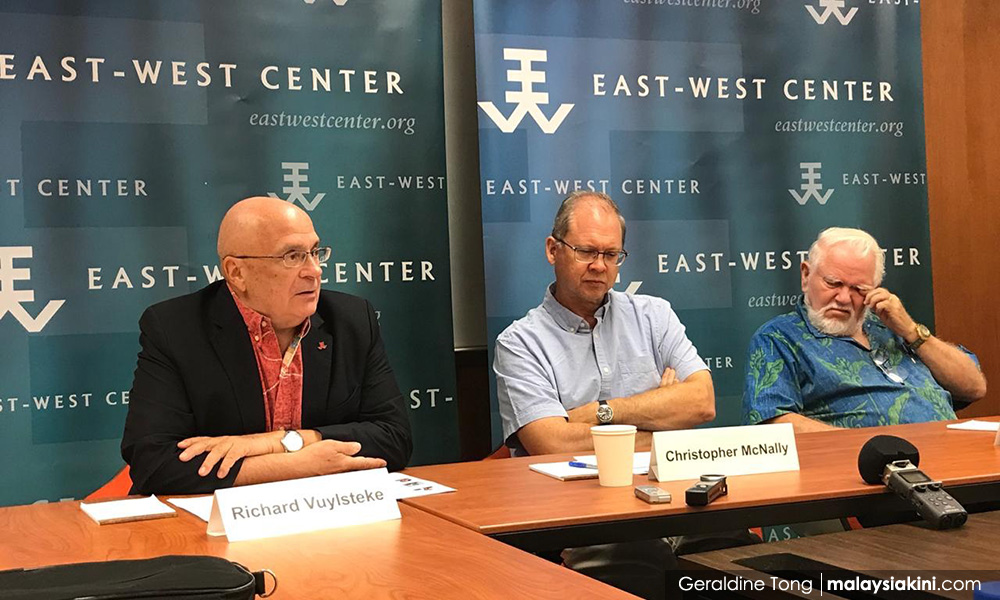
“If you want anything built, a bridge, a road, a railway, go to the Chinese. It is a one-stop-shop and they can do it.
“The US cannot compete with this. Just no way,” McNally told reporters in a briefing in Honolulu.
Instead, the US has chosen a different approach manifested by the passing of the Better Utilisation of Investment Leading to Development (Build) Act by Congress last October.
The law allows for the setting-up of a US development finance institution (DFI), which will seek to “crowd in” vitally needed private sector investment in low and lower-middle-income countries.
According to Eric Jones, chief of staff of the Overseas Private Investment Corporation (Opic), which will be rebranded to a DFI under the Build Act, Malaysia is considered an upper-middle-income nation.
Due to this, Opic would consider Malaysia more as a potential partner to invest in the region, he said.
'Best foot forward'
Center for Strategic and International Studies (CSIS) senior vice-president Matthew Goodman said such initiatives show that US’ strategy in the region is about putting its “best foot forward” to facilitate infrastructure transactions in a way that would be beneficial for both the recipient countries and US interests.
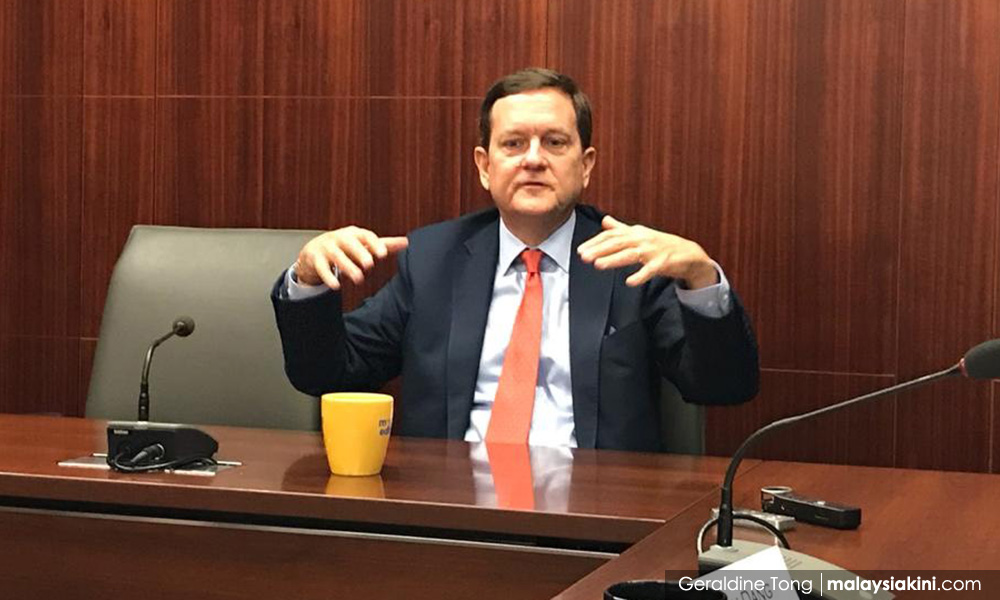
Goodman (photo) specifically highlighted the Transaction Assistance Fund (TAF) programme, which is meant to have a US$10-million allocation, but has yet to receive congressional approval.
Under the TAF, Washington would be able to send legal experts and diplomats to countries which may require expert assistance in negotiating contracts.
“I highlight this because it is a very small but important initiative that the US (is doing).
“I like it, I think it is a good idea to try to do things like that because we are not going to spend huge amounts of money on that kind of activity (infrastructure investments),” he said in a briefing to reporters in Washington DC.
The US has already tested the waters in Myanmar, which had renegotiated a deal with China over an infrastructure project last year.
The Wall Street Journal reported in April that Yangon had received help from the US in their efforts to renegotiate the deal.
“A team of US economists, diplomats and lawyers were dispatched to the country on a pilot programme to scrutinise the contracts, flag bad deals and empower the country to push for better terms with Chinese agencies and companies,” the US business daily had reported.
The WSJ said that this may become a regular strategy by the US to counter China’s growing influence, especially in the Indo-Pacific region.
McNally also noted the US could compete with China through “soft power,” as he believes the US offers better services, technology and more sophisticated regulations and environmental protections.
“I say 'more' because, really, the Chinese are catching up as well,” he added.
'China its own worst enemy'
McNally noted that China, which is classified as a developing country, still suffers from corruption and bribery in its international projects.
“The Chinese tend to be their own worst enemy because they not only bring large investments and infrastructure, they also bring in their own Chinese labourers as well and as a result, you have very new dynamics that I feel, especially in the US, aren't really quite understood.
“A lot of things that go on in China the Chinese take abroad as well including a lot of corruption, bribery and other things,” he claimed.

In Malaysia, Suria Strategic Energy Resources Sdn Bhd (SSER), a subsidiary of the Finance Ministry, had awarded two petrochemical and gas pipeline projects worth RM9.4 billion to the China Petroleum Pipeline Engineering on Nov 1, 2016.
But in early April, SSER was fined RM18 million for failing to comply with Bank Negara conditions.
Meanwhile, the influx of Chinese workers is also affecting neighbouring countries such as Indonesia.
In January, a video went viral on social media supposedly depicting thousands of workers protesting on the island of Sulawesi against Chinese migrants whom they said were taking local jobs.
However, the Indonesian manpower minister has since dismissed the claims, saying the protest depicted in the viral video was about wages and not against Chinese workers specifically.
Definition of good governance
Pacific Forum executive director Carl Baker also acknowledged that some countries may prefer the opaque deals China offered them over the US' insistence on transparent, ethical deals.
“I see this as something that still needs to be resolved between what the US is calling their Indo-Pacific strategy, which relies on good governance.
"And 'good governance' gets defined in very Western terms, rather than the loose terms that Asean has allowed itself,” he said.
The US, he warned, has to be careful about being too righteous about the definition of good governance, lest it drives Asean countries towards China.
“I think that if the US isn’t careful, it will drive the Southeast Asian countries into China’s arms by them saying 'at least they accept us for what we are'.
“If you try to force the whole idea, it will shut off your avenue of exchange with these countries."
Baker gave the example of the US trade sanctions on Cambodia which, he pointed out, makes the Southeast Asian country more dependent on Beijing.

Prime Minister Hun Sen (photo) has been cultivating ties with China, and there have been reports that it will be allowed to station troops within Cambodian borders. Cambodia has denied these allegations.
Within Malaysia, as reported by the WSJ in January this year, there have been accusations that officials within the former BN administration had held secret meetings with senior Chinese officials in 2016.
Apparently, during these meetings, the latter offered to bail out the beleaguered 1MDB state agency in exchange for lucrative stakes in infrastructure projects in Malaysia,
Former prime minister Najib Abdul Razak and China have both denied these accusations.
Baker suggested that the discussion between the US and Asean on what constitutes good governance should start with the United Nations' definition of the concept.
“Take the UN definition rather than starting with this fictionalised notion of what we have as good governance and pretending that the US doesn’t have any problems with its own governance in its own domestic system,” he said.
Goodman, meanwhile, said economic engagement should be done in a fair and non-corrupt way, but recognised that is not always possible.
“I am not naive. At the end of the day, if a Chinese bidder comes and offers a cheap and fast project and it’s something Malaysians want, I can understand not having an American show up at all or (an American) coming and say, well you need to do it our way and not be corrupt and we lecture them and it’s more expensive.
“If you have a choice between a cheap road and no road, you’re probably going to choose a cheap road."
Not zero-sum exercise
During a visit to Bangkok in early August this year, US Secretary of State Mike Pompeo had said that Washington isn’t trying to ask Asian nations to choose between the US and China as both countries engage heavily the region.
“Our engagement in this region has not been and will not be a zero-sum exercise. Our interests simply naturally converge with yours to our mutual benefit,” Pompeo had said.
Pence statement came amid a raging trade war between the US and China, as the world’s two largest economies continue to impose tariffs on each other’s goods even as their leaders attempt to negotiate over them.
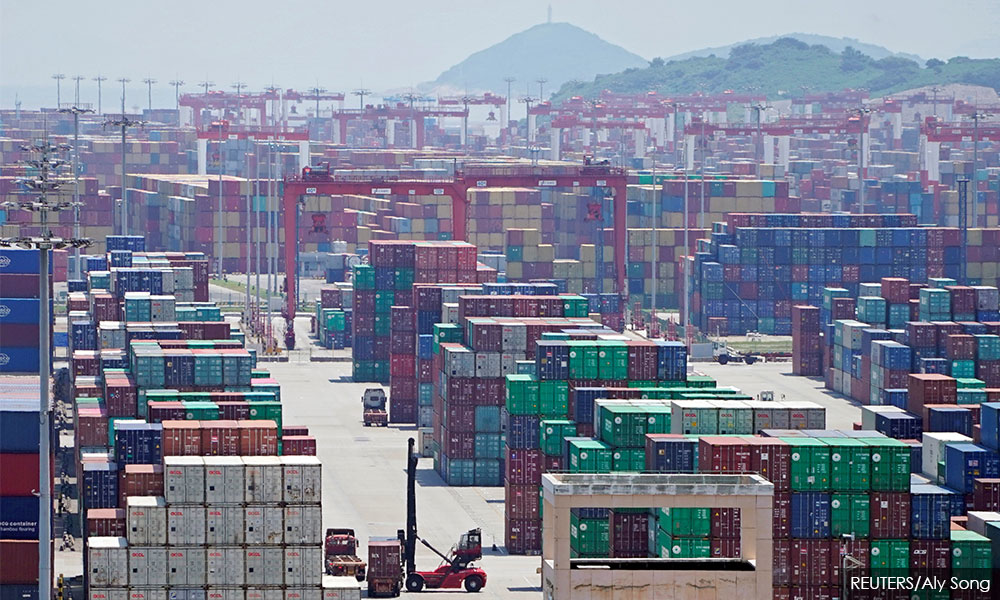
Observers have noted that Asean countries may stand to benefit, at least in the short-term, from this trade war.
US-Asean Business Council senior vice-president for policy Marc Mealy told reporters in Washington DC that Vietnam is already beginning to reap the benefits with several global companies announcing plans to shift some of their production from China to Vietnam.
Nintendo, Sharp and Kyocera are among some of the companies who have already announced plans to move some of their production away from China to Vietnam.
Finance Minister Lim Guan Eng had said in June that Malaysia had also benefited from the trade war through similar manufacturing relocations and trade and investment diversions in the first quarter of this year.
However, he warned that prolonged trade tensions would cause a global economic slowdown, which would eventually damage Malaysia.
Data from Malaysia External Trade Development Corporation (Matrade) shows that though Malaysia-US trade as of June 2019 increased by 5.8 percent year-on-year, it is still below the total trade between Malaysia and China.
Goodman acknowledged that US trade with Asia is still weak, adding that it would be beneficial for the US to place greater importance on China as a trading partner.
“It makes sense for the Malaysian government to put great importance on China as a trading partner because I feel the same way about the US vis-à-vis China.
“I don’t believe it makes sense for us or (Malaysia) or anybody else to somehow decouple economically because we get great benefits from our economic engagement,” he said.
McNally, however, said he does not think the US should be going head-to-head with the Chinese in terms of trade in the Asean region.
“You basically see, in that sense, a competition between American capitalism and Sino-capitalism and to construe that, as our government has to some extent, as a battle for the hearts and minds of Southeast Asia (but it) doesn’t really fit the bill.
“Because the hearts and minds of Asia are basically quite happy with both. They like to be, basically, buddies with both sides because both offer things that are very different from each other."


Report this comment
Are you sure you want to delete this comment?
This action cannot be undone.