


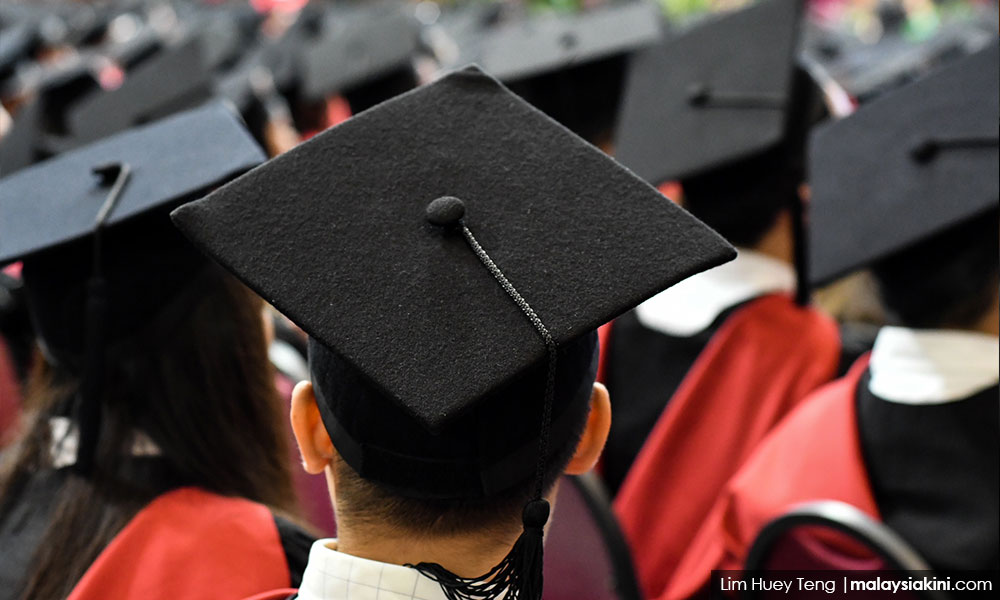

'Unchecked meritocracy in higher education could widen inequality'
Two researchers at Khazanah Research Institute (KRI) have cautioned against unchecked meritocracy at the tertiary education level which could promote and widen inequality, including during the Covid-19 pandemic.
This is despite statistics suggesting public higher education institutions in the country are still serving the needs of students from disadvantaged socio-economic backgrounds.
Two researchers at Khazanah Research Institute (KRI) have cautioned against unchecked meritocracy in tertiary education institutions which could promote and widen inequality, especially during the Covid-19 pandemic.
Jarud Romadan Khalidi and Hawati Abdul Hamid pointed to the US where the belief that higher education is an equalising tool has turned out to be untrue, as recent studies have shown that student placements in top universities receiving large public funds were mostly taken by the relatively well-off.
They said this is because government assistance favours the more politically influential middle-class, and not the poor.
“This misallocation has a large opportunity cost in depriving public resources from those in greater need and subsequently could perpetuate and exacerbate existing inequalities,” they said in an article on the KRI website.
The article is the researchers’ personal views and does not necessarily reflect the views of KRI.
However, statistics have suggested that the Malaysian public higher education institutions are still serving the needs of students from disadvantaged socio-economic backgrounds.
“In 2017, close to half of graduates were from households earning less than RM2,000 per month. The proportion of graduates from households in this income group was the highest compared to other income groups.
“Nonetheless, trends in student enrolment at these institutions require continuous scrutiny, especially with the increasing emphasis on meritocracy.
“Despite conventional wisdom that education is important to narrow the disparity between societies and within a society, if left unchecked it could serve as a means to exacerbate inequality,” Jarud and Hawati said.
In reality, the researchers said children from well-off families are born in “privileged” conditions and have advantages as they are sent to the best kindergartens and schools as well as having better access to resources like health care and nutrition.
“Thus, unchecked meritocracy can promote and widen inequality. Even so, this does not negate the importance of meritocracy,” they said.
Meritocracy should be practised with caution and with a clear awareness of who would be left behind in the “academic arms race”, they said, as they advocate for an open, inclusive and broad educational system.
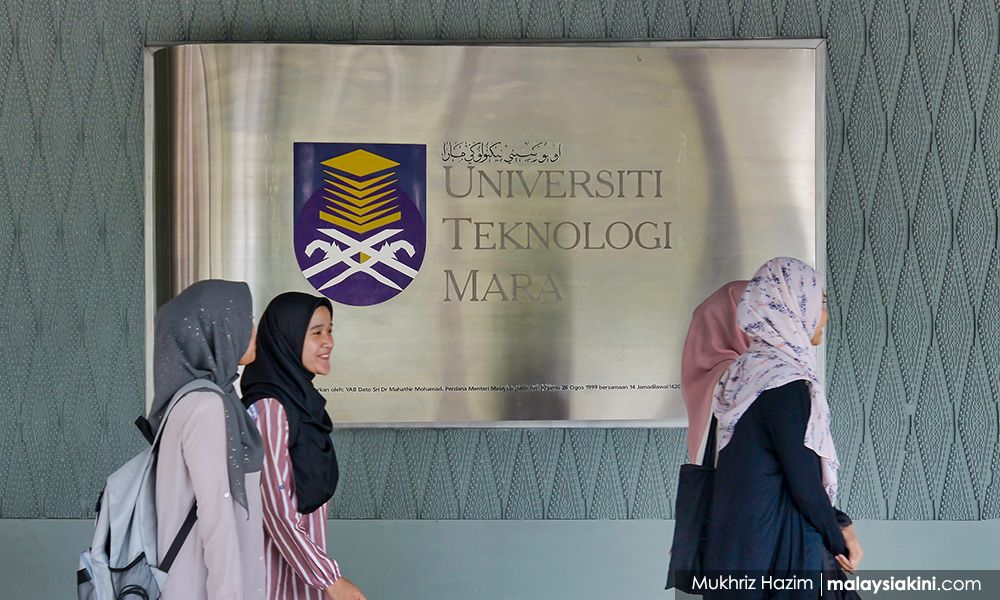
They urged for better data collection on prospective and current students’ socio-economic background in order to make better-informed policies on the admission process into public universities.
Having this data also gives the universities the capacity to better identify and assist disadvantaged students, they said.
“Considering the contribution of tertiary education to upward mobility for the poor, measures can be put in place to ensure these children remain in school during times of crises, including providing the equipment for online learning should long-distance learning become necessary.
“Events such as the Covid-19 pandemic will be a dent to Malaysia’s progress in reducing inequality and promoting social mobility.
“We should ensure that higher education continues to be a platform that can cushion these impacts,” they said.
The researchers explained that they decided to look into the data on the socio-economic backgrounds of students as the Education Ministry received the largest allocation from the Budget 2020, at RM64.1 billion.
Of this amount, RM11.4 billion, or almost 20 percent of their total allocation is intended for the higher education sector.
“Based on the existing evidence, tertiary education is generally considered a means to promote upward social mobility especially for the poor, thus justifying government funding of higher education.
“Considering this relatively huge amount, it is worthwhile to review the profile of the students benefiting from the budget, both directly and indirectly,” they said.
Data from the Education Ministry’s 2017 Tracer Study, which involves all graduates of higher education institutions, revealed that 14,827 graduates, or almost 20 percent of total graduates, were from families earning below RM1,000 per month.
“Considering the average absolute poverty line is currently around RM1,000, the data reveals that almost a fifth of these graduates were from poor families.
“In contrast, only 11,167 graduates, or 14.4 percent, were from families earning more than RM5,000 monthly,” they said.
They also compared the shares of graduates and households between groups, and revealed that there is a concentration of graduates from lower-income groups.
For example, while 8.8 percent of households were in the RM2,000-and-below income group, close to half of the graduates were from this group.
The researchers also looked at data on enrolled students, focusing on public higher education institutions as they are mainly funded by government allocation.
As there were no income data collected on the backgrounds of enrolled students, they used the parents' highest education level as a proxy for the students' socio-economic status.
They found that 43.7 percent of students in public higher education institutions were from families where the parents had secondary education at most.
“Since education level is generally believed to be closely linked with income level, this finding suggests that the majority of students were not predominantly from a high economic background,” they said.


Are you sure you want to delete this comment?
This action cannot be undone.