


/file/publisher-c1a3f893382d2b2f8a9aa22a654d9c97/2022/11/b33dda77e66d28285e5d6833e31c5b16.jpg)

Despite BN's state polls win, Labis voters still dream for a change
In the 1960s, the founder of Genting Group, the late Lim Goh Tong used to run an iron ore business there before he made his fortune.
Today, Labis is famous for its durian, and the area thrives on its main industry which is plantation- namely oil palm.
Labis is under the spotlight this general election as questions arise whether incumbent MP, DAP’s Pang Hock Liong, could secure a second term or would former MCA MP Chua Tee Yong make a comeback.
Labis, a northern Johor town is one of three parliamentary seats in Johor where non-Malays make up 60 percent of the electorate or more.
In the 1960s, the founder of Genting Group, the late Lim Goh Tong used to run an iron ore business there before he made his fortune.
Today, Labis is famous for its durian, and the area thrives on its main industry which is plantation- namely oil palm.
Labis is under the spotlight this general election as questions arise whether incumbent MP, DAP’s Pang Hock Liong, could secure a second term or would former MCA MP Chua Tee Yong make a comeback.
The constituency had been an MCA stronghold in the past. From 1986 to 2008, it was held by two former MCA presidents, Ling Liong Sik and Dr Chua Soi Lek.
Then in 2008, Tee Yong, the second son of Soi Lek became his father’s successor and kept it for MCA until 2018, when Pang won the seat for Pakatan Harapan.
Despite the stature of its candidates, MCA’s majority in the seat had dropped from about 10,000 votes in 2004 to just 353-votes in 2013 - with DAP steadily increasing its vote share.
However, DAP is also unsure of its fate in the seat - with party chairperson Lim Guan Eng openly declaring in March that they may lose Labis after its two state seats - Tenang and Bekok, returned to BN in the Johor state election.
But they’re not giving up just yet.
During the 15th general election (GE15) campaign period, DAP’s big guns such as secretary-general Anthony Loke, Johor chief Liew Chin Tong, deputy chief Teo Nie Ching and Lim himself were seen helping Pang in Labis to give him a fighting chance for a second-term.
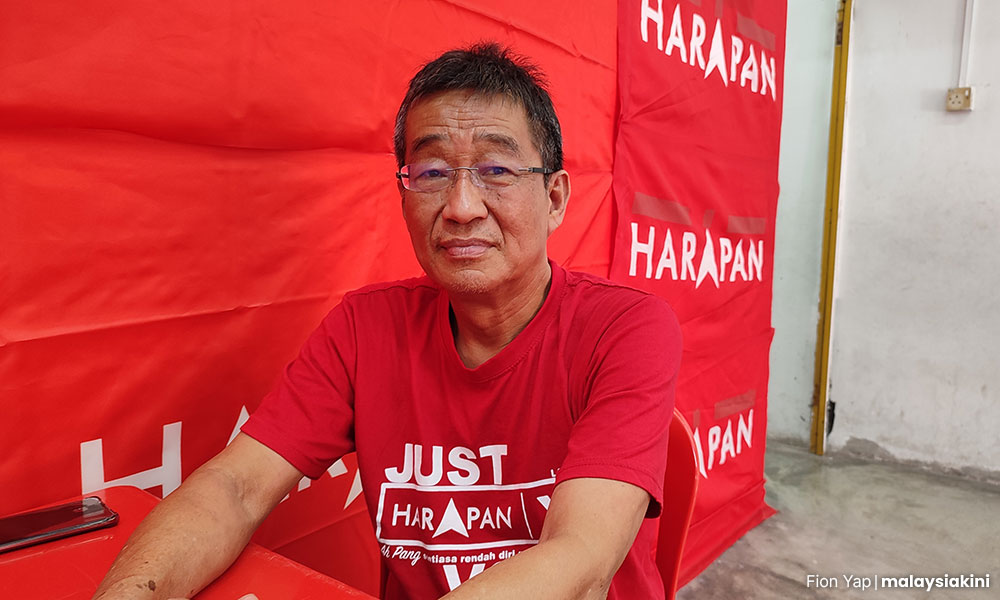
Things started slowly, however.
During a ceramah on Nov 11, turnout was so poor that Pang said that DAP would lose the seat if things do not improve.
According to a Sin Chew Daily report, Pang had asked the 50-odd crowd in the Chaah district if he could win the election.
When the crowd said “yes”, Pang replied: “Don't lie, we can’t win if the attendance was so low!”
He then urged the crowd to remind their friends and relatives who work or live outside their hometown to come back to vote on Nov 19.
Poor turnout had been the primary reason BN was able to capture Labis’ state seats in March in three-cornered fights.
Data showed that the total number of votes cast in Labis during the state election was 6,000 less than in 2018 - a significant difference for Johor’s smaller parliament seat in terms of registered voters which now has 49,000 voters.
The drop in ballots was detected despite a rise in new voters on the electoral roll there.
When met, Pang told Malaysiakini the momentum of the first week was "frighteningly low".
However, he said the situation started to improve in the second week.
At 9.30am on Tuesday, about a hundred people crammed into local kopitiam to hear Pang speak, together with Johor Jaya state assemblyperson Liow Cai Tung and Jementah state assemblyperson Ng Khor Sim as his special guests.

Some residents from the area gathered outside of the shop. Some even brought their families and children, and several others sat on their motorcycles while chatting.
During his speech, Pang focused on the issue of constituency funds allocated to MPs and stressed that Harapan MPs would spend public funds directly for the people without going through middle persons and "taking a discount" for themselves when distributing government funds during their term of office.
“If I were willing to be corrupt, I could get 20 percent of the allocation and I will have RM1.6 million to put in my campaign without doing crowdfunding with you all,” he said.
The allocation issue was clearly Pang’s main card in the campaign this time.
He also challenged Tee Yong to reveal how much he received in constituency funds from 2008 to 2018, and list down which schools, places of worship or organisations benefited from it.
When Pang thanked the voters for giving Harapan a chance to “catch a big thief and send him to jail”, the crowd applauded and laughed at the reference to former premier Najib Abdul Razak.
“But there are still many thieves who have not yet been punished, we have to win comfortably and continue to bring those thieves to justice,” he added.
During the walkabout on the same day at a neighbouring kopitiam, Pang was welcomed by voters and met up with his old local friends who wanted to shake hands and take selfies with him.
With local sentiments warming up, Pang told Malaysiakini that the biggest challenge he is facing now is whether outstation and overseas voters will come back to vote.
He explained that Labis does not have a highway passing by. With a low population, it was hard for investors to come and build factories.
Hence, many Labis youths will leave their hometown to pursue better opportunities in bigger cities such as Kuala Lumpur or even Singapore, he said.
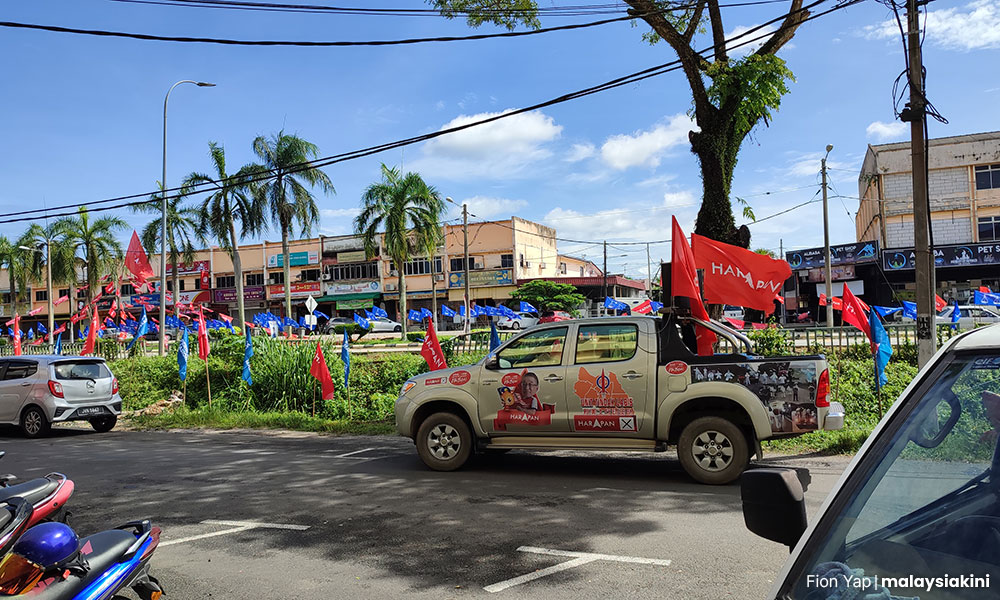
Aiming to address the lack of jobs available in the constituency, Pang pledged that if he were to win again, he would focus on developing eco-tourism, which could promote local durian, other fruits and agricultural products to tourists, especially from Singapore.
He believed this could boost the local economy and increase residents’ income.
Pang’s allocation distribution approaches were well received by voters in Labis.
Several Chinese and Indian voters Malaysiakini spoke to described Pang as “very generous” to give out allocations and passed it directly to the target organisations or individuals.
They claimed the practice could reduce concerns over corruption and it was different from when BN held the seat.
An oil palm smallholder who wished to be known by his surname Lee was one of those who praised Pang for being transparent with how funds were being spent.
“He doesn’t only give out funds just before the election but also on normal days. Even if he knows the individual or the organisation supports BN, he will just give them funds.
“Yes, the allocation is from the government, but not everyone is willing to give that much instead of putting it into their own pockets,” he said.
However, Lee does not believe Pang has a better shot at winning this time as he said BN could get more Malay votes than Harapan.
On the other hand, a hawker who wished to be known as Yap saw a chance for Pang to win since he believed the turnout rate would be better than the Johor state election in March.
He said his younger sister who is working in Singapore is among those who have decided to come back and that these outstation voters tend to vote for a “reformist”.
Looking at the ‘bigger picture’
“Frankly speaking, both parties’ leaders have put their efforts to serve the people here, including (BN’s Bekok assemblyperson) Tan Chong, Tee Yong and Pang. I don’t want to take sides.
“But we’re not going to vote for the candidate now, but the political party instead, since it’s about the bigger picture.
“We’re heavily influenced by Singapore, where a lot of talented Malaysians go there for work.
“So, we wonder how such a small country with no natural resources can be so developed? That’s why we pursuing a change," said Yap.
These Chinese voters were from Chaah, a small town under Bekok state seat which is about 20 minutes south of the Labis’ main town area. It was an MCA stronghold before.
Lee and his two friends, which Malaysiakini spoke to, voted for MCA candidate Tan Chong in the Johor state election in March.
They said they gave Tan a chance since the latter is their friend and a local boy, but lost in the 2013 and 2018 general elections under the strong wind of change because he “followed the wrong boss”.
According to Yap, the sentiment among Chinese voters during the state election was one of disappointment with Harapan’s 22 months in power.
But now people are eager to punish political frogs, he said.
DAP gained only 43 percent of Chinese support in Bekok during the Johor state election, while other state seats which were won by DAP at that time gained at least 80 percent of the Chinese votes.
The above-mentioned Chinese voters considering voting for a different coalition during the state and parliamentary elections is a sign that Harapan may gain more ballots tomorrow.
Meanwhile, several Indian voters in Labis town also agreed that Pang responded quickly to residents’ demands, giving funds for Tamil schools and temples without taking “discounts”, as well as helping out during Covid-19 period.
M Rajandren, 56, who votes in North Labis Estate told Malaysiakini that when Tenang was flooded before, Pang personally visited the area and offered financial assistance.
Indians still wary of MIC
“We invited him to our football event before…he didn’t play, just came for the opening ceremony. I think he can win this time,” said Rajandren.
Some Indian voters refused to vote for BN due to their dissatisfaction towards MIC, alleging the party tends to help their own friends and cronies.
72-year-old voter S Gabriel claimed that the Malaysian Indian Transformation Unit (Mitra) is one of the agencies that practises unfair distribution of resources.
In 2018, Labis had the largest percentage of Indian voters in a Johor constituency - at 15 percent.
Although Tee Yong seems to face many disadvantages, most voters agree that he has a good image and a friendly personality.
This affinity was on display on Tuesday when Tee Yong delivered a speech at a food-sharing event organised by the Sungai Karas New Village committee.
He greeted and shook hands with villagers, as well as took photos with them before and after his speech to about 120 attendees.

After the speech, Tee Yong had to leave early due to his tight campaign schedule, but some residents warmly asked him to taste some foods prepared by them.
Unable to refuse the warm request, Tee Yong took away a bowl of Lei Cha - a Hakka tea-based dish - before departing to the next campaign site.
Earlier during his speech at the event, Tee Yong raised three issues to refute Pang, including reassurances that Umno president Ahmad Zahid Hamidi will not become prime minister if BN wins.
He also explained that his team took down the “MP office” signboard at his local office after losing in 2018 to show they had accepted the voters’ choice and changed it to “MCA Labis service centre”.
This is after Pang claimed that the MCA leader left and did not want to serve the people right after losing the election.
Tee Yong had earlier taken to social media to respond to the removal of the MP office signboard and announce his report card from 2008 to 2018.
Tee Yong, in his speech, also urged the crowd to not be misled by Pang and Harapan.

He stressed that he continued to work for Labis people after 2018, including bringing in a Covid-19 vaccination centre so that the residents need not go to Segamat, a town which is 30km away to get vaccinated.
Tee Yong said his volunteer team had also helped out with registration for vaccines and Bantuan Keluarga Malaysia aid.
He added that although Tenang and Bekok are now under BN, the state government has limited resources and many local development programmes would need the federal government and local MP’s assistance - hence the need for all three to be from the same team.
His father, Soi Lek also delivered a speech to canvass votes for his son.
He criticised Pang for taking credit for doing an MP’s basic job of distributing constituency funds.
"Being an MP, distributing funds is the easiest thing, because that’s not his money but the taxpayers'. Some people also complained that they didn’t get it,” Soi Lek said.

Soi Lek also promised that if Tee Yong is elected in this election, he would personally assist him with his experience and connections in the implementation of large-scale development projects.
Development is among Tee Yong's pledges in this election, which includes a promise to revive the local mini stadium as well as resume an affordable housing project, which he said was cancelled during Harapan’s time in office.
Malay voters to be kingmakers
While Pang appears to have the upper hand among non-Malays at the moment, the 38 percent of Malay voters in Labis could be the kingmaker.
During the campaign, Pang visited Malay and Orang Asli villages, hoping to get more support to help Harapan to defend the seat.
However, Harapan’s Malay support is expected to drop significantly in GE15 compared to 2018 since Bersatu has left and there is no Malay party in the coalition now.
In addition, there are two Felda settlements in Labis which are commonly seen as “fixed deposits” for BN.
BN is also putting in time and effort to recapture the seat - with Johor Menteri Besar Onn Hafiz Ghazi campaigning in Labis on Nov 16 to help Tee Yong.
MCA president Wee Ka Siong, who was once at loggerheads with Soi Lek, also campaigned for Tee Yong yesterday at an event in Chaah.
Chua and Pang are believed to be neck to neck in the race for Labis while the third candidate - Alvin Chang from Perikatan Nasional, stands a very low chance of winning in this election.
/file/publisher-c1a3f893382d2b2f8a9aa22a654d9c97/2022/11/6c63b73d9b45f7cf55539d86ace87685.jpg)
/file/publisher-c1a3f893382d2b2f8a9aa22a654d9c97/2022/11/b46236678d59b78a07a8bceb674e32ea.jpg)
/file/publisher-c1a3f893382d2b2f8a9aa22a654d9c97/2022/11/56785cc67dd19714f0b75e5b416b9396.jpg)
/file/publisher-c1a3f893382d2b2f8a9aa22a654d9c97/2022/11/40013609669d7d5ec888a27999f19e2c.jpg)
/file/publisher-c1a3f893382d2b2f8a9aa22a654d9c97/2022/11/05e7de39a325f6ad18e14e769337611c.jpg)
/file/publisher-c1a3f893382d2b2f8a9aa22a654d9c97/2022/11/b686c6fa5dc1c0942b7cfc8c8bf2bdcd.jpg)
/file/publisher-c1a3f893382d2b2f8a9aa22a654d9c97/2022/11/66f3806c88edbdd2b879df98bd958d1f.jpg)


Report this comment
Are you sure you want to delete this comment?
This action cannot be undone.