


/file/publisher-c1a3f893382d2b2f8a9aa22a654d9c97/2023/01/eed712939298ffddbaad9957c5ed53f0.jpg)

Artist Hasanul lives out sci-fi dreams through his work
Speaking to Malaysiakini, the 45-year-old pinned his entry to the world of art-making on a friendship between his older brother and Malaysian artist Amron Omar - who is known for his figurative oil paintings.
“I knew quite early that I could draw. During the end-of-year school holidays in 1989/1990, I went to Kuala Lumpur and stayed at my brother's house.
“He had a close friendship with Amron, so I always hung out with him,” said Hasanul, adding that he was just 12 years of age back then...
MALAYSIANSKINI | There has been a time in all our lives when, as children, we were asked about our hopes, dreams and aspirations. While most follow a conventional path set by those around them, artist Hasanul Isyraf Idris’ call to his vocation came at an early age.
Speaking to Malaysiakini, the 45-year-old pinned his entry to the world of art-making on a friendship between his older brother and artist Amron Omar - who is known for his figurative oil paintings.
“I knew quite early that I could draw. During the end-of-year school holidays in 1989/1990, I went to Kuala Lumpur and stayed at my brother's house.
“He had a close friendship with Amron, so I always hung out with him,” said Hasanul, adding that he was just 12 years old then.
Hasanul - who was born in Manjung, Perak on Sept 11, 1978 - recalled that upon entering the figurative painter’s studio, he was faced with Amron’s famed “Pertarungan” series that the latter produced throughout the 1980s.
“There was an aluminium ashtray in his studio, the scent of nicotine and linseed oil (often used to produce oil paintings with a glossy finish) was strong because the room was tight for space,” he said.
Hasanul also spoke of another experience where the senior artist took him to meet art students at Universiti Teknologi Mara (UiTM) Shah Alam, hitching a ride on Amron’s Pajero.
“I felt it was a first-hand experience that really thrilled me, meeting art college students for the first time.
“From then on, I decided I wanted to be an artist,” he said.
At the tertiary level, many of the nation’s art schools were concentrated in the Klang Valley, with smatterings across states such as Penang, Sarawak, Sabah and Kelantan.
Hasanul, like Amron, would go on to be a fine art graduate, majoring in painting and minoring in sculpture, from UiTM.
While private art colleges are ever-prevalent in urban centres, public universities - which operate art programmes often in less populated parts - are the first port of call for struggling young artists of predominantly bumiputera backgrounds.
Its host of alumni, who have walked its halls and have gone on to have illustrious careers in the field include Ahmad Zakii Anwar, Jalaini Abu Hassan, Ahmad Fuad Osman, Samsudin Abdul Wahab and Saiful Razman, as well as former lecturers Jolly Koh, Khatijah Sanusi, and Sulaiman Esa.
Beginning as the Rural and Industrial Development Authority (Rida) Training Centre in 1956, it was an institution that was established in the nation’s teething years to harness and educate the talents of rural Malays.
It went through various incarnations such as Mara College, Institut Teknologi Mara (ITM) in 1967 and became UiTM in 1999.
There is a narrative that hangs over UiTM's Fine Art department, that it no longer possesses the experimental and idealistic streak that was present in its earliest incarnation as the university’s School of Art and Architecture - founded by Hijjas Kasturi, a household name in Malaysian architecture.
However, this is evidently not the case for Hasanul, whose experimental streak is notable with every stride and step he takes on his journey as an artist.
Creating own constellation of artists
Hasanul, who is now based in Penang, most recently showed his works at the Art SG fair in Singapore this month - which covers paintings, drawings, installation art, video work and sculpture.
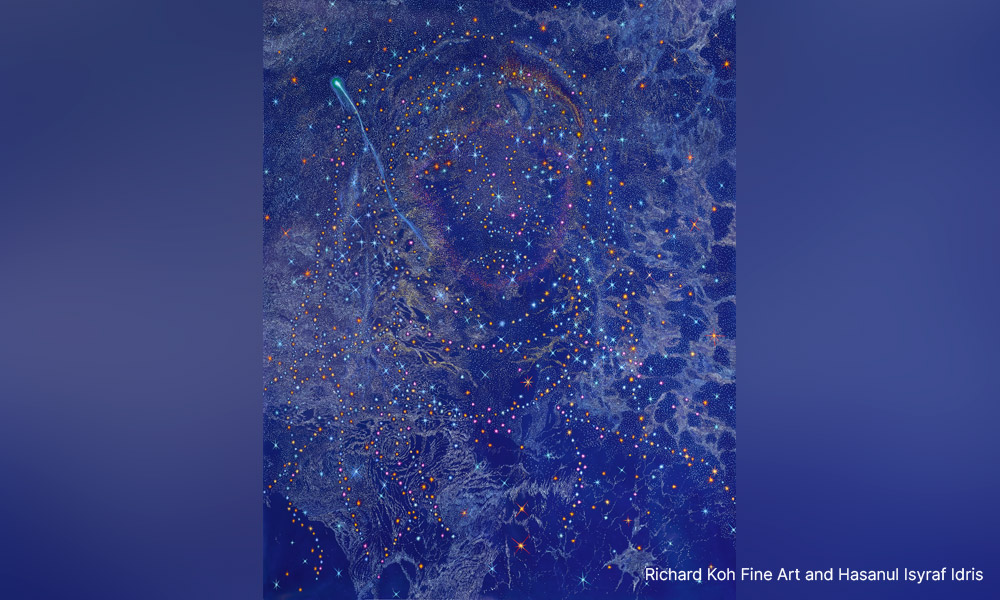
“My new artworks are based on my experiences of night walking and stargazing on Penang island. From that experience, I created my own constellation,” he said.
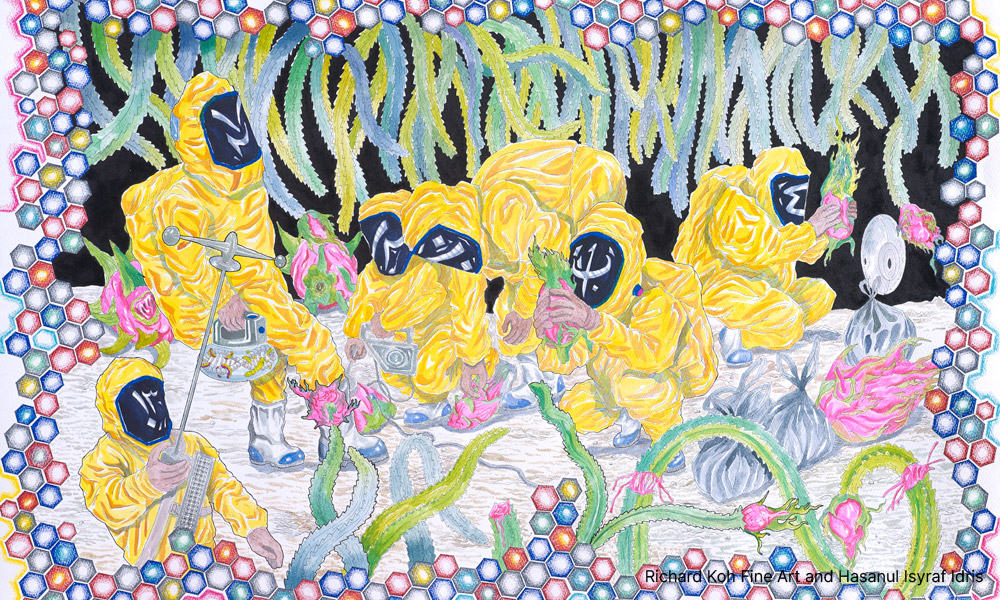
Producing his works is an arduous process. For his “Higher Order Love” series, Hasanul, with the help of two-part time assistants, is said to have spent 18 hours a day working on his 40-panel series depicting landscapes ravaged by wild animals and strange folk donning hazmat suits, among others.
According to the Richard Koh Fine Art website, Hasanul came across the word “HOL”, which was etched on an ancient marble in a Jewish burial site in Penang.
Ascribing meaning to it, he interpreted “HOL” as an acronym for “Higher Order Love”. This is based on a Google search result “Higher Order Logic”, referencing a complex high-level mathematical theory.
Being greatly influenced by comic books, films and British sci-fi writers such as HG Wells (whose book ‘War Of The Worlds’ was adapted into a 2005 film), Hasanul’s work is steeped in fantasy and lore, with surreal universes of his own invention - which allows most viewers to identify his works from a kilometre away.
The artist noted the influence of living with scientific minds during his time away from his hometown.
“In 2009, I followed my wife who was doing her doctorate studies for three and a half years. We were the only ones who worked in the art field. (We ended up) living with scientists, so I have a lot of friends who were talking about science and cancer.
“In the evenings, when they got back from the labs, we would talk about their progress (into their studies),” he recalled.
“When I lived in Sabah, I lived with friends who are zoologists, marine biologists and literature experts, (and) we'd discuss theory. Some (of my friends) were religious and others weren’t.
"I have always been surrounded by these scientific guys. Your arguments must come from facts. You can't make ridiculous statements (benda yang mengarut),” he said, noting its influence on how he views his work.
Bearing brunt of pandemic
A finalist in the 2007 Bakat Muda Sezaman (Young Contemporaries) Awards, Hasanul has exhibited his works in Malaysia, Singapore, New York (the US), India, Switzerland and Jakarta (Indonesia).
In an industry where art collectives are aplenty, Hasanul claimed that he doesn’t actually know many of his fellow artists.
Notably, however, he did get together with his contemporaries like Izat Arif Saiful Bahri - whose work was mired in controversy in 2014 - and Hoo Fan Chon to create the zine “3 Tabib HooHaZat” in 2021.
“I don’t know many artists. I get involved in projects with friends who have ideas and aesthetics of their own. Maybe it’s eccentric, maybe it seems crazy and there is a ‘funny bone’ (in the works),” he added.
He explained that he often initiates projects from conversations he has with other artists, sharing their thoughts through Whatsapp.
“Once there is structure, then we can materialise our ideas and understand our individual capacities, paradigms and all. There are also projects with other artists where I try the same methods but they don’t work.
“When I feel the conversation is kosong (empty) and boring, it’s a sign for me to cancel such projects. Ideas must develop when conversations start and bring me to much more interesting areas that are out of my comfort zone.
“I am ‘organic’ in whom I pick to work with. I am not sure who (else) I will collaborate with in the future. If it works out, OK je,” he quipped.
Malaysia, like other countries in the region, saw its arts industry weathering the Covid-19 pandemic with some help from government agencies.
Some of its players, however, were still unable to face the brunt of the pandemic, due to the economic downturn of the period.
For Hasanul, Covid-19 meant the loss of three relatives to various illnesses. His journeys across Perak - triggered by his losses - involved passing by granite quarries where his father had worked as a security guard.
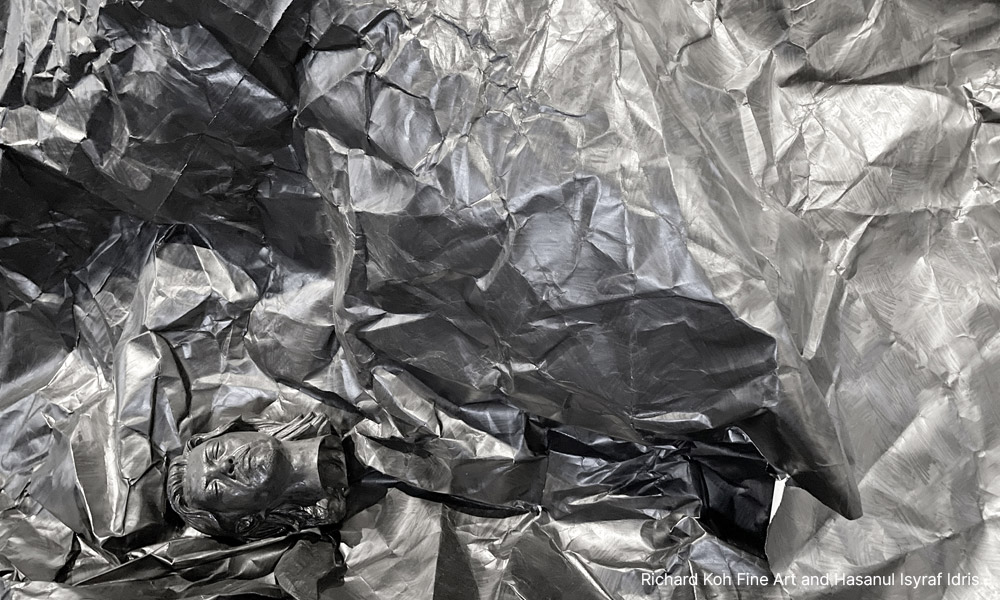
Ultimately, its multiple sightings on these various trips led to the creation of “Quarry”, shown at the Ilham Gallery in 2021, which depicts three severed heads with a likeness to the artist placed at the bottom of the installation.
Each head is meant to represent each relative Hasanul had lost in the midst of the pandemic.
Interestingly, the solemn work - a continuation of work done during his 2016 art residency at Rimbun Dahan - employs the use of graphite. The organic matter is the result of the metamorphosis of dead plant and animal matter.
“Quarry” represents one of his first works that depict Hasanul's likeness - a marked contrast to the fantastical style of his “Higher Order Love” series.
Pushing back against his losses head-on, his sombre stylistic choices for this work show a man earnestly tackling grief in the best way he can.
Surviving without a gallery
When asked if it is possible for artists to survive without the patronage of a gallery, Hasanul said: “There are many ways (to do so). If you aspire to go (display your works at) an art fair, for example, you must have the finances and capital to do so.
“If you only want to play in the local market, there is no issue. For me, the gallery exists to manage things like framing, shipping, press releases and so on.
“I'm not able to handle such things because my work demands focus on my artworks and conceptualising the next project. I think it's a bit of a waste of time to manage such things. I just take note of what's happening and keep updated, that's enough.”
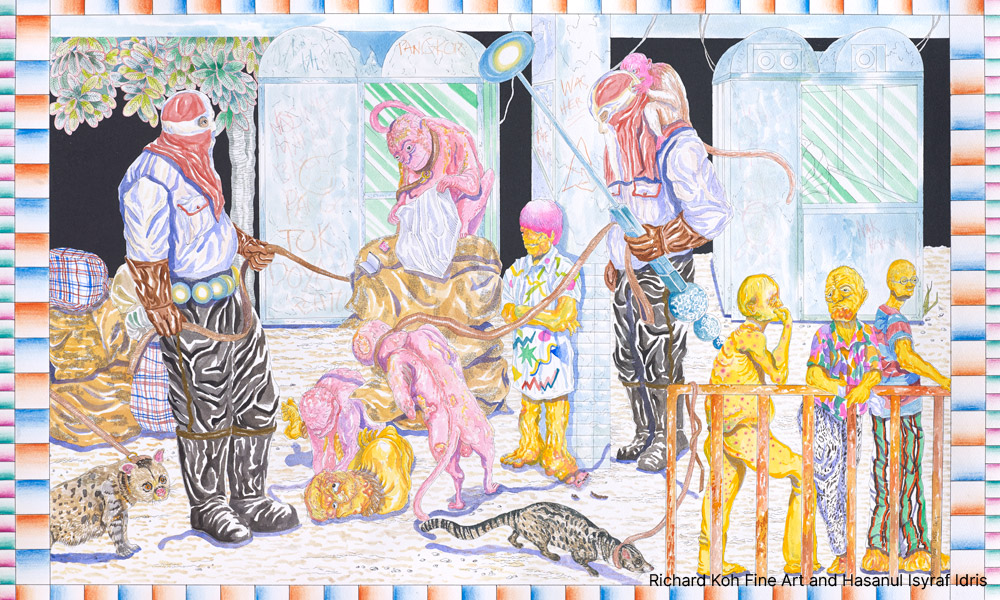
The artist, linked to the Richard Koh Fine Art gallery, noted that other artists may have their own way of going about the system.
“It depends,” he shrugged.
Talking about ways to survive in the art ecosystem, Hasanul advised the younger generation of artists to take their own path instead of taking orders.
“Don’t listen to what your friends, lecturers, girlfriend, or parents say. Listen to what your heart is telling you.”
MALAYSIANSKINI is a series on Malaysians you should know:
106 countries on two wheels: A retiree’s goal to combat climate change
Called a monster as a child, Joshua Benedict is now Mr Malaysia World
Interpreting Hannah: How sign language interpreter duo bridges two worlds
Imran Syafiq celebrates traditional dance in any way he can
Author Shamini Flint on her iconic Inspector Singh being a TV show
/file/publisher-c1a3f893382d2b2f8a9aa22a654d9c97/2022/11/5da463f4093c6c4711eb387c7c3e61de.jpg)
/file/publisher-c1a3f893382d2b2f8a9aa22a654d9c97/2022/11/3cb7ff7325eb49ebd774883e37122c92.jpg)
/file/publisher-c1a3f893382d2b2f8a9aa22a654d9c97/2022/10/10a9e579347a9319c27ef5dd64ca0615.jpg)
/file/publisher-c1a3f893382d2b2f8a9aa22a654d9c97/2022/09/874159a8446152aef88c78091644fbcd.jpg)


Report this comment
Are you sure you want to delete this comment?
This action cannot be undone.