


/file/publisher-c1a3f893382d2b2f8a9aa22a654d9c97/2023/09/633fd2d688042d34280244a07d381bb2.jpg)

S'wak redelineation looms, watchdog calls for reforms
This means the Election Commission can start reviewing election borders soon. Under Article 113(2)(ii) of the Federal Constitution, the interval between the “date of completion” of one review and the “date of commencement” of the next review shall not be less than eight years.
Sarawak’s legislative assembly passed the...
PARLIAMENT | The interval between the redrawing of Sarawak’s election borders will expire this year, the Dewan Rakyat was told.
This means the Election Commission can start reviewing election borders soon. Under Article 113(2)(ii) of the Federal Constitution, the interval between the “date of completion” of one review and the “date of commencement” of the next review shall not be less than eight years.
Sarawak’s legislative assembly passed the present constituency borders on Dec 3, 2015. It is unsure if the “date of completion” stated in Article 113(2)(ii) referred to the borders’ passage through the legislative assembly or the date of government gazette.
Currently, Sarawak has 82 state constituencies.
Minister in the Prime Minister’s Department (Law and Institutional Reform) Azalina Othman Said said the eight-year interval for Sabah will expire in 2025 and 2026 for Peninsular Malaysia, said Azalina.
She was responding to Hishammuddin Hussein (BN - Sembrong) who asked if Putrajaya will be redrawing borders in view of the last exercise being conducted in 2016.
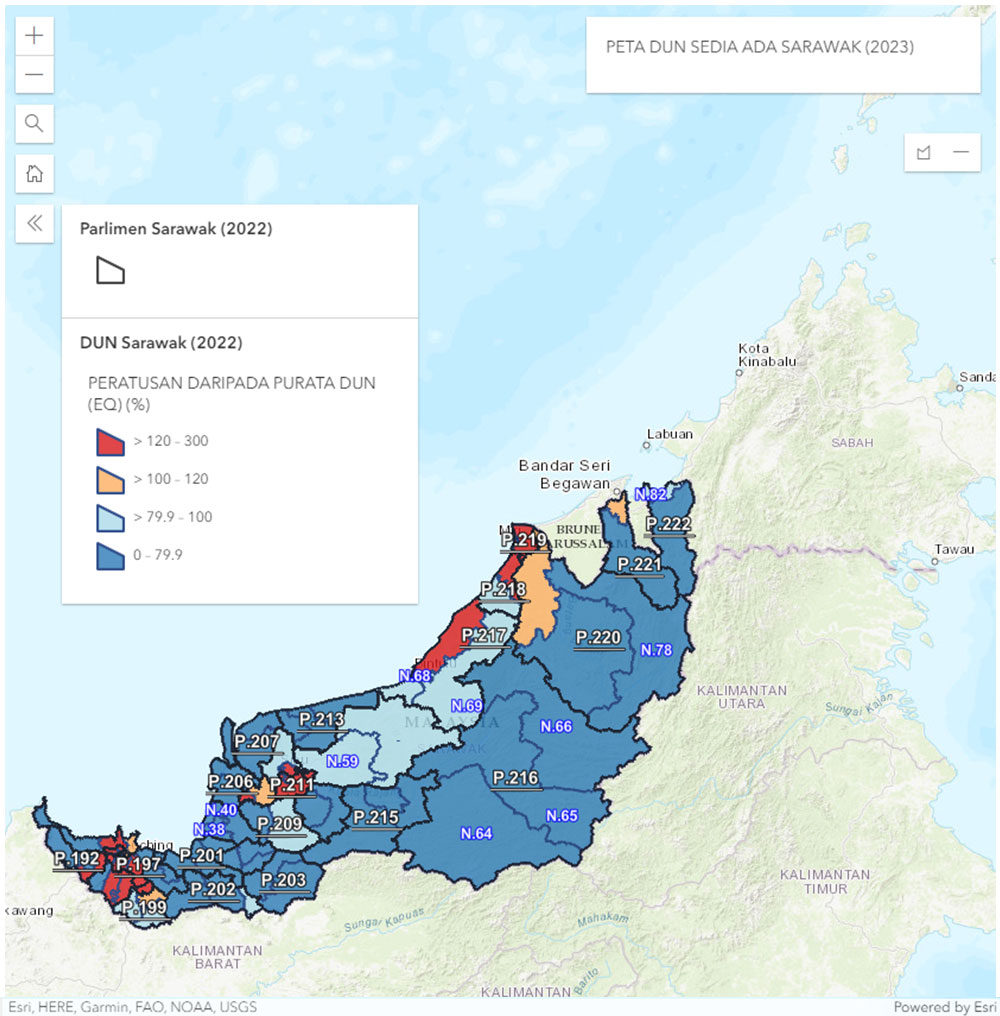
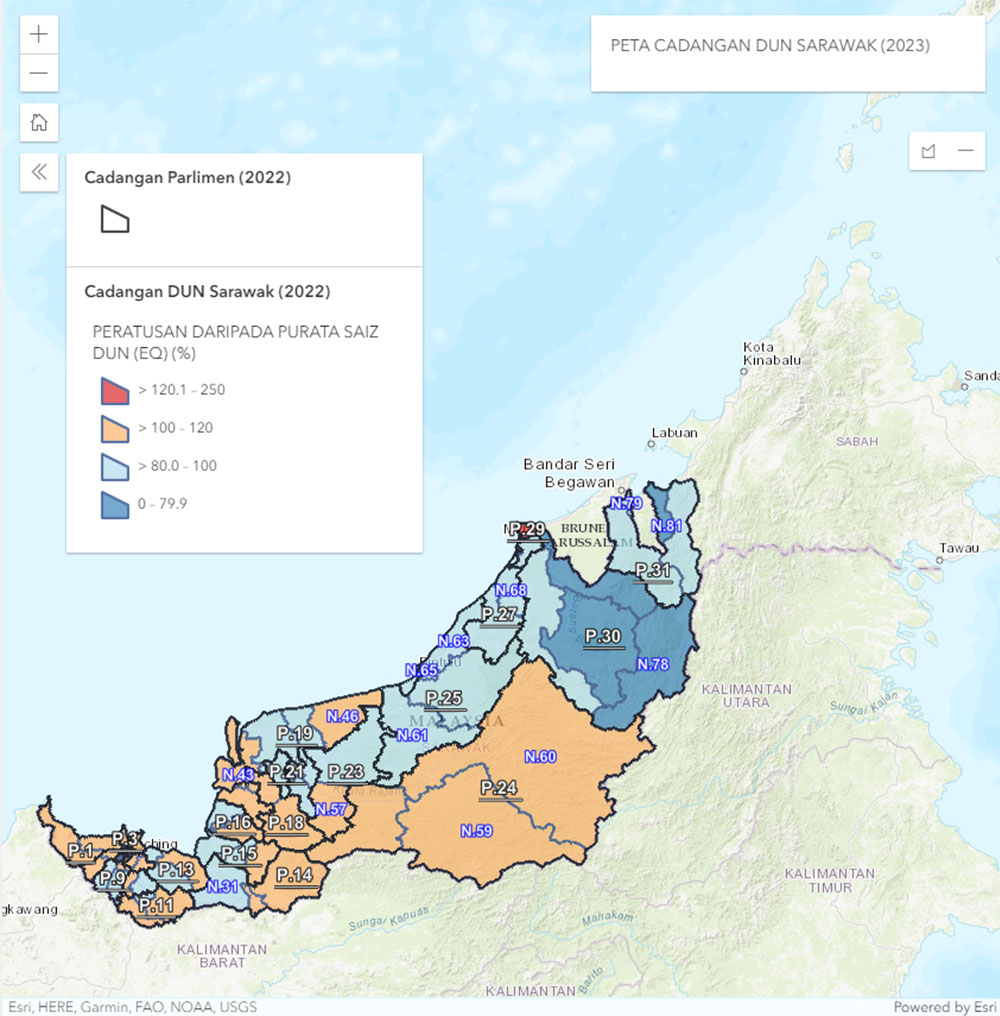
‘Gross malapportionment’ in Sarawak
Meanwhile, democracy watchdog Tindak Malaysia has argued that Sarawak suffered from gross malapportionment.
In a statement yesterday, the group said the largest constituency in Sarawak was Senadin, with 68,564 voters, while the smallest, Gedong, had only 10,067.
“This has created a massive urban-rural gap and constitutes a complete disregard for the principle of ‘One Person, One Vote, One Value’,” said Tindak Malaysia director Danesh Prakash Chacko.
Yesterday, the group launched a website with suggestions on how the Election Commission could draw an electoral map where the number of voters in each of Sarawak’s state and federal constituencies is within a 20 percent difference from the average.
In a redelineation exercise, the EC can make alterations at each of these levels: parliamentary seats, state seats and polling districts.
There are a total of 222 parliamentary seats in Malaysia, each of which contains between two and six state seats.
Within the state seats are polling districts, which can be as little as four in small areas and more than 20 in large and densely populated areas.
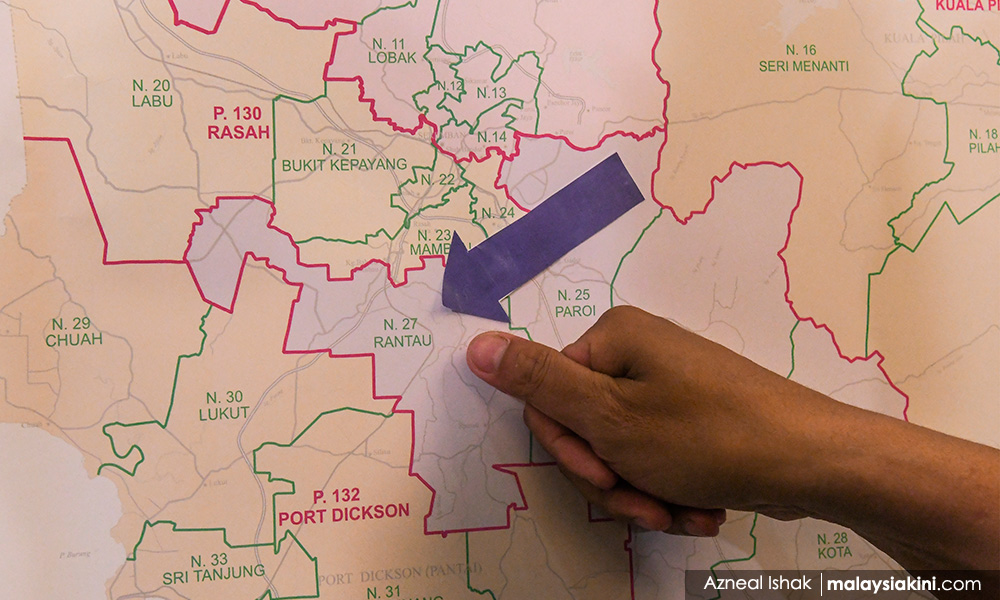
At the federal level, the EC can move or swap a state seat from one federal constituency to another, thereby altering a parliamentary seat’s composition, voter population, and even political leaning.
The same thing can be done at the state level by moving polling stations from one state constituency to another.
Another form of alteration that the EC can carry out, though less common, is to break up a polling station into two and place them in separate state constituencies.
Alternatively, the EC can merge polling stations from separate constituencies into one.
Apart from the transfer, the EC can also change a constituency or polling station’s name.
/file/publisher-c1a3f893382d2b2f8a9aa22a654d9c97/2022/11/a6c8ba97978af7c3d9af33b7d2986781.jpg)
/file/publisher-c1a3f893382d2b2f8a9aa22a654d9c97/2021/11/065d00360b13c59c8d6921d2ebc456f0.jpg)


Are you sure you want to delete this comment?
This action cannot be undone.