
Sabah exposé shows political financing law needed - C4 Center
“We reaffirm our previous calls for the government to introduce a political funding bill that guarantees transparency through mandatory reporting requirements as to the amount of donations received by political parties...
Summary
C4 Center urges Malaysia to enact a political financing law to ensure transparency and limit corruption risks.
Sabah Chief Minister Hajiji Noor defends political donations but faces backlash for inconsistent statements and secrecy.
Unregulated political donations and patronage are said to remain key corruption risks in Malaysia.
The alleged corruption scandal which erupted in Sabah showed Malaysia needs to enact a political financing law, said the Center to Combat Corruption and Cronyism (C4 Center).
“We reaffirm our previous calls for the government to introduce a political funding bill that guarantees transparency through mandatory reporting requirements as to the amount of donations received by political parties.
“The bill must also place a hard limit on the amount political parties receive from private individuals, while completely doing away with corporate donations as they represent a significant risk area for the proliferation of money politics,” the group said in a statement today.
In a recent post on TikTok, Sabah Chief Minister Hajiji Noor addressed the alleged corruption, saying the videos leaked by a whistleblower could be referring to political donations, not bribes.
The Gabungan Rakyat Sabah (GRS) chairperson stressed that his assemblypersons have never solicited bribes.
“But it would be a lie to say that political parties and politicians do not accept political funding from donors.
“I conveyed this to the prime minister last week. Everyone understands that political funding is not wrong in this country or other countries.
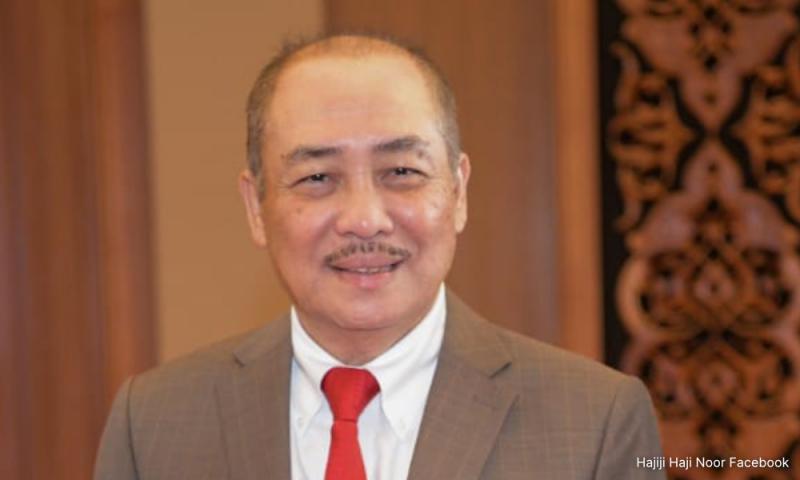
“How can a political party function without financial contributions from those who can afford it? If we were to rely solely on the salaries of elected representatives, there wouldn’t even be enough to eat,” Hajiji (above) was reported as saying.
Risk of corruption
Unimpressed, C4 Center said Hajiji’s comments only exposed a fundamental problem in the nation’s political system.
For starters, the group chastised the chief minister that the existing ways of receiving political donations are acceptable locally and internationally.

“This argument is flawed. The means of political funding is an ongoing debate internationally (among) international organisations such as the United Nations, Transparency International, and the Organisation for Economic Co-operation and Development.
“All have published many documents relating to corruption risks involving political donations and financing and the need to introduce preventative measures against corruption from taking place,” the group said.
Even locally, C4 Center noted that past and current governments have made commitments to introduce a law to regulate political funding, as per the National Anti-Corruption Plan (NACP) 2018-2023 and the National Anti-Corruption Strategy 2024-2028.
These commitments, C4 Center added, explicitly recognise there is an inherent corruption risk in how political parties obtain financing.
“The NACP 2018-2023 even went so far as to state that the proposed political funding legislation would include an offence pertaining to lobbying under Strategic Objective 1.2.5.
“This is an unambiguous acknowledgement that government lobbying above a certain degree is a harmful act that must be penalised,” the group stressed.
Strategic Objective 1.2.5 mentions the need to enact legislation to govern political funding and outlaw lobbying. The report mentioned the law should have been enacted by December 2020.
‘Why only admit now?’
Taking Hajiji to task, C4 Center pointed out that it was contradictory of the chief minister to say it was alright to accept political donations but at the same time saying the allegations against his administration were slanderous.
“If such allegations were not necessarily ‘wrong’ in the eyes of the society, what impact could there be on his and his administration’s reputation?
“If they were mere donations, why were they performed so covertly, and why was this admission only made when videos from a whistleblower were released to the public?” the group asked.
C4 Center said it was common knowledge that patronage is a key feature of the Malaysian political system, with politicians seeking financial support from the business elites to head to the polls.
In return, these business elites are usually rewarded indirectly with political favours and lucrative business opportunities.
“And despite the clear corruption risks arising from this relationship, the practice of political donations and the various ways in which political parties raise funds remains unregulated.”
/file/publisher-c1a3f893382d2b2f8a9aa22a654d9c97/2024/12/020515712031aa06e4ede5271a872e6e.jpg)

/file/publisher-c1a3f893382d2b2f8a9aa22a654d9c97/2020/09/0542bc51d95b7d4f9e4137c17f419a48.jpg)
/file/publisher-c1a3f893382d2b2f8a9aa22a654d9c97/2024/03/1022635271c4e9ae76716414dd3a456d.jpg)
/file/publisher-c1a3f893382d2b2f8a9aa22a654d9c97/2023/10/fb175fa214a3c6889ea683e9bd918a2f.jpg)
/file/publisher-c1a3f893382d2b2f8a9aa22a654d9c97/2020/09/5907992fcd683a62318c19812247def9.jpg)
/file/publisher-c1a3f893382d2b2f8a9aa22a654d9c97/2024/12/5d288d5306f12955d679020df8e3060c.jpg)
Are you sure you want to delete this comment?
This action cannot be undone.