
In lawsuit, Orang Asli leader testifies of historical relic tying them to land
Historical stone relics, including a knife, an axe, and a sharpening tool, are evidence in the Temiar community’s lawsuit at the Kota Bharu High Court, as they fight for legal recognition of their ancestral land in Kampung Kelaik, Gua Musang, Kelantan.
The community filed a lawsuit in March 2021 seeking rightful ownership against 14 defendants, including the Kelantan state government.
Summary
Historical relics from the Temiar’s native land in Kampung Kelaik, Gua Musang, are part of the evidence in a lawsuit naming 14 defendants, including the Kelantan state government.
The lawsuit filed in March 2021 seeks rightful ownership of the land against parties which they alleged had encroached into it for logging, plantations, and mining.
The community has discovered high levels of heavy metals in their blood following a Malaysiakini investigation into pollution in the river downstream from iron mining operations.
Historical stone relics, including a knife, an axe, and a sharpening tool, are evidence in the Temiar community’s lawsuit at the Kota Bharu High Court, as they fight for legal recognition of their ancestral land in Kampung Kelaik, Gua Musang, Kelantan.
The community filed a lawsuit in March 2021 seeking rightful ownership against 14 defendants, including the Kelantan state government.
Since then, they have discovered high levels of heavy metals in their blood, following a Malaysiakini investigation into the rivers at Kampung Kelaik, downstream from iron ore mining, which had turned a rusty red.
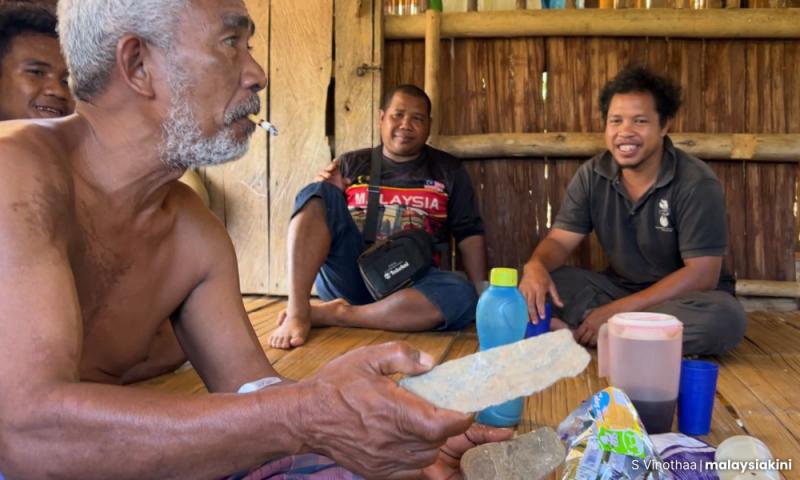
When asked to explain the photographs of the relics, Kampung Kelaik action committee leader, Ahak Uda, 58, who was the first to testify, said: “Yes, these are the ‘batu asah’, ‘batu jex’, and ‘batu pisau’ used by our ancestors.”
Photos of relics are often used as evidence instead of the actual items, primarily to preserve their condition and prevent damage or loss.
Ahak was referring to stone relics shown to Malaysiakini during a site visit last October.

“We believe our ancestors brought these tools into the cave (located within their ancestral land), and each served a different purpose.
“The batu asah (sharpening tool) was used to sharpen the batu pisau (stone knife), the batu jex functioned as an axe, and the batu pisau was used for cutting,” he told the court today.
Another tool introduced to the court was the batu rai, which Ahak described as an “elephant whisperer.”
“We believe it comes from a fallen elephant tooth or the remains of a deceased elephant.
“For the Orang Asli community in Kelaik, the batu rai symbolises protection against human-elephant conflicts.
“With its presence, elephants have never destroyed our crops, allowing us to coexist peacefully with these animals,” Ahak told the court.

Yesterday, the court heard that logging, mining, and plantation development on the community’s ancestral land had severely disrupted their way of life.
The plaintiffs, represented by counsels Sachpreetraj Singh Sohanpal, Rajesh Nagarajan, and Ambbi Balakrishnan, have seven witnesses scheduled to testify over four days.
Rajesh stated that the court has yet to set dates for the defence’s cross-examination.
High tension inside, outside court
The 14 defendants named in this lawsuit are Syarikat Perlombongan Gua Musang Sdn Bhd, Redstar Capital Sdn Bhd, Aqua Orion Sdn Bhd, Damai Corporate Services Sdn Bhd, Sindiyan Sdn Bhd, and Sindiyan Agro Park Sdn Bhd.
Others include Ladang Kelantan Sdn Bhd, Ikrar Bumi Sdn Bhd, Ladang Ulu Nenggiri Sdn Bhd, and Iliasco Engineering & Construction Sdn Bhd.
Meanwhile, the government agencies named in the lawsuit are the Kelantan Land and Mines Office, the Kelantan Forestry Department, the Department of Orang Asli Development (Jakoa), and the Kelantan state government.
Tension filled the air inside and outside the Kota Bharu High Court since the case commenced yesterday.
Outside, at least 100 Orang Asli from Kampung Kelaik and neighbouring villages, donning traditional headgear, wait anxiously for updates from the proceedings.

Inside, the packed courtroom was dominated by at least 20 lawyers representing the defendants, as judge Hasbullah Adam presided over the civil lawsuit.
Orang Asli activist Eliana Tan, who travelled to Kota Bharu to document the proceedings, said the villagers arrived in two buses.
“The villagers, especially those from neighbouring villages, said the case was important because if they won, it would set a precedent for future cases,” said Eliana, who is also part of an all-women Orang Asli filmmaker group - Apa Kata Wanita Orang Asli.
Going all out
Ahak, who was the first to testify, said: “I brought this case to court to determine once and for all whether the people of Kampung Kelaik have the right to their land”.
The community has been waiting for this day since filing the lawsuit in 2021, and attempts to block encroachment in the meantime were repeatedly dismissed right up to the highest court in 2022.

Meanwhile, in response to a question in relation to the Kampung Kelaik ancestral land in the Parliament Special Chambers, Deputy Rural and Regional Development Minister Rubiah Wang said Jakoa oversees over 8,000ha of gazetted land to protect the welfare of indigenous residents, but approvals did not go through the department unless complaints were received.
She explained that the land was designated as “tanah adat” (customary land) and gazetted as indigenous reserve land under the laws that govern the state authority, specifically Section 62 of the National Land Code (Act 828), where the state secretary serves as the supervising officer.
Ahak, however, told Malaysiakini that many had told the Temiar villagers that they had no such rights.
“That’s why I did everything I could to fight for recognition,” he said.
“If the judge rules in our favor, it will finally confirm that this land is rightfully ours,” said Ahak, whose son, Azlan Ahak, was found to have chromium levels in his blood that put him at a lifetime risk of cancer estimated to be 64,000 times higher than normal.
Azlan, 20, was the youngest of six villagers who volunteered for a blood test by an independent lab commissioned by Malaysiakini last year.
READ MORE | Red rivers and death: Natives fight iron ore mining in Kelantan rainforest
Following the Malaysiakini report, one mine was found to be operating illegally, and both mining operations had been halted by the Natural Resources and Environmental Sustainability Ministry.
The ministry started an internal investigation into how an iron ore mine operated for nine years without an environmental impact assessment.
Biological samples from villagers have also been collected by the Health Ministry.
/file/publisher-c1a3f893382d2b2f8a9aa22a654d9c97/2025/03/c5b15825ae2913a6d3735a0de9d6eebb.jpg)

/file/publisher-c1a3f893382d2b2f8a9aa22a654d9c97/2025/03/e8a7b3044c843fee0a997e1dc6d22b03.jpg)
/file/publisher-c1a3f893382d2b2f8a9aa22a654d9c97/2024/12/1557787ecceeb9db15de384da4bacb5f.jpg)
/file/publisher-c1a3f893382d2b2f8a9aa22a654d9c97/2024/12/e76631b61c0ff5dc39e7e74fe9de35ed.jpg)
/file/publisher-c1a3f893382d2b2f8a9aa22a654d9c97/2025/02/4c1fb470639b8aca6c43537e0d507751.jpg)
/file/publisher-c1a3f893382d2b2f8a9aa22a654d9c97/2025/02/f55276cee0c16877ce3e1a64e1ce178d.jpg)
/file/publisher-c1a3f893382d2b2f8a9aa22a654d9c97/2023/11/02dd2ecb10da7de4b638616638581743.jpg)
Are you sure you want to delete this comment?
This action cannot be undone.