


/file/attachments/orphans/PrimeMinistersOfficeofMalaysia334_879470.png)

PAS draws parallels between Netanyahu and junta leader, questions red-carpet reception
PAS has questioned the apparent contradiction between Malaysia’s calls for international accountability for Israeli leaders and its decision to roll out the red carpet for Myanmar junta chief Min Aung Hlaing, without clear assurances on accountability, victim protection or justice.
PAS information chief Ahmad Fadhli Shaari drew parallels between international efforts to hold leaders accountable over alleged crimes in Myanmar and Gaza...
PAS has questioned the apparent contradiction between Malaysia’s calls for international accountability for Israeli leaders and its decision to roll out the red carpet for Myanmar junta chief Min Aung Hlaing, without clear assurances on accountability, victim protection or justice.
PAS information chief Ahmad Fadhli Shaari drew parallels between international efforts to hold leaders accountable over alleged crimes in Myanmar and Gaza.
He noted that the International Criminal Court’s (ICC) prosecutor sought an arrest warrant for Min Aung Hlaing in November 2024, while the court issued warrants against Israeli Prime Minister Benjamin Netanyahu and his former defence minister Yoav Gallant that same month over alleged war crimes and crimes against humanity in Gaza.
“The principles of justice must not change according to a leader’s identity or diplomatic interests. Malaysia must consistently uphold international law, whether in relation to Palestine, Myanmar or any other country,” he added in a statement.
Fadhli cautioned Putrajaya against sacrificing principles, national dignity and human rights for short-term political gain, saying Min Aung Hlaing’s visit would be remembered as a discordant diplomatic move while Myanmar remains mired in armed conflict, political repression and a prolonged humanitarian crisis, with civilians facing grave abuses.
“An official reception, complete with a red carpet befitting a distinguished statesman, risks normalising the junta leadership, which continues to be associated with allegations of human rights violations,” he added.
Not at expense of national principles
Fadhli said PAS understood public concerns over undocumented foreigners, gaps in refugee management, security threats and labour exploitation, stressing that the safety and interests of Malaysians must remain the government’s top priority.
However, he said diplomacy to address issues involving Myanmar nationals and refugees must not come at the expense of national principles, international justice or human security.
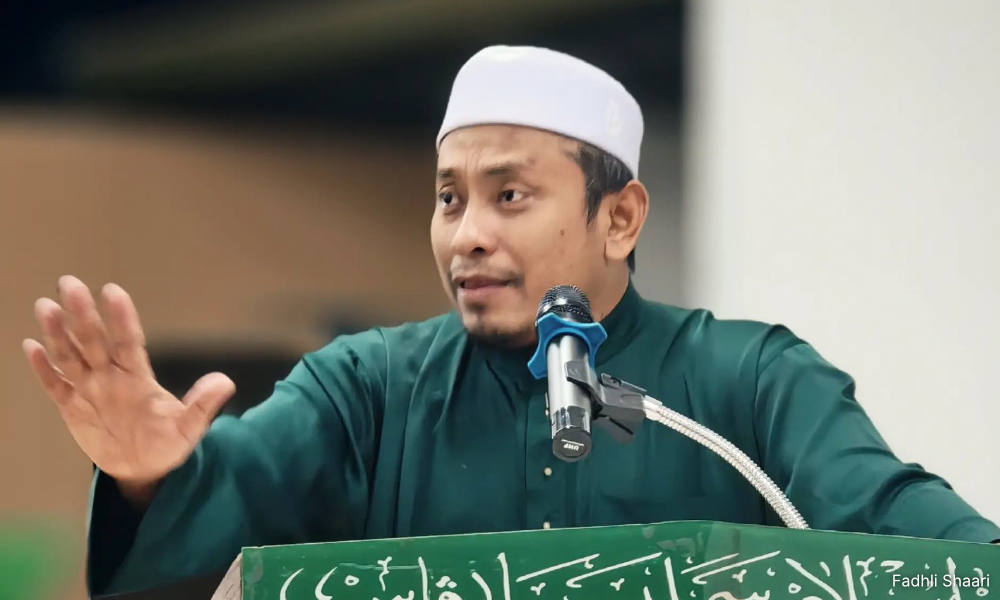
He added that the government’s decision to engage Min Aung Hlaing also raised questions about Malaysia’s commitment to the Asean Five-Point Consensus, particularly its calls for an end to violence, inclusive dialogue and a political solution to the Myanmar crisis.
Fadhli (above) stressed that the repatriation of Myanmar refugees and undocumented migrants must comply with international law and take into account the risks to their safety and humanitarian rights.
“PAS does not defend unauthorised entry or weak enforcement. The government must secure the country’s borders, combat human trafficking syndicates and enforce immigration laws.
“However, action against undocumented migrants must be distinguished from the management of refugees and asylum seekers who may face persecution if returned without a clear and orderly process,” he added.
Fadhli urged the government to explain the screening process, risk assessments and post-arrival safety guarantees for Myanmar nationals and refugees who had already been repatriated, as well as those who might be sent back in future.
“Has each individual been properly assessed, including those who may require international protection?” he asked.
/file/attachments/orphans/gsadfad_102573.png "Photos of deportation session Myanmar refugees via Home Ministry September 29th 2026 290926")
PAS also called on the government to clarify the objectives and outcomes of Min Aung Hlaing’s visit, as well as Malaysia’s position on the alleged international crimes associated with him.
“Disclose the screening mechanisms and safety guarantees for Myanmar nationals being repatriated, and ensure that no returns violate protection obligations.
“Strengthen the management of refugees and undocumented migrants through clear policies, firm enforcement against violations of the law, and regional cooperation guided by the Asean Five-Point Consensus,” he added.
Diplomacy is not endorsement
Responding to criticism of Min Aung Hlaing’s two-day official visit, which ended yesterday, Anwar Ibrahim’s political secretary Kamil Abdul Munim said negotiations and dialogue were part of diplomacy and should not be construed as recognition or endorsement.
“Opening the door to discussion does not mean turning a blind eye to atrocities,” he said, citing Malaysia’s first prime minister, Tunku Abdul Rahman, who sat at the same table as Communist Party of Malaya leader Chin Peng during the 1955 Baling talks.
“Did that mean Tunku recognised the armed struggle of the Communist Party of Malaya? Certainly not. He negotiated because, as a leader, he had a greater responsibility to find a way to end violence and save lives,” he added.
/file/publisher-c1a3f893382d2b2f8a9aa22a654d9c97/2025/05/a52efce415d18808f21aac853973fe69.jpg "Interview with Ketua Angkatan Muda Keadilan (AMK) Kamil Abdul Munim 290525")
Kamil (above) also cited then prime minister Abdul Razak Hussein’s 1974 visit to Beijing, where he met Mao Zedong and Zhou Enlai and established diplomatic relations with China despite anti-communist sentiment at the time.
He was responding to former DAP lawmaker Charles Santiago, who recalled Anwar telling the United Nations three years ago that he was horrified by the Myanmar junta’s violence against its own people.
READ MORE: COMMENT | Junta chief's visit: You cannot negotiate refugees out of existence
Anwar has defended engagement with Myanmar as necessary to resolve the longstanding refugee issue, arguing that Malaysia cannot host those displaced by the crisis indefinitely.
In a podcast aired on Sept 16, he said Malaysia, in line with Asean, was not ready to recognise Myanmar’s new government but needed an authority with which to negotiate the return of refugees.
/file/attachments/orphans/adqweadsadasd_587584.png)
/file/attachments/orphans/36345345_213357.png)
/file/attachments/orphans/homeministry1asdesd_153225.png)
/file/publisher-c1a3f893382d2b2f8a9aa22a654d9c97/2026/07/47d840e9a7348bd1a114851f2922127b.jpg)


A debate between this parties and Pmx’ aide to represent PKR ? Rakyat will be the judge ? What say you ?
I find political secretary to Prime Minister Anwar Ibrahim, Kamil Abdul Munim’s comparison between Tunku Abdul Rahman’s meeting with Chin Peng at the 1955 Baling Talks and Malaysia’s recent red-carpet welcome for Myanmar’s military ruler, Min Aung Hlaing, to be seriously misplaced. It raises legitimate questions about his appreciation of the historical and political distinctions involved. The Baling Talks were convened in December 1955 with a specific and urgent objective: to end the Communist insurgency, restore peace and facilitate the path towards Malaya’s independence. Tunku met Chin Peng, the leader of the Communist Party of Malaya, as an adversary in a formal peace negotiation. He was seeking to persuade the communists to abandon armed struggle and accept the realities of a Malaya moving towards self-government. The negotiations ultimately failed because the two sides could not agree on the terms for ending the insurgency. This was a meeting to resolve an armed conflict, not a ceremonial endorsement of the party waging it. The current controversy is of a different nature. Min Aung Hlaing came to power through the military coup of February 2021, which plunged Myanmar into a devastating political and humanitarian crisis. His recent visit to Malaysia, accompanied by a red-carpet reception, raises legitimate questions about the diplomatic legitimacy and political symbolism being conferred upon a military leadership whose record remains deeply contentious. Of course, diplomacy requires engagement with difficult and even objectionable leaders. Refusing all contact with those in power is not necessarily a sensible foreign policy. But the question is not simply whether Malaysia should talk to such leaders. It is the purpose of the engagement, the circumstances in which it takes place, the symbolism surrounding it, and the tangible outcomes it delivers. Kamil’s invocation of Tunku Abdul Rahman therefore does not, by itself, justify the manner in which Min Aung Hlaing was received. Nor does the fact that leaders have historically met adversaries mean that every such encounter is equivalent. A peace negotiation aimed at ending an insurgency is not automatically comparable to a high-profile diplomatic reception that may help rehabilitate the international standing of a military ruler. The same distinction applies to Tun Abdul Razak Hussein’s historic visit to Beijing in 1974. That visit, during which he met China’s leadership, paved the way for the establishment of diplomatic relations between Malaysia and the People’s Republic of China. It was a strategic foreign-policy decision to normalise relations with a major country. It was not an endorsement of every aspect of communist ideology or Chinese domestic policy. More importantly, it addressed a fundamental question of interstate relations, rather than simply conferring ceremonial recognition on a controversial individual.
Completely ridiculous to compare one leader trying to survive murderous neighbors trying to constantly overwhelm and murder its citizens. The other is trying to get rid of what they believe inhabitants from another country infringing on their territory. Why doesn’t he invite them into his state as it’s widely known the men there are working in other productive states ?
Report this comment
Are you sure you want to delete this comment?
This action cannot be undone.