


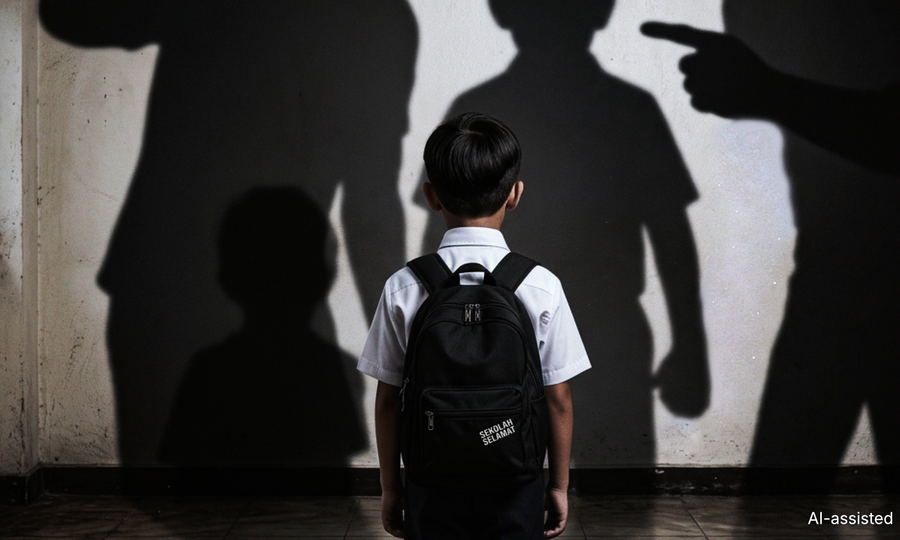

LETTER | Mental health, school safety are everyone's responsibility
LETTER | As a father of two young children, I am deeply concerned by the recent spate of violence in our schools.
Like many parents, I expect schools to be a place where children can learn safely and teachers can carry out their work without fear.
The latest attack on a teacher and students at an international school in Kuching follows a series of troubling incidents in our schools.
These include the death of a girl found unconscious near her hostel in Sabah, the fatal stabbing of a schoolgirl in Bandar Utama last year, as well as the recent deaths of a schoolboy in Kuala Pilah and a schoolgirl in Yong Peng.
There were also other reported incidents of serious physical assault involving students.
The circumstances differ, but together, they should prompt us to examine whether our arrangements for prevention, protection and support are sufficient.
These cases also remind us that emotional distress affects not only children from disadvantaged families. Even those from the upper echelons of society are not spared.
Pressures facing urban families
In Bukit Bintang, where I am active in community work, I see firsthand the pressures urban families face. Living costs and long working hours can leave parents stretched, with consequences for family life.
The pressures differ across households, but support should be available regardless of income.
A starting point is a better understanding of mental health. Parents, teachers and society at large need to understand what mental health really means, rather than dismissing signs of distress as mere behavioural problems.

Public education must also address the stigma that discourages families from seeking help. This can make it easier for families to seek support early, before a child’s mental health concerns worsen.
The Bandar Utama case shows why early intervention matters. The High Court found that the perpetrator had developed a very early onset of schizophrenia that had gone untreated for about five years, despite counselling and concerns raised by his school.
Could the loss of an innocent life be prevented had the problem been addressed early? Possibly.
At the same time, we must be careful not to equate mental illness with violence, as the overwhelming majority of people living with mental health conditions are not violent.
Better coordination needed
In this respect, we need stronger links between schools, families and health services. Parents cannot leave everything to teachers, while schools need families to remain involved.
Teachers should receive practical training and clear referral guidance, backed by qualified professionals. When a referral is made, responsibility for follow-up must be clear so that a child does not fall between services.
Support must extend beyond school gates. Young people and families should be able to access timely, affordable help in their communities, including professional care and peer or family support groups.
These groups can provide a space to share experiences, reduce isolation and help people find further support when they need it.
The government must also ensure that these services have sufficient funding and capacity. The Education and Health Ministries should coordinate referrals and track whether children receive assessment and follow-up care.

Clear responsibility at each stage would help families navigate the system and reduce the risk of children missing out on treatment.
Mental wellbeing is a collective responsibility involving government, schools, teachers, parents and the wider community. Each must have a clear role, with the resources and coordination needed to fulfil it.
As a father and someone involved in community work, I share the concern of parents across the country: every child should be safe in school, and every teacher should be able to work without fear.
And we all have a role in making that expectation a reality.
Suicide is a complex phenomenon with multiple contributing factors, but it is preventable, and recovery is possible. If you or someone you know is struggling, you are not alone - please reach out for support:
Talian Kasih Hotline: 15999 (Call) / +6019 26 15999 (WhatsApp)
Health Ministry’s Talian Heal: 15555 (8am - 12am daily)
The Befrienders Hotline: 03-76272929
Agape Counselling Centre Malaysia Hotline: 03-77855955 or 03-77810800
Writer is the chairperson of the Bukit Bintang parliamentary zone residents’ representative council.
The views expressed here are those of the author/contributor and do not necessarily represent the views of Malaysiakini.



Report this comment
Are you sure you want to delete this comment?
This action cannot be undone.