




Nearly half of M'sians think graft perception is better
The latest survey commissioned by the Performance Management and Delivery Unit (Pemandu) on the perception of corruption among Malaysians has found that 45 percent said their overall perception of graft in Malaysia has improved.
The latest survey commissioned by the Performance Management and Delivery Unit (Pemandu) on the perception of corruption among Malaysians has found that 45 percent said their overall perception of graft in Malaysia has improved.
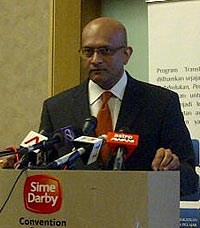 The proxy survey to the Transparency International Global Corruption Barometer conducted on 2,000 Malaysians by research company TNS from March to May 2011 showed a slight drop from 51 percent the previous quarter.
However, national key results area director in charge of reducing corruption D Ravindran (right) said that this is an achievement as it was a marked improvement from 2009 when only about a third of Malaysians believed there were any improvements.
“This shows that Malaysian are starting to believe that it is a good place to do business,” he told reporters after a media briefing on the Government Transformation Programme in Petaling Jaya today.
Ravindran said that among the initiatives which could have contributed to the improvement was the adoption of the Integrity Pact based on the Transparency International model.
He said that this was also adopted by MRT project owner Prasarana Negara Berhad and other companies involved in the estimated multibillion ringgit project.
He added that the Auditor-General’s office and the Malaysian Anti-Corruption Commission are acting as independent monitors of the project to ensure that everything is above board, as part of the integrity pact.
“This is the first the Auditor-General is coming in early into the project... we hope to have this for two or three other projects that have been identified, but we cannot divulge details yet,” he said.
Separately, NKRA director for urban public transportation Ahmad Suhaili Idrus revealed that pre-feasibility studies for the Kuala Lumpur-Singapore high speed rail will be ready on Aug 19.
“The pre-feasibility study will allow the government to make decisions about the exact corridor and stations. More refinement is needed and we hope the feasibility study can start by the end of the year,” he said.
The train, which is part of the Greater Kuala Lumpur/Klang Valley Project, is expected to slash door-to-door journey time between the two cities to 2.4 hours compared to 3 hours by air.


Are you sure you want to delete this comment?
This action cannot be undone.