


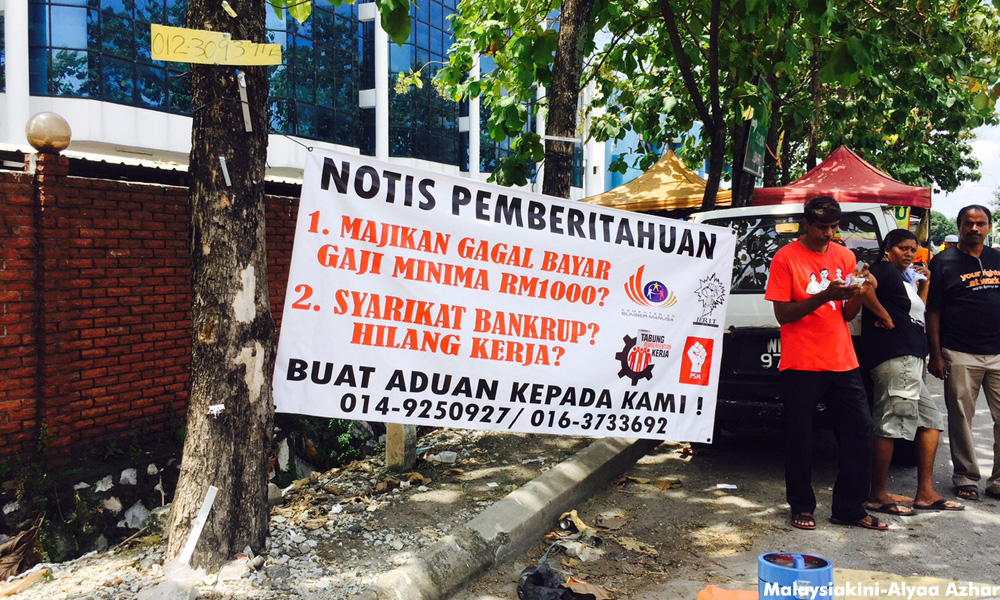

Push for retrenchment fund amid delayed Employment Insurance Scheme
With last year's retrenchment in the country reaching its highest in a five-year period, Socialist party PSM is pushing for the creation of a retrenchment fund to aid workers who are laid off by their employers.
As the government drags its feet in implementing an Employment Insurance Scheme, retrenched workers often find themselves in a bind – left jobless, they must cope with bills that still need paying, as they hunt for a new job.
Many retrenched staff are not given a single sen in compensation if their employers had gone bankrupt or do not provide retrenchment benefits.
With last year's retrenchment in the country reaching its highest in a five-year period, Socialist party PSM is pushing for the creation of a retrenchment fund to aid workers laid off by their employers.
As the government drags its feet in implementing an Employment Insurance Scheme, retrenched workers often find themselves in a bind – left jobless, they must cope with bills that still need paying, as they hunt for a new job.
Many retrenched staff are not given a single sen in compensation if their employers had gone bankrupt or do not provide retrenchment benefits.
Without any form of retrenchment benefit or aid, most face a bleak future.
And even if they want to pursue legal action against such unscrupulous employers, it would take time, money, and resources – none of which they may have, as they struggle to go on with life.
And money issues aside, the problem of retrenchment looks to be on the rise of late as the global economy contracts and Malaysia, as an oil exporter, takes a hit from diving crude oil prices.
Last year alone saw the highest number of workers retrenched in the last five years, with 38,499 workers let go.
Although the number is lower than in 2007, 2008 and 2009, the occurrence is a worrying trend – one which labour groups fear will be just as bad this year.
Allowance for retrenched workers
Aware of the plight of retrenched workers, the Human Resources Ministry had proposed an Employment Insurance Scheme to provide allowance for retrenched workers for up to six months, which unfortunately has yet to take off.
It is because of this that PSM decided to come out with a campaign, demanding that a retrenchment fund be set up, while the wait goes on for the Employment Insurance Scheme.
Speaking to Malaysiakini, PSM workers bureau coordinator M Sivaranjani said the government had spoken with regard to the scheme, but disappointingly it has been nothing but that – talks – for the past three years.
“Last year in March they said they will table it, but in the end nothing happened. This year they also announced that they will table it.
“We basically want to give more pressure to make the minister more serious on this matter,” she said.
 Human Resources Minister Richard Riot (photo) said that the Employment Insurance Scheme needs input, feedback and action from more than just the ministry, which requires more time before it is finalised.
“My officers have gone to many countries to study the system that they have in the other countries,” he told Malaysiakini.
“We have already prepared the cabinet paper and we are only waiting for it to be tabled at the cabinet level.”
Those who have been retrenched, he said, should be given an allowance whilst looking for jobs.
“People suddenly finding they are out of job, when that happens, especially those who have families - how are they going to continue living?”
The scheme, he added, requires both workers and employers to contribute, just like the Social Security Organisation (Socso).
Riot was previously reported as saying that the scheme had also been agreed by employers, albeit in principal.
Managed by Socso
PSM, too, wants its proposed retrenchment fund to function like the Socso and be managed by Socso.
The party, however, said the government must first allocate money for the retrenchment fund and only then should contribution be made by both employees and employers.
“Our suggestion is that employees contribute 50 sen while employers provide RM1 per month. This amount is not burdensome,” said Sivaranjani.
“(The fund only acts) as a safety net. It’s not like companies go bankrupt every other day.”
 Like the Human Resources Ministry, PSM is also of the opinion that workers should be given an allowance for up to six months after retrenchment.
Bank Negara, Sivaranjani added, must also instruct banks to allow retrenched workers to postpone paying for their cars and houses.
“Banks are always so quick to take action. But for retrenched workers, where are they going to get the money to make payment?” she asked.
While the Human Resources Ministry has yet to confirm whether the scheme would be for Malaysian employees only or otherwise, Sivaranjani stressed that all workers needed to be taken care of.
PSM started planning the campaign in September last year, in which the first roundtable discussion was held with several quarters like the Malaysian Trades Union Congress (MTUC).
After details were finalised, top PSM leaders went to all party branches to explain the matter to members who were tasked with carrying out the campaign.
Retrenched workers at forefront
The party subsequently launched a hotline for retrenched workers to obtain advice given by PSM members on a pro bono basis.
Sivaranjani is of the belief that individuals who have faced retrenchment should be at the forefront to support the campaign.
“Those who have never experienced being retrenched would not know. This is the main reason why we launched the hotline,” she said.
The hotline, launched last month, saw many queries and PSM had received 550 calls in the first month alone.
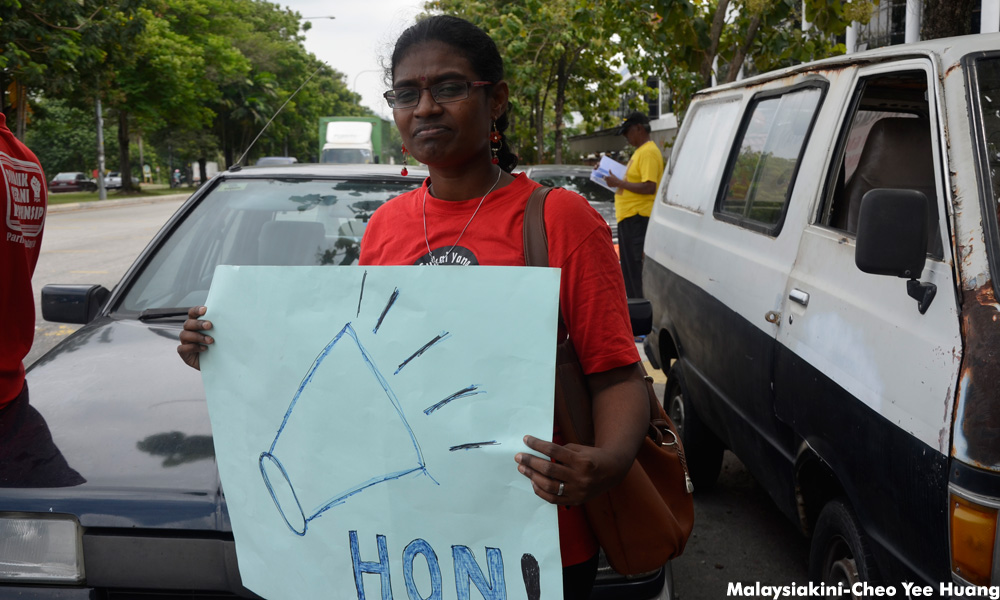 The party is currently occupied with its roadshow on the campaign, going from one industrial area after another to reach out to workers about the retrenchment fund.
This month, the party’s campaign focuses on areas in Selangor and PSM plans to head on to Penang next month.
“We expect the roadshows to be concluded in October,” said Sivaranjani.
PSM then hopes to present the responses it receives from the workers as well as their signatures to the government.
But Sivaranjani admitted it would be a challenge to convince both the government as well as the Malaysian Employers Federation (MEF) on the feasibility of the party’s proposal.
Although the party might encounter several challenges, Sivaranjani said the campaign also has an advantage – no one would refuse it.
“Asking workers for 50 sen a month is a convincing demand. Workers would think ‘why not’, especially since it will benefit them,” she said.
Fund can solve problem
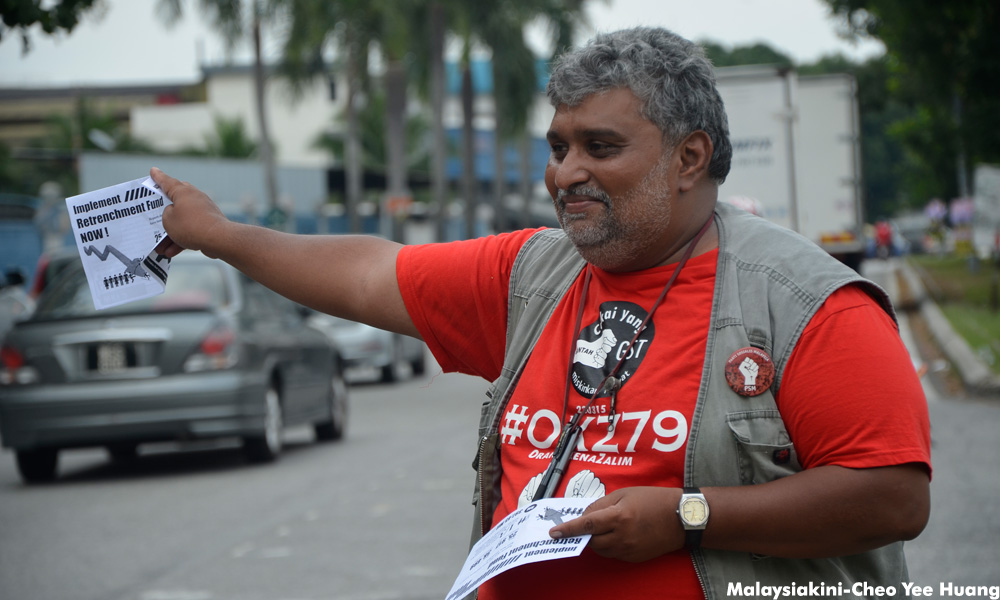 PSM central committee member S Arutchelvan (photo), in stressing the importance of a retrenchment fund, cited the party’s experience in assisting retrenched workers.
“Many workers have won cases in the labour court but they don't get any money as there is no such fund to distribute them the money.
“Using money from the fund can solve the problem of companies going bankrupt,” he said.
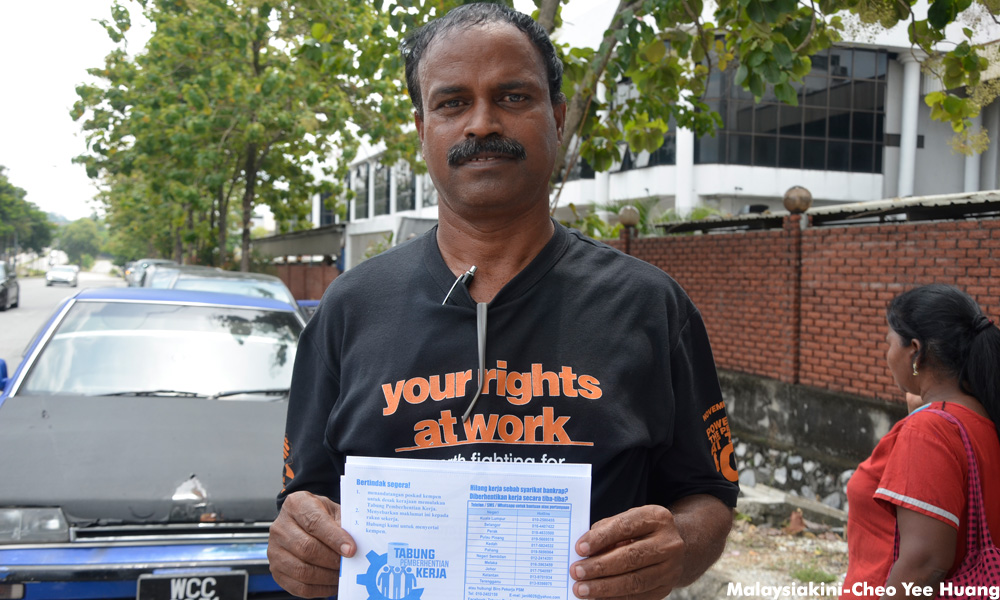 PSM member A Letchumanan (photo), 49, is an example of such a case.
Having worked for CHG Plywood for 15 years, Letchumanan said he, as well as other workers of CHG Plywood, started seeing their salaries delayed in the year 2000.
The workers gradually received their salaries, but although they won a case they filed at the labour court, none of the workers received compensation.
“We won RM500,000 but we didn't get a single sen because the employer filed for bankruptcy at the High Court.
A retrenchment fund, he said, would have been helpful as meetings with the Human Resources Ministry were fruitless since the ministry had their hands tied.
“The ministry cannot come up with the money to compensate us. That's why a fund like the retrenchment fund would have been useful,” he said.
Recounting his experience, Letchumanan said he was jobless for three months and had to dip into his savings from the Employees Provident Fund (EPF) to pay the monthly payment for his house.
PSM hopes that the fund will be a stopgap measure to assist retrenched workers until the Employment Insurance Scheme kicks in, so that no more workers will have to share Letchumanan's fate.


Are you sure you want to delete this comment?
This action cannot be undone.