




Veteran physician pans health minister's explanation as 'pathetic'
Experienced physician Dr Milton Lum has reacted strongly to the claim by Health Minister Dzulkefly Ahmad (photo, above) that allegations of birth control injections being forced on the Orang Asli community need more proof before an investigation is warranted.
"The allegations are very serious and merit an investigation. The question is whether there was consent to the contraception administered, irrespective of whether it was oral or injection," Lum told Malaysiakini in an interview conducted through email...
Experienced physician Dr Milton Lum has reacted strongly to the claim by Health Minister Dzulkefly Ahmad (photo, above) that allegations of birth control injections being forced on the Orang Asli community need more proof before an investigation is warranted.
"The allegations are very serious and merit an investigation. The question is whether there was consent to the contraception administered, irrespective of whether it was oral or injection," Lum told Malaysiakini in an interview conducted through email.
"Was sufficient information provided for an informed decision to be made? Were the risks of contraception explained so that the Orang Asli understood the risks and benefits of contraception?"
"If not, then there was no valid consent."
Lum is a member of the Malaysian Medical Council and previously served as the president of the Malaysian Medical Association.
Other posts he formerly held include that of president of the Federation of Private Medical Practitioners Associations of Malaysia, president of the Obstetrical and Gynaecological Society of Malaysia and executive board member of the International Federation of Gynaecology and Obstetrics.
Lum said he has been watching the case unfold and following the reports with concern.
On Tuesday, representatives from five Orang Asli villages submitted a memorandum to the government at Parliament on, among others, complaints about the supply of birth control pills to the community without sufficient details.
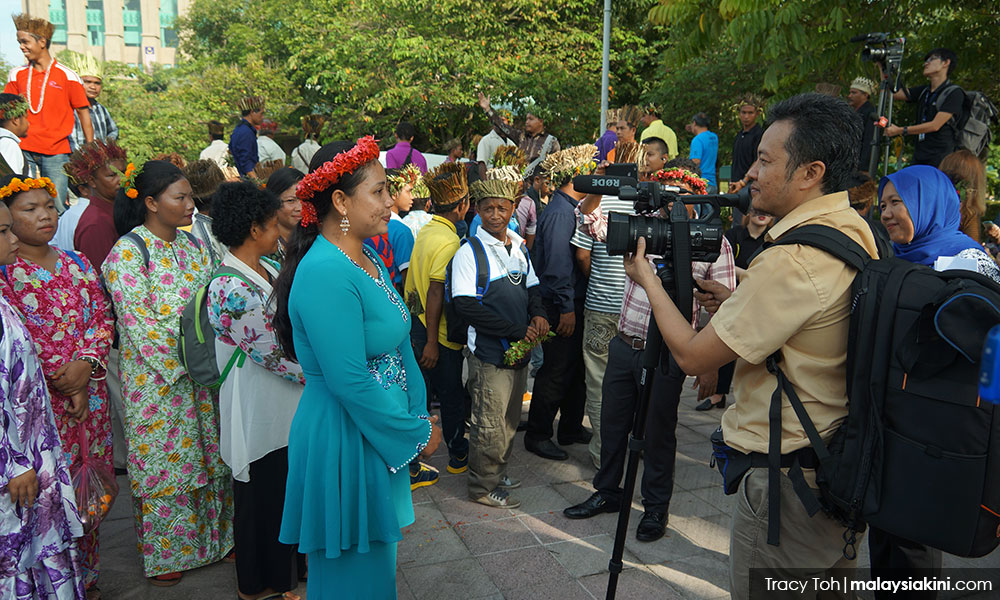
This was followed by explosive revelations on Wednesday from Nora Kantin (dressed in blue in photo above), a Temiar villager from Kampung Lambok, RPS Kuala Betis in Gua Musang, Kelantan.
Nora told Malaysiakini that women in her village were threatened by nurses and told that they must take birth control medication, either in the form of pills or injections, failing which their medical cards would be confiscated, which would impact on their access to medication and future appointments.
"Newlyweds among the community are especially targeted and forced to take the injections after having just one child," she said
However, Health Minister Dzulkefly yesterday brushed off calls from fellow minister P Waythamoorthy for a probe into the matter and said that no investigation would be launched without any proof.
He also said that the birth control medications that were administered to Orang Asli women were meant to avoid complications associated with anaemia and that the intervention was done out of a sense of responsibility as it is important for women with anaemia to avoid pregnancy.
Unanswered questions
Lum feels that such an explanation from the health minister leaves the people with many questions.
"The reason given was that the family planning programme for the Orang Asli gave contraceptive injections only to women already with health issues such as anaemia, which could result in dangerous pregnancies."
The unanswered questions, Lum said, include:
1. What was the haemoglobin level at which contraceptive injections were administered?;
2. Were haemoglobin estimations done before the injections?;
3. Is the same practice carried out in the Health Ministry’s Klinik Kesihatan and if not, why not? After all, what is good for the Orang Asli must also be good for all other Malaysian women, particularly when the prevalence of anaemia is high; and
4. What proof is needed before the Health Ministry supports an investigation?
"In short," Lum added, "the explanation provided is pathetic and raises questions about the flaws in the family planning programme for the Orang Asli."
Treatment of anaemia
"Anaemia, defined as haemoglobin below 11.0 gm/dL, is common in Malaysian women in the reproductive age group (15-49 years). The estimated prevalence has varied from 22 percent to 40 percent over the years, with the lowest in 2010, i.e. 22 out of 100 women were anaemic in 2010," Lum said.

The prevalence among pregnant women varied from 33 percent to 43 percent, with the lowest in 2008, with 33 out of 100 pregnant women being anaemic in that year.
"The most common type of anaemia is iron deficiency, followed by folate deficiency. The treatment of anaemia includes good diet, iron and/or folate tablets, iron injections and intravenous iron infusions, depending on the clinical situation.
"The prevention of anaemia usually involves the taking of iron and/or folate tablets.
"Hormonal contraceptives, whether tablets or injections are associated with a reduction in the prevalence of anaemia. However, they are no substitute for treatment with iron and/or folate," Lum added.
Informed consent
He also questioned the ethics of whether the Orang Asli women had freely given their informed consent before being administered the birth control medication.

"Prior to administering any treatment, the doctor or other healthcare professional has to obtain the patient’s consent.
"Consent is a fundamental principle of medical practice and law. The reason is simple – every individual has a right to bodily integrity, i.e. no one has the right to touch anyone else without lawful excuse and if doctors do so, it may well undermine patients’ trust.
"Such conduct may lead to a medical negligence claim, a complaint to the Malaysian Medical Council or even civil or criminal proceedings for assault," Lum said.
There are three elements of consent. The patient must have the capacity to decide, provision of information and it must be voluntary.
"The provision of information is cardinal to obtaining valid consent," he said.
He said the Federal Court has decided on the standard for the provision of information, which is based on the Australian case, Rogers v Whitaker.
"A doctor has a duty to warn a patient of any material risk involved in a proposed treatment. A risk is considered material if a reasonable person in the patient’s position would be likely to attach significance to the risk, or the doctor is or should reasonably be aware that the particular patient would be likely to attach significance to it.
"A patient’s decision has to be respected, even if it is against a doctor’s advice, i.e. force or threats cannot be used to obtain consent," Lum added.






Report this comment
Are you sure you want to delete this comment?
This action cannot be undone.