
Summary

  • Waste from the suspended Perak rare earth mine’s leaching process recorded radiation up to 13 times the limit, said Acting Natural Resources Minister Johari Abdul Ghani in Parliament.

  • The investigation is now focused on the type of chemicals used in the leaching process, which produced a bluish discharge similar to the Sungai Perak discolouration.


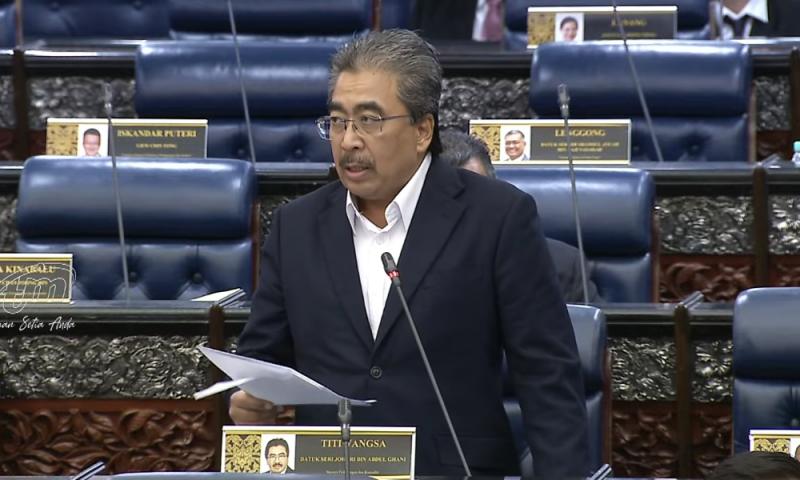
Radiation readings at one of the mines suspended over the “blue river” pollution incident in Perak in October were found to be far above limits, according to Acting Natural Resources and Environmental Sustainability Minister Johari Abdul Ghani.

He reportedly told the Dewan Rakyat’s special chambers yesterday that the measurement of the waste from the mine’s in-situ leaching process reached as high as 13 becquerels, compared to the one becquerel limit stipulated in the site’s environmental impact assessment report.

Based on initial findings, he said the discharge samples also showed a blueish tone, almost the same as the discolouration of Sungai Perak on Oct 21.

“Therefore, the investigation is now focusing on the type of chemicals used in the leaching process and whether it is consistent with the information that has been reported to the authorities,” Bernama quoted him as saying.

For context, the radioactivity of a typical banana is around 15 becquerels, mostly due to the presence of naturally occurring potassium-40.

The minister likely meant “becquerels per gram” instead of “becquerel”. In the context of rare earth mining, where thorium and its decay products are typically involved, one becquerel per gram is the regulatory limit above which it may be considered radioactive waste with special requirements for licensing, handling, and disposal.

Rare earth elements

Johari added that the cabinet meeting last Friday approved a three-week suspension for the rare earth mine operated by MCRE Resources Sdn Bhd, along with Rahman Hydraulic Tin Sdn Bhd.

The report stated that Rahman Hydraulic Tin operates the largest open-pit tin mine in Malaysia, located in Klian Intan, Perak.

Separately, a Natural Resources and Environmental Sustainability Ministry (NRES) statement yesterday confirmed the suspension of the two mines, as well as another tin mine involving Asiatic Mine Sdn Bhd and Nalidah Tin Mine Sdn Bhd.

The statement made no mention of the duration of the suspension or any radiation readings, but instead cited non-compliance with the Minerals and Geoscience Department’s conditions regarding the release of effluents, erosion and sediment control, and management of the use of chemicals.

“From an environmental perspective, the NRES and JMG will never compromise with the release of untreated effluents. The handling of chemicals must be done in a safe and controlled manner, while the control of erosion, sediments, and water quality monitoring must be fully functional,” said the ministry.

It said the suspension will be in effect until all remedial measures and technical improvements have been implemented and verified by the JMG.


READ MORE: KINIGUIDE | Can Kedah extract ‘clean’ rare earth elements?


Radioactive, toxic by-products

In-situ leaching is often touted as a more environmentally friendly alternative to open-pit mining.

However, it still poses risks of groundwater, river, and soil contamination.

The process involves injecting chemicals into the soil to flush out rare earth elements (REE), and the REE-rich solution is then pumped out for further processing to concentrate its contents. The ore concentrate is then ready to be sent to refineries for further processing.

The MCRE Resources site near Gerik, Perak, has been in operation since October 2022. In the following year, Perak Menteri Besar Saarani Mohamad said the site generated almost RM16 million in royalties for the state.


READ MORE: Satellite images show Perak rare earth mine built before approval


In 2022, Saarani sought to assuage concerns about the site’s radiological and environmental risks and accused the then Pakatan Harapan-led opposition of misleading the public.

Environmental activists countered that while lanthanides mined were not radioactive, by-products such as thorium are radioactive, while the chemicals used, like ammonia, are toxic even though it is non-radioactive.