


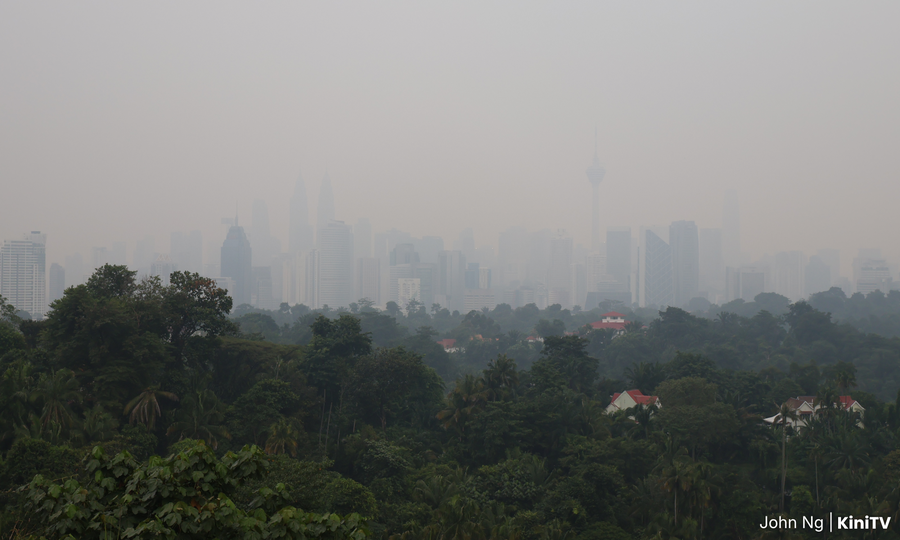

Groups call for science-based haze response, not 'performative' gestures
Two groups have called for the response to the haze crisis to be backed by scientific reasoning and evidence, instead of "performative decisions".
In a joint statement today, Rakyat in Action (Engage) and Projek Sama urged the government to prioritise assistance for those most affected by the worsening transboundary haze...
Two groups have called for the response to the haze crisis to be backed by scientific reasoning and evidence, instead of "performative decisions".
In a joint statement today, Rakyat in Action (Engage) and Projek Sama urged the government to prioritise assistance for those most affected by the worsening transboundary haze.
Among their proposals was the distribution of free N95 masks to vulnerable groups, including schoolchildren, the elderly, pregnant women, outdoor workers, B40 households, and those with respiratory or heart conditions.
Another measure would be for the government to subsidise high-efficiency particular air (Hepa) purifiers for B40 families, particularly those with young children and elderly or sickly members.
The groups also proposed for financial aid to be distributed through existing welfare schemes to daily wage earners, self-employed workers, and low-income parents who lose out on their income during school closures.
In addition, they called for limited emergency assistance for small businesses that depend on schools, to help them weather prolonged closures.
"And employers should be encouraged to provide flexible work arrangements and emergency childcare leave without penalising staff who have no alternative," they added.
The worsening haze situation has prompted several MPs to urge the government take firmer action, with Tasek Gelugor MP Wan Saiful Wan Jan calling for investigation on Malaysian companies allegedly linked to forest and peatland fires in Indonesia and establish a special compensation fund for haze victims.
On Oct 13, Muar MP Syed Saddiq Syed Abdul Rahman called for stronger diplomatic and financial pressure on companies linked to forest fires in Indonesia.
“We need to hit them where they hurt the most,” the former minister said.
Last week, Deputy Natural Resources and Environmental Sustainability Minister Syed Ibrahim Syed Noh told the Dewan Rakyat’s special chamber that the government had assessed the feasibility of enacting a Transboundary Haze Act.
READ MORE: 'We have done everything we can': Anwar defends haze response
Avoid unnecessary disruptions
Commenting further, the NGOs warned against short-term emergency responses, such as school closures, for its unnecessary disruptions to the lives of ordinary Malaysians.
This includes interruptions to income generating activities for parents and school-dependent businesses.
"School closures must be guided by transparent science, not ad hoc or performative announcements.
"Authorities should publish Air Pollution Index (API) thresholds, weather forecasts and health criteria in advance, and communicate decisions by a fixed time wherever possible," they asserted.

They also cautioned against blanket school closures across entire states, arguing that such measures should be reserved for statewide emergencies as haze conditions can vary significantly between districts.
READ MORE: Fadhlina: Agong's decree on school closures reversed after consulting experts
"Instead, district education authorities and individual schools should be allowed to make closure decisions within a clear national framework."
The framework, they said, should also specify whether lessons could continue online, taking into account indoor air quality readings and the needs of vulnerable students.

The recurring haze has long tested relations between Southeast Asian neighbours, with calls for stronger preventive measures and accountability continuing whenever smoke from Indonesian fires drifts across the region.
Although member states had ratified the Asean Agreement on Transboundary Haze Pollution (AATHP) in 2015, critics have continued to condemn the treaty for its lack of enforcement.



Water bombing is the only answer. They know where the fires are even if they can't seem to find the companies involved or their directors, shareholders and nominees.
The single most urgent need right now is being overlooked: people must have "immediate access to good quality N95 masks". When PM2.5 levels are hitting around 288 micrograms per cubic metre (µg/m³), we are breathing air that is dozens of times higher than what is considered safe. This vastly exceeds the World Health Organization’s recommended average annual exposure of 5 µg/m³ and poses a direct threat to respiratory and cardiovascular health, especially for children, the elderly, and those with existing illnesses. Science-based haze policy is important, but it must start with basic, practical protection for the rakyat. That means urgent public distribution or subsidised sale of certified N95 (or equivalent) masks, clear guidance on when to use them, and targeted outreach to vulnerable communities. Without that, calls for “science-based responses” risk sounding like yet another performative slogan while ordinary Malaysians are left to inhale toxic air unprotected.
Report this comment
Are you sure you want to delete this comment?
This action cannot be undone.