


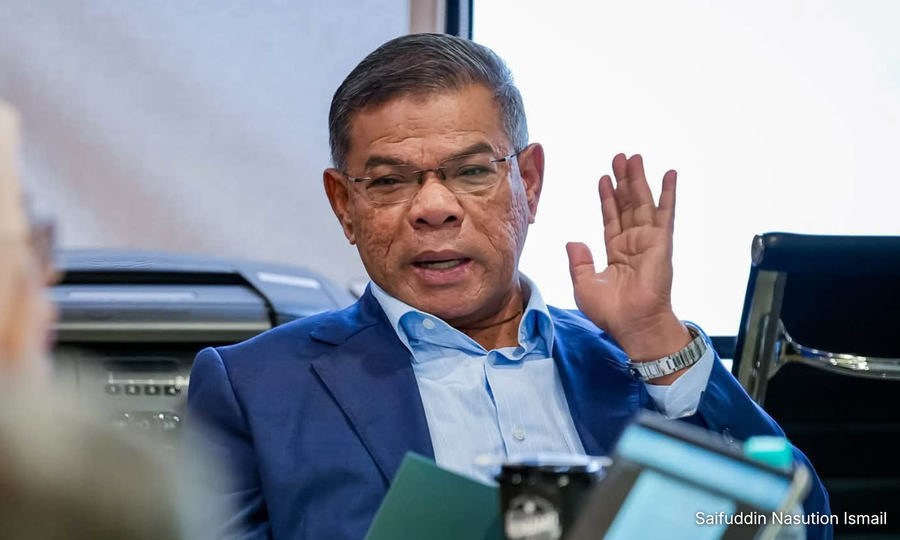

Refugees registered under govt programme to get conditional job access: Saifuddin
Putrajaya’s Refugee Registration Document (DPP) programme will provide valid cardholders with conditional access to formal employment sectors.
Home Minister Saifuddin Nasution Ismail said the move, which human rights and business groups have repeatedly advocated for, will help Malaysia wean off reliance on migrant workers.
The matter came...
Putrajaya’s Refugee Registration Document (DPP) programme will provide valid cardholders with conditional access to formal employment sectors.
Home Minister Saifuddin Nasution Ismail said the move, which human rights and business groups have repeatedly advocated for, will help Malaysia wean off reliance on migrant workers.
The matter came amid a months-long wave of public hostility against refugees in Malaysia, particularly the Rohingya, following disinformation campaigns which claimed that the persecuted community was demanding land and special rights.
READ MORE: Get tough on undocumented migrants, refugees, consider deploying military - PN MP
The animosity has also spilt offline, with a group of Rohingya refugees allegedly driven out of their settlement by locals in Penang.
READ MORE: No Rohingya among 1,476 repatriated to Myanmar, says PM
According to Saifuddin in a written parliamentary reply yesterday, the permission to work will also prevent refugees from falling into the clutches of the shadow economy or exploitation by syndicates.

“Additionally, the work skills and experience possessed by DPP holders will open up better opportunities for third-country resettlement via complementary pathways,” Saifuddin added.
However, the minister did not detail the sectors in which DPP holders will be allowed to work.
Saifuddin also emphasised that all social services provided to DPP refugees, including healthcare and education, will not draw upon existing government services provided to the rakyat.
READ MORE: Refugee healthcare comes at a price - MPs push for insurance, cost-sharing
As such, he said healthcare for DPP refugees will only be provided via insurance or paid without government subsidies, while private educational institutions will provide basic education and training to refugee children.
The latter initiative, Saifuddin noted, will prevent refugee youths from being exposed to street crime, exploitation, or social threats.

The minister said this to a query from former human resources minister and Batu Gajah MP V Sivakumar, who sought details on the government’s long-term strategic framework to manage Rohingya refugees.
Not a new initiative
In 2016, the government said it was implementing a pilot project to allow 300 Rohingya refugees holding the United Nations High Commissioner for Refugees (UNHCR) card to work in the country.
However, the project was discontinued three years later, with a 2019 UNHCR Malaysia report and policy brief by the Institute of Strategic and International Studies Malaysia reportedly finding flaws in the project.
Among others, the initiative lacked transparency, had limited communication with refugee communities, and failed to match refugees with suitable jobs.
The DPP, launched on Jan 1 this year, is a government-led refugee registration and identification system, with its first phase limited to individuals held in immigration detention centres.

Saifuddin yesterday said a total of 4,008 detainees have been recorded as potential candidates to be given temporary protection as refugees, subject to security screening and the government’s refugee status determination process.
Those whose refugee status has been verified will be issued a DPP card, which is a special pass under the Immigration Regulations 1963. It is the sole document recognised by the government for refugees and allows them to reside in Malaysia pending a “final management”.
The minister added that the three potential outcomes for DPP refugees are resettlement in a third country, returning to their country of origin when conditions permit, or deportation if they commit crimes or violate the DPP pass conditions as established by the government.
Restricted travel
He also said that the movement of DPP cardholders is controlled according to geographical zones, with inter-state travel prohibited without special permission from the Immigration Department.

The DPP card must be renewed annually and excludes temporary residence in Sabah, Sarawak, and the Federal Territory of Labuan.
Malaysia is not a signatory to the 1951 Refugee Convention and has no specific law recognising refugees or defining their legal status.
Rights groups have questioned the lack of clarity surrounding the DPP framework, including the criteria for determining refugee status, whether rejected applicants can appeal, how biometric data will be protected and whether applicants could face prolonged detention during verification.



Credit to the Home Ministry for making an effort to address this sensibly. Allowing screened, registered refugees to work legally can help them support themselves, reduce exploitation and meet labour needs. The conditions must be clear and employers held accountable. A practical step forward that deserves support.
Report this comment
Are you sure you want to delete this comment?
This action cannot be undone.