


/file/publisher-c1a3f893382d2b2f8a9aa22a654d9c97/2024/08/60e7fdf9bf002a29aacaf75df4fcf448.jpg)

US envoy: Have things in Gaza improved because of boycotts?
In an interview after visiting the Malaysiakini office, he asked, “Does anyone think the boycott has led to any improvements to conditions in Gaza? If someone wants to make that argument, I am open to hearing the basis for it.”
However, Kagan reiterated...
Amid a global boycott launched against companies branded as supportive of Israel, United States ambassador to Malaysia Edgard D Kagan questioned the “practical impact” of such movements, including by Malaysians.
In an interview after visiting the Malaysiakini office, he asked, “Does anyone think the boycott has led to any improvements to conditions in Gaza? If someone wants to make that argument, I am open to hearing the basis for it.”
However, Kagan reiterated the US’ support for peaceful protests and boycott actions.
“We believe in peaceful protests. That is acceptable and we support it. We recognise people have strong views, so have at it.
“For boycotts, I don’t question the right to boycott. But I do question a certain selectivity.
“I do also question the fact that the practical impact of boycotts is quite limited and often more negative for Malaysians,” he said.
Kagan, who assumed the ambassador’s position in April, noted during his first official press conference that such boycotts would ultimately hurt Malaysian employees hired by the targeted companies.
Since the escalation of attacks by Israeli forces against Palestinians in Gaza, among the boycotted brands included McDonald’s and Starbucks, which employ thousands across Malaysia.
The Boycott, Divestment, Sanctions (BDS) for Malaysia group has also expanded its “targeted boycotts” to support Palestinian groups.
BDS has urged Marvel Studios and its parent company Walt Disney Studios to remove the character Ruth Bat-Seraph from the “Captain America: Brave New World” movie.
The character, known by her alter ego Sabra, was depicted in the comics as an agent for Mossad, Israel’s intelligence organisation, as well as a police officer in Tel Aviv.
Local consequences
Kagan told Malaysiakini his position has not changed since his last press conference, both on the rights to peaceful protest and the impact of such boycotts.
“Obviously we don’t like it. We prefer not to see it.
“But it just seems the effectiveness of this is questionable… I think as a practical matter, in my view, the (current) boycott tends to be more symbolic and such symbolic actions have more consequences on Malaysians,” he said.
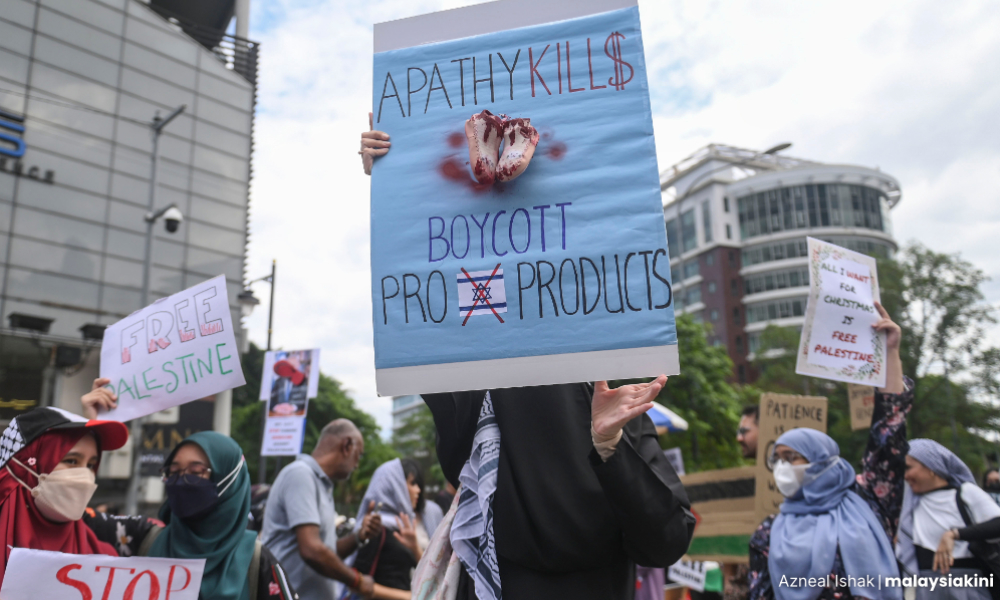
Contacted for comments, BDS Malaysia chairperson Nazari Ismail argued that many companies have now withdrawn their investments from Israel and from companies that are complicit with Israel’s atrocities towards Palestinians.
“Consumers are also boycotting companies that are complicit.
“These will help to weaken the Israel economy and reduce its ability to commit atrocities towards Palestinians,” he told Malaysiakini.
In response to the boycott, McDonald’s Malaysia franchise owner - the 100-percent Muslim-owned Gerbang Alaf Sdn Bhd - donated RM1 million in aid to Palestinians, and denied any links to Israel.
Globally, however, the firm last month blamed boycotts in countries with large Muslim populations for a dip in its global sales for the first time in three years - a one percent decline in sales across quarter-to-quarter.
Meanwhile, Berjaya Food Bhd, which runs several brands in Malaysia, including Starbucks, reported a pre-tax loss of RM33.16 million for the third financial quarter ending March 31, 2024, and its revenue fell by nearly half from RM265.85 million to RM138.65 million during this period.
This compared to the RM25.39 million profit it made during the corresponding period last year.
Starbucks Malaysia has said it stands for humanity and has no political agenda but its shops and employees have been targeted with violence due to misinformation about the nature of its business.
Malaysiakini has contacted BDS for comment on the ambassador’s latest remarks.
/file/publisher-c1a3f893382d2b2f8a9aa22a654d9c97/2024/08/d84c7410b563179233e77707cce29382.jpg)
/file/publisher-c1a3f893382d2b2f8a9aa22a654d9c97/2024/08/2b264d944eab3127661a0f9c45034ef4.png)
/file/publisher-c1a3f893382d2b2f8a9aa22a654d9c97/2024/04/9ab29dd21fbdc08668d57d74aab953aa.jpg)
/file/publisher-c1a3f893382d2b2f8a9aa22a654d9c97/2024/01/3314f7b7902c657c7287b54e39e050f4.jpg)
/file/publisher-c1a3f893382d2b2f8a9aa22a654d9c97/2024/04/ad623851b47237edca08f38929b75da0.jpg)


Report this comment
Are you sure you want to delete this comment?
This action cannot be undone.