


/file/publisher-c1a3f893382d2b2f8a9aa22a654d9c97/2024/09/6fa36f79c65fb0d10e4cfa8b9fa5707b.jpg)

Penang physicist's groundbreaking work at Large Hadron Collider
Born in Kuala Lumpur and raised in Penang, his journey to the cutting-edge of physics began early, with a curiosity that has since grown into a profound dedication to unravelling the mysteries of the universe.
“I was born in KL but grew up in Penang, where my father’s family has roots,” he shared, recalling his early education at SK Batu Lanchang and later at Penang Free School.
It was a combination of natural aptitude and opportunity that saw Khoo awarded a scholarship to complete his pre-university studies at Uplands International School in Batu Ferringhi. There, he first dabbled in topics such as relativity and quantum physics.
In 2005, he made his way to the US for undergraduate studies at Williams College in Massachusetts.
“It’s a tiny university, very...
MALAYSIANSKINI | Khoo Teng Jian’s career as a particle physicist may have taken him around the world, but his roots are firmly grounded in Malaysia.
Born in Kuala Lumpur and raised in Penang, his journey to the cutting-edge of physics began early, with a curiosity that has since grown into a profound dedication to unravelling the mysteries of the universe.
“I was born in KL but grew up in Penang, where my father’s family has roots,” he shared, recalling his early education at SK Batu Lanchang and later at Penang Free School.
It was a combination of natural aptitude and opportunity that saw Khoo awarded a scholarship to complete his pre-university studies at Uplands International School in Batu Ferringhi. There, he first dabbled in topics such as relativity and quantum physics.
In 2005, he made his way to the US for undergraduate studies at Williams College in Massachusetts.
“It’s a tiny university, very ‘ulu’ and away from major cities like Boston,” he said, reflecting on the setting that allowed him to focus on his academic pursuits.
Initially driven by an interest in theoretical physics, he explored various fields before eventually gravitating towards particle physics.
“When I was reaching the end of my degree, I had an opportunity to apply for a scholarship from Williams College to fund PhD studies at Cambridge, where I had applied unsuccessfully as an undergraduate,” he said.
The Large Hadron Collider
Khoo further said this was also a perfect time to immerse himself in particle physics, as the Large Hadron Collider (LHC) was preparing to launch.
That timing helped him convince the scholarship panel that he had a good reason to study in the UK, as Cambridge University had built parts of the LHC and was actively involved in the project.
He joined the Atlas experiment collaboration and became part of a global team at Cern, the European Organization for Nuclear Research, working on one of the most ambitious scientific projects of our time.
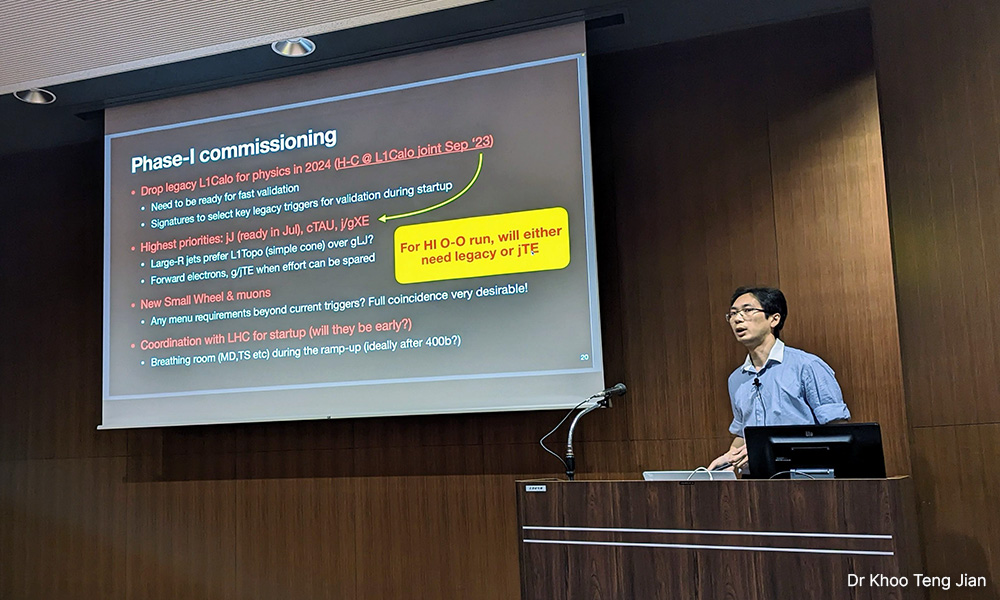
“Atlas has 6,000 members, of whom I am one of 3,000 scientific authors,” Khoo explained.
The LHC is the world’s largest and highest-energy particle collider, which was built by Cern between 1998 and 2008.
It lies in a tunnel 27km in circumference and as deep as 175m beneath the France–Switzerland border near Geneva.
Built in collaboration with over 10,000 scientists and hundreds of universities and laboratories across more than 100 countries, its purpose is to allow physicists to test the predictions of different theories of particle physics.
Initially, Khoo’s research focused on exploring alternative theories, such as supersymmetry, which postulate the existence of additional particles.
The Higgs boson
However, the search for the Higgs boson quickly overshadowed other theories.
“The evidence grew steadily for the Higgs, and that discovery was announced in 2012, towards the end of my PhD, he said.
The Higgs boson is a tiny particle that helps explain why things have mass, a key piece in understanding how the universe works.
Sometimes called the Higgs particle, it is an elementary particle in the standard model of particle physics produced by the quantum excitation of the Higgs field, one of the fields in particle physics theory.
In the standard model, the Higgs particle is a massive scalar boson with zero spin, even (positive) parity, no electric charge, and no colour charge that couples to (interacts with) mass.
Khoo’s contribution to the discovery involved developing software to detect “invisible” particles like neutrinos.
“Although my role was small, it was part of a larger collaborative effort,” he said, reflecting on the magnitude of the discovery, which validated decades of theoretical work in physics.
Since 2020, he has focused on more advanced aspects of Higgs research, particularly studying rare events where two Higgs bosons are produced simultaneously.
“It’s like studying rhinos that normally give birth to one baby, but very rarely have twins,” Khoo said.
Recently, he was elected Trigger Coordinator at Atlas, a prestigious role that oversees the system determining which data to record from the LHC’s 40 million collisions per second.
“I’m about to move back to Geneva, Switzerland, for one year to take on this role,” he shared.
The position requires him to manage complex systems while leading a team of dedicated and creative young physicists.
“The strong community we have makes it fulfilling, as it allows me to think of my job as finding ways to help our bright stars do their best work.”
The other side of Khoo
Outside the lab, Khoo enjoys a balanced life.
After moving to Berlin, Germany, he and his partner finally reunited after a long-distance relationship spanning Geneva and Osaka, Japan.
“I’ve also focused more on cooking, coffee, and exploring cafés,” he said.
As he prepares to return to Geneva, he’s excited about the prospect of spending more time outdoors, cycling, hiking, and skiing as the seasons allow.
Word to the wise
For aspiring physicists, Khoo offers straightforward advice.
“Get as much exposure as you can to the big ideas that are out there. Read books, watch documentaries, listen to podcasts by active physicists,” he encouraged.
“And learn to code! Programming is essential in physics these days.”
Looking ahead, he hopes his research will lead to something groundbreaking, particularly in the study of the Higgs boson.
“Every property we’ve studied shows that the theoretical predictions are spot on. But science makes progress when something violates our understanding, demanding a better explanation.”
As Khoo moves forward in his career, his journey from Penang to the forefront of particle physics serves as a powerful example of where passion, curiosity, and perseverance can lead.
MALAYSIANSKINI is a series on Malaysians you should know.
Maverick ROTTW publisher Rom keeps looking forward
Innovative way to assist visually impaired Muslims in prayer
20 years on, FreedomFilmFest still all about nation-building
Borneo Komrad activist dedicates life to being voice of the unheard
From first graduate in family to Harvard-trained global neurosurgeon


Report this comment
Are you sure you want to delete this comment?
This action cannot be undone.