


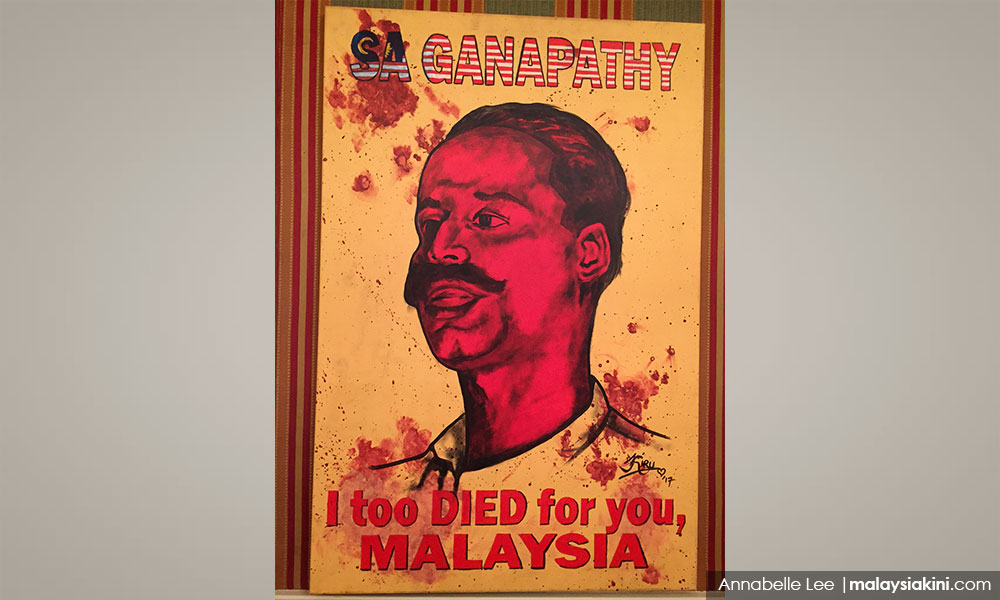

Doing his best to keep martyred Ganapathy’s memory alive
However, keen students of history will tell you that SA Ganapathy, the first president of the 300,000-strong Pan Malayan Federation of Trade Unions (PMFTU) was another early important figure.
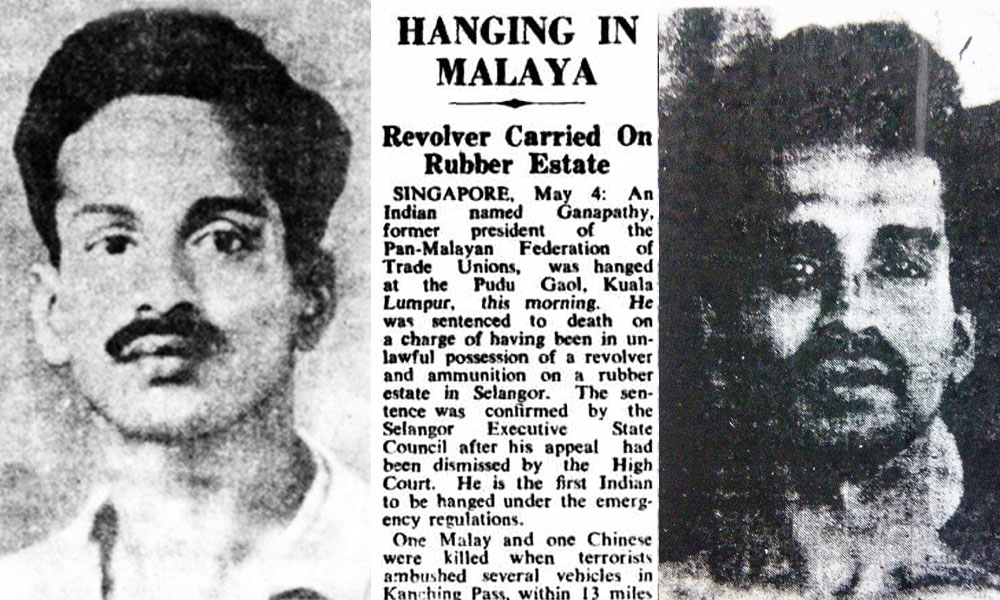
Born in Tamil Nadu, India, in the 1910s, Ganapathy was orphaned at an early age and brought to Singapore by his uncle. As an influential trade unionist and a Communist, he was hanged in the early days of the Emergency by British authorities in Malaya, on May 4, 1949, after being convicted for the possession of firearms.
While that period of history is murky and often coloured by one’s political sympathies, amateur historian Saminathan Munisamy found Ganapathy’s story a fascinating one and he has devoted many years of study and research to tracking down archival information that may shed light on the truth about Ganapathy.
In 2009, Saminathan founded a blog dedicated to preserving Ganapathy’s memory and he has been involved in a number of projects, including a recent exhibition at the Netaji Hall Indian Cultural centre on the former unionist’s life...
MALAYSIANSKINI | The most celebrated figure of the Malaysian trade union movement is almost certainly PP Narayanan, who was the founding president of the Malaysian Trades Union Congress.
However, keen students of history will tell you that SA Ganapathy, the first president of the 300,000-strong Pan Malayan Federation of Trade Unions (PMFTU) was another early important figure.
Born in Tamil Nadu, India, in the 1910s, Ganapathy was orphaned at an early age and brought to Singapore by his uncle. As an influential trade unionist and a Communist, he was hanged in the early days of the Emergency by British authorities in Malaya, on May 4, 1949, after being convicted for the possession of firearms.
While that period of history is murky and often coloured by one’s political sympathies, amateur historian Saminathan Munisamy found Ganapathy’s story a fascinating one and he has devoted many years of study and research to tracking down archival information that may shed light on the truth about Ganapathy.
In 2009, Saminathan founded a blog dedicated to preserving Ganapathy’s memory and he has been involved in a number of projects, including a recent exhibition at the Netaji Hall Indian Cultural centre on the former unionist’s life.
Saminathan told Malaysiakini in an interview that he is determined to preserve the legacy of Ganapathy’s contribution and sacrifices.
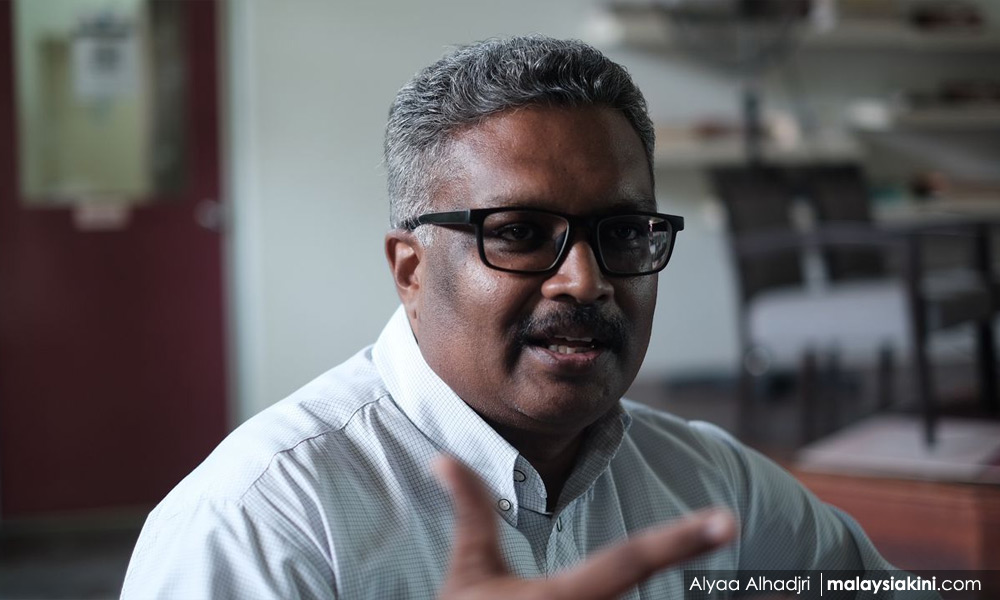
“My interest in him probably dates back to the 1990s. I was interested in history I started to see that official history is often twisted to serve the narrative that the political powers want to project.
“As part of my work, I went to Japan for training in Nagano prefecture. Then I saw that the Japanese still honour Takeda Shingun a famous warlord who lived from 1521 to 1573. To this day, every year they have celebrations to commemorate him.
“I started thinking. When I go back to Malaysia, who do I celebrate? Some might say former minister VT Sambanthan or PP Narayanan… but to me, there should be somebody who fought against the British and the Japanese, and fought for labourers and all Malaysians.
“To me, that man is SA Ganapathy,” Saminathan added.
Politically active at a young age
Ganapathy had become politically active at a young age. He joined the Malayan Communist Party in 1939 and was part of the underground rebellion during the Japanese occupation of Malaya.
In the aftermath of the war he became prominent as a trade unionist and in February 1947, was elected as president of the Pan Malayan Federation of Trade Unions (PMFTU). Later that year the PMFTU was one of the key components of All Malaya Hartal, on Oct 20, 1947, which saw Malay nationalists inspired by then Indonesian president Sukarno team up with Chinese left-wing groups and Indian-dominated labour unions.
The Putera-AMJCA strike, which was held in spite of minor counter-strike attempts by Umno, was a great success and made the British rulers determined to crack down on leftist forces, resulting in the 1948 declaration of Emergency.
While activist Fahmi Reza chronicled the efforts in his documentary Sepuluh Tahun Sebelum Merdeka, much of this is forgotten.
“Ganapathy is hardly known to most Malaysians today because history was written by the victors. Those who win the struggle will tell the story. Those who are on the other side of the story, leftists like Ganapathy who actually stood up to the Japanese and the British, are neglected.
“The hartal was the point that the British realised that they are going to lose Malaya together. A lot of people have forgotten, but the whole thing was huge.
“But Ganapathy was made a target and swiftly sentenced to death. His death by hanging was even proclaimed as ‘murder’ by the International Federation of Labour Unions (WFTU),” Saminathan said.
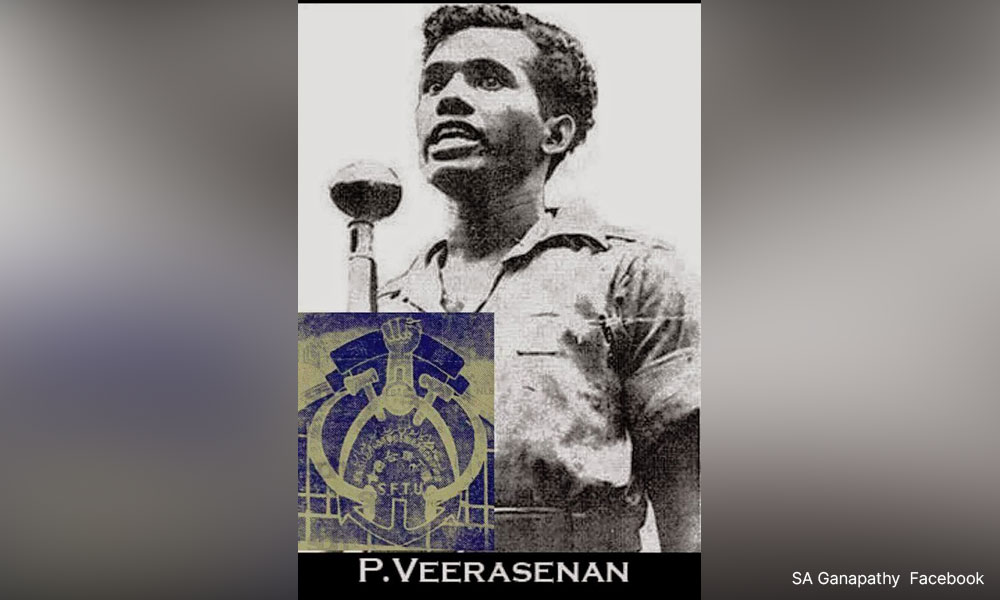
At the time Ganapathy took the leadership of PMFTU, fellow unionist P Veerasenan was elected to be the president of the Singapore Federation of Trade Unions (SFTU).
Ganapathy and Veerasenan disappeared when the Emergency was declared. On March 1, 1949, Ganapathy was caught when he was in hiding in a rubber estate, the Waterfall Estate in Rawang. He was tried and sentenced to death by hanging for unlawful possession of a .45 revolver and carrying six rounds of ammunition.
Veerasenan joined the First Brigade of Malayan National Liberation Army (MNLA) and was shot dead on May 3, 1949, by a Gurkha unit.
Passionate about the hidden history
“My own journey has turned out to be more intense than I first expected. I remember I took the bus from JB to KL in the year 2000 to meet up with publishers to talk about research on Ganapathy.
“To me, I found this character. At first, I thought Ganapathy fought for Indians only but I was impressed that he fought for all races. His struggle is beyond race and religion. That’s why when Hindraf emerged in 2007 and tried to portray him as somebody who fought for Indians, to me, this narrowed down his contributions, and in fact, I found it childish.
“Many Indian leaders of the time were national leaders who were later re-cast as Indian community leaders,” Saminathan added.
He said that some things fell into place by good fortune.
“When you tune your mind to something, it will come for you. I have never been to the public record office in London. My friend working for SIA as a pilot happened to go there and found some documents that were untouched for almost 60-70 years.”
Saminathan himself has a day job as an operations manager involved in the food and beverages industry. Aside from the blog and occasional presentations, he also brought a brick for RM1,000 at the Malaysiakini wall in the name of Malaya Ganapathy,” he said.
Given that it’s so long away in the distant past, what can be achieved?
“I would like to see a posthumous pardon or some other way to acknowledge Ganapathy’s struggle and clear his name. At least an apology from the Queen’s government.
“Because of what is associated with communism, there are a lot of stigmas. When I met Ganapathy’s cousin, he told me this story, that his father said none of you should speak about him.”
So what does Saminathan think of the class struggle in Malaysia today?
“We must stand for labourers who build the country regardless of nationality. We have a history of being migrants. Your children can also be a migrant in another country. When will they learn – that these are our rights?
Despite his keen interest, Saminathan never considered going into politics.
“I prefer activism. I see leaders like PSM’s Dr Jeyakumar Devaraj and S Arutchelvan they are both activists in the political system. I used to see the late Irene Fernandez as somebody who stands up. I met her and told her, ‘you are like SA Ganapathy’.”
While there are many entries in the past, Saminathan has not been so prolific recently.
Saminathan said: “Previously, I was working in Singapore. More about design than fieldwork, so I had a lot of time to spend.
“I continue my blog. I make it professionally. I don’t put my thoughts. Just try to see this as history. But you cannot be neutral in a moving train. Either you are right or left. I choose to be left.
“I am actually working on a book too. At first, I was deciding… should I write a historical novel or should I make it very technical, with court reports? So far, I’m working on the Tamil version of a historical novel with one of my friends. I have completed three chapters and still have a long way to go.
“I never ever feel like giving up and dropping my documents. It is a worthy battle, to try and represent the truth against the odds.”
Malaysianskini is a series on Malaysians you should know.
Previously featured:
Wrestler Ayez Shaukat makes history in Texas competition
Hakken: Bringing favourite anime characters to life for millions
Dancer Jeremie Gan is thriving at Singapore Ballet
Ultramarathoner Jeff Lau runs to help fight HIV/Aids
Dog wheelchairs - One man's mission to help paralysed pets
Pilot turned farmer finds 'corny' niche
Pulitzer winner Marcus Yam risks life for shots on the ground


Report this comment
Are you sure you want to delete this comment?
This action cannot be undone.