


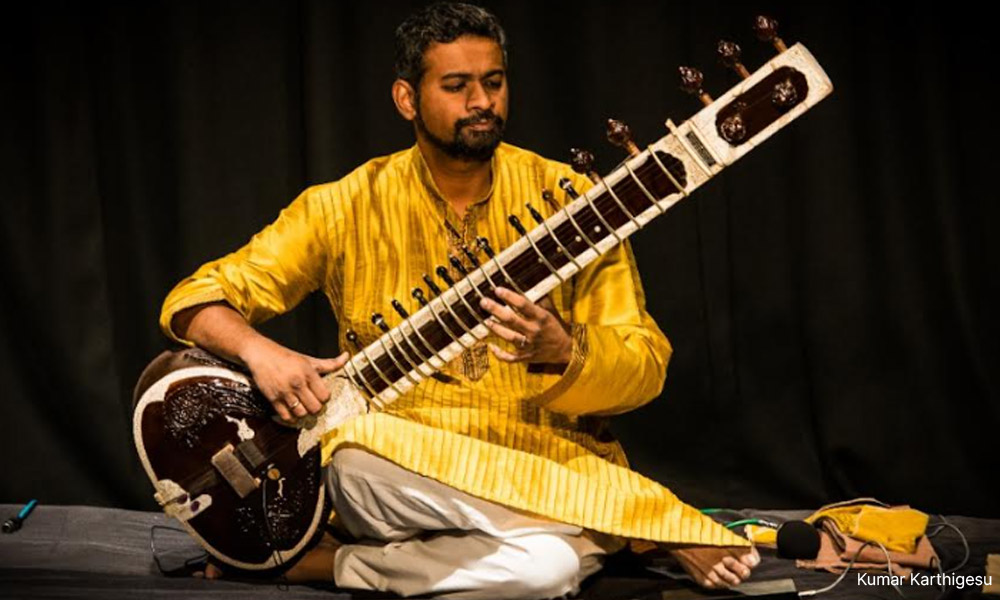

Spreading the gospel of Sitar
MALAYSIANSKINI | Kumar Karthigesu first performed the sitar at the tender age of 11 at a 1984 concert, barely a year after he started learning to play the classical stringed instrument.
Today, he has toured the world, been involved in drama productions, recorded albums, and received many notable awards such as the Anugerah Karyawan Seni by the Unity, Culture, Arts and Heritage Ministry in 2009.
Despite the success, Kumar is still brought back to that time in 1984 when he played the sitar in front of a crowd for the first time at a secondary school.
"I remember the excitement of getting onto a stage and the attention and applause I received after performing.
"I guess that contributed to the motivation to keep at it," he told Malaysiakini, noting that a fire was ignited in him, and it hasn't gone out since.
Kumar got his first taste of learning music at the age of...
MALAYSIANSKINI | Kumar Karthigesu first performed the sitar at the tender age of 11 at a 1984 concert, barely a year after he started learning to play the classical stringed instrument.
Today, he has toured the world, been involved in drama productions, recorded albums, and received many notable awards such as the Anugerah Karyawan Seni by the Unity, Culture, Arts and Heritage Ministry in 2009.
Despite the success, Kumar is still brought back to that time in 1984 when he played the sitar in front of a crowd for the first time at a secondary school.
"I remember the excitement of getting onto a stage and the attention and applause I received after performing.
"I guess that contributed to the motivation to keep at it," he told Malaysiakini, noting that a fire was ignited in him, and it hasn't gone out since.
Kumar got his first taste of learning music at the age of six when his parents, keen music lovers, enrolled him and his siblings in various music classes.
"I learnt mridangam, violin, vocals, guitar, tabla. But I was very playful and took most of it lightly, as most kids do.
"I started learning sitar when I was 10. Somehow, I developed a liking for sitar, and that stuck," he said.
This liking would eventually grow into a full-blown career, setting Kumar towards his ultimate objective in life; making music.
The start of a musical journey
In 1991, after meeting renowned sitarist Ustad Usman Khan, Kumar was invited to India to learn the instrument under Ustad’s guidance.
Although Kumar was grateful for this once-in-a-lifetime opportunity, he didn't feel like he deserved it.
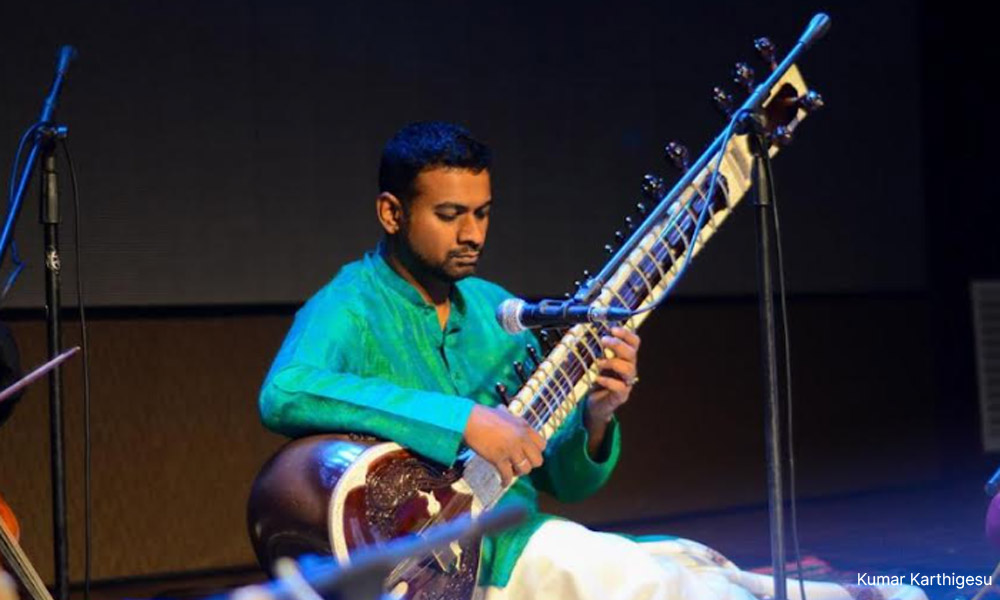
"I feel so blessed in this regard, but I don't feel like I really worked hard for opportunities like this as it just fell on my lap.
"Retrospectively, I can see now just how lucky I was. There would have been so many students more deserving than me," he said.
With this in mind, Kumar made it a point to make the most out of his training in India, spending hours in lessons and rehearsals.
“We would start rehearsals at 7am, and our lessons would continue right until 9 or 10pm, with breaks for meals and to stretch our legs.
"We shared light moments, jokes and stories (in class). We would even have impromptu lessons as we went for a walk or a drive.
"Using our constant footsteps, we could create a complex rhythm. Everything was about learning music, but we didn't feel any pressure," he recalled.
Kumar attributed this to his master, Usmanji, with whom he formed a close relationship and who made him feel at home.
"He became a father figure, mentor and friend, and his whole family became my family too," he said.
An educator in the Temple of Fine Arts
After completing his Bachelor's and Master's degree overseas, Kumar returned to Malaysia and kick-started the sitar department at the Temple of Fine Arts in Kuala Lumpur, Penang, and Singapore, serving as the sitar teacher in all three centres.
He was later appointed director of the Temple of Fine Arts' Music Department in 2008.
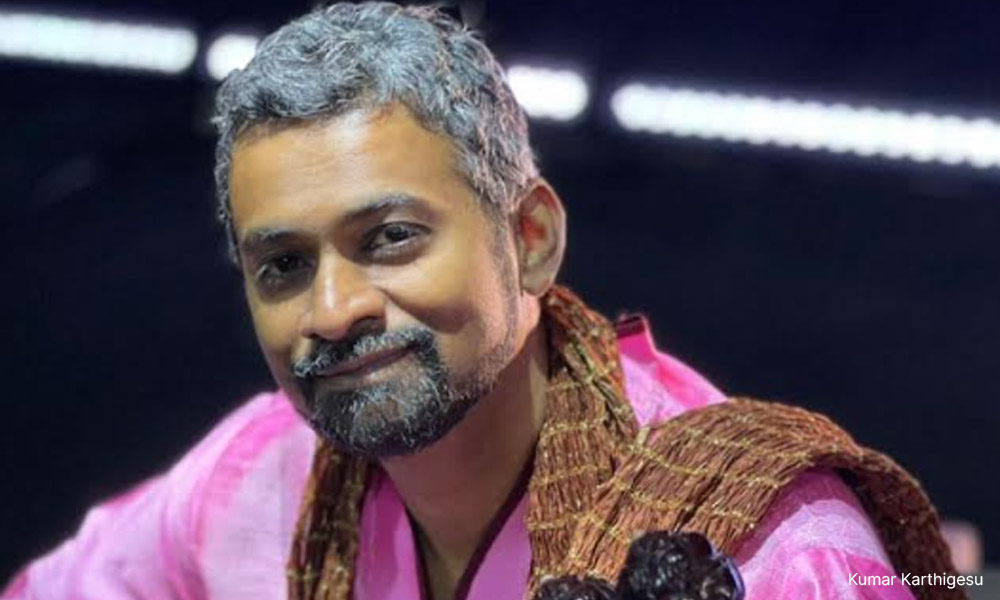
This new role came with the challenge of balancing time, which Kumar admitted was not an easy thing to do.
"It was constantly tiring. I was also developing myself as a performer, so there were practices and rehearsals for concerts," he said.
However, he realised that he picked a career that was also his passion, and seeing the fruits of his labour brought him much joy despite the hectic schedule.
"I loved watching my students grow and develop with a little help from me. I have had good relationships with my students until today, even though some have stopped learning," said Kumar.
Besides getting motivation from his students, Kumar noted that the support he gets from his family is the little push he needed during challenging moments.
He never forgets the support his family showered him with throughout his journey, despite his parents wanting him to be an engineer.
"They were encouraging me to be an engineer by profession! The main concern, of course, was financial sustainability.
"But once they realised that my heart was in music, my happiness lay there and that I could make a living from teaching and performances, they threw their support behind me all the way," he said.
Diversifying local music scene
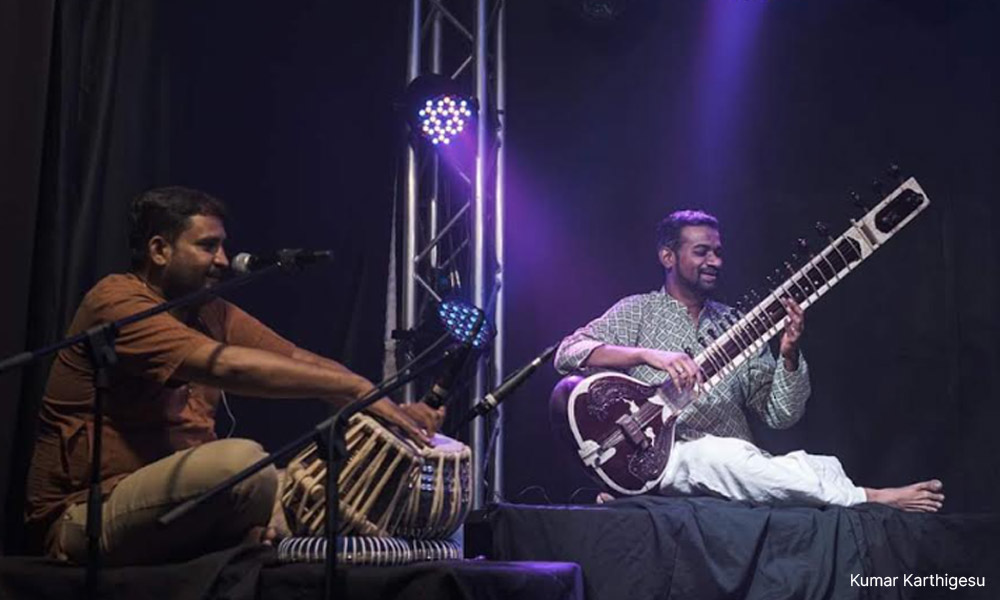
In 2008, Kumar made a new addition to his wide variety of experiences. With some fellow musicians, he formed AkashA, a band incorporating Malay, Indian, Chinese, and Western music for which he played the sitar.
"AkashA was cobbled together very quickly as we had received an invitation to perform at the Rainforest World Music Festival in Sarawak in 2008.
"The band is mainly about friendship and sharing music, and we have stuck it out for 14 years now," said Kumar.
Kumar reminisced about a stand-out performance in South Korea where the audience, from having no expressions on their faces at the beginning of their performance, slowly moved their heads and smiled as the band played.
"By the end of our set, the crowd was dancing to our music, and we received a prolonged standing ovation.
"It reminded me of the power of music to transcend any communication gaps over race, creed and faith. We were one," he said.
The band has since performed in more than 200 concerts and festivals, with their next performance at the Petronas Philharmonic Hall on Sept 9.
Seeing how AkashA's music has piqued the interest of many fans with its diversity, Kumar believes incorporating traditional elements into modern music should be done more in Malaysia's local music landscape.
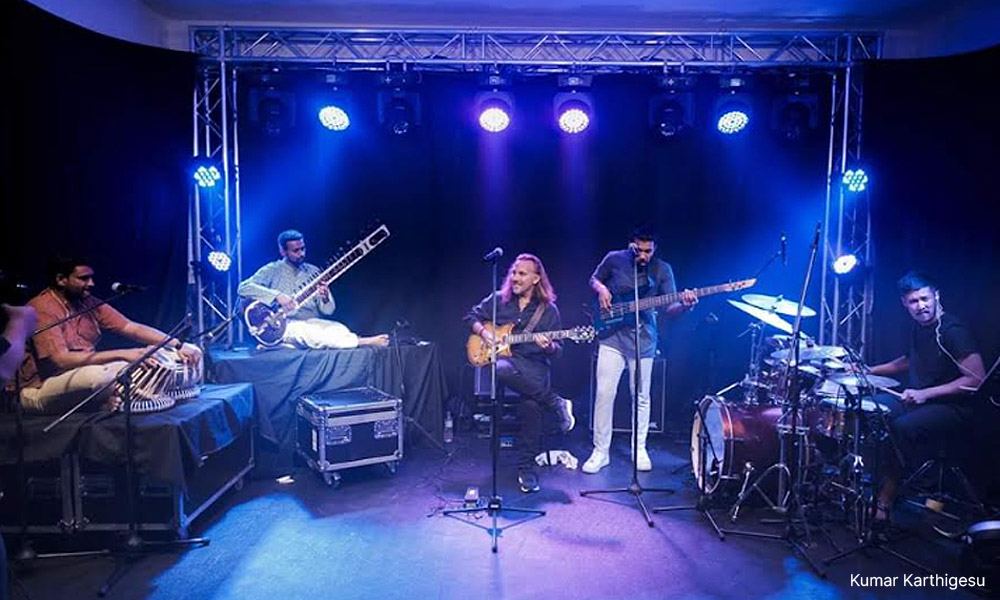
"People have this fear that sharing our tradition or assimilating other cultures in our music means that we are giving up our traditional values or watering them down.
"We live in a country where we incorporate everything without necessarily having to sacrifice our own cultural and traditional identities,” said Kumar.
He brings up an analogy in which Malaysians enjoy experiencing western culture. However, doing so does not change their traditional identities as Malaysians.
"It enhances our experiences. Why should this be any different in music? I can remain a traditional Indian musician but still work with ensembles to play other genres.
"We have some of the best musicians. Assimilation and incorporation of our art forms should be natural, not something we have to force-promote," he said.
Kumar played a part in promoting this diversity by collaborating with local artists such as Reshmonu, who Kumar highly praised for creating music without boundaries and labels.
He added that there is much to discover when it comes to music and that a lifetime is simply not enough.
"I engage myself in different performances and productions, be it traditional, inter-genre or fusion.
"I meet and play with new musicians all the time, sometimes fixed and sometimes, spontaneous, impromptu sessions," said Kumar, expressing that this helps keep his music fresh.
A call to support local music
Musicians, like many others, have struggled to stay afloat during the pandemic. However, now that the endemic has come and things have opened up, Kumar urges the public to support the local musicians in their city.
"Attend and watch as many live shows as you can. Encourage your kids and friends to attend and watch as many live performances as they can.
"Also, food for thought. Can anyone name a successful city or country that does not have a thriving art scene? To me, these two go hand in hand,” he said.
He believes that for Malaysia to advance as a flourishing and sophisticated country, Malaysians should play their part in growing and developing the music and art landscape here.
"Do it for the country, but most importantly, do it for you," he said.
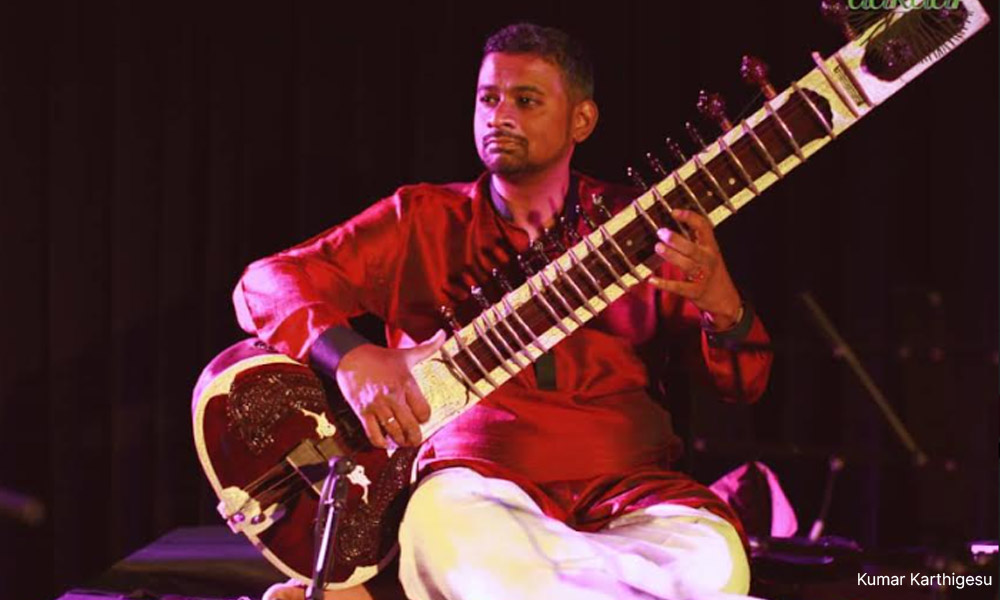
With his demanding schedule, it would seem tough for Kumar to find other things to enjoy besides music.
However, besides doing woodwork and gardening, the father of two exclaims his excitement every time he gets to spend time with his children.
"We do as many outdoor activities as we can: hiking, cycling, nature walks, or the beach.
"I love reading to them and telling them stories, and listening to their stories and watching their antics!” he said.
When asked what his next project would be, Kumar said he is currently recording a ten-track album of light classical Indian melodies.
However, he expressed that it’s challenging for indie musicians to create an album and, more importantly, to make money from it since the cost of producing an album is high.
Nevertheless, the musician is determined to keep going in his pursuit of music.
To Kumar, what means the most to him in his journey is not the awards he receives, the money he makes or the countries he has travelled to, but the people who spend their time listening to his music and watching his concerts.
Malaysianskini is a series on Malaysians you should know.
Previously featured:
Wrestler Ayez Shaukat makes history in Texas competition
Hakken: Bringing favourite anime characters to life for millions
Dancer Jeremie Gan is thriving at Singapore Ballet
Ultramarathoner Jeff Lau runs to help fight HIV/Aids
Dog wheelchairs - One man's mission to help paralysed pets
Pilot turned farmer finds 'corny' niche





Report this comment
Are you sure you want to delete this comment?
This action cannot be undone.