


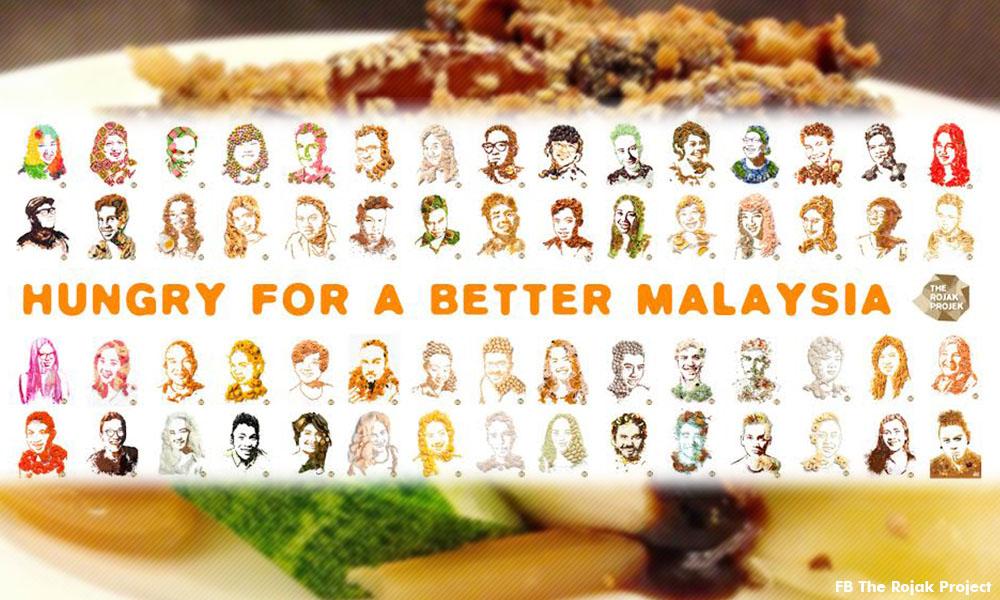

Portraits of unity, through the colours of food
MALAYSIANS KINI The Rojak Projek is an initiative seeking to capture the visual flavour and racial diversity of Malaysia, using the savoury colours and rich textures of nasi lemak, char koay teow, roti canai, rojak buah, muruku, and other local favourites.
This, according to founding member Faye Lim, was a reaction to the trend of posting black and white photographs online to promote the idea of colour blindness among the races circa 2014.
At the time, there was a lot of negative racial issues on social media and people were trying to spread something positive instead. While Lim said the pessimism on social media "annoyed and bugged" her too, she was left dissatisfied with the black and white solution.
MALAYSIANS KINI The Rojak Projek is an initiative seeking to capture the visual flavour and racial diversity of Malaysia, using the savoury colours and rich textures of nasi lemak, char koay teow, roti canai, rojak buah, muruku, and other local favourites.
This, according to founding member Faye Lim, was a reaction to the trend of posting black and white photographs online to promote the idea of colour blindness among the races circa 2014.
At the time, there was a lot of negative racial issues on social media and people were trying to spread something positive instead. While Lim said the pessimism on social media "annoyed and bugged" her too, she was left dissatisfied with the black and white solution.
"(They say) we shouldn't see colour or race, but if you think about it, we should see colour and race because that is who we are.
"Why are we telling ourselves not to look at it? It's mindblowing to think that we should shun ourselves from who we really are." she said in an interview with Malaysiakini .
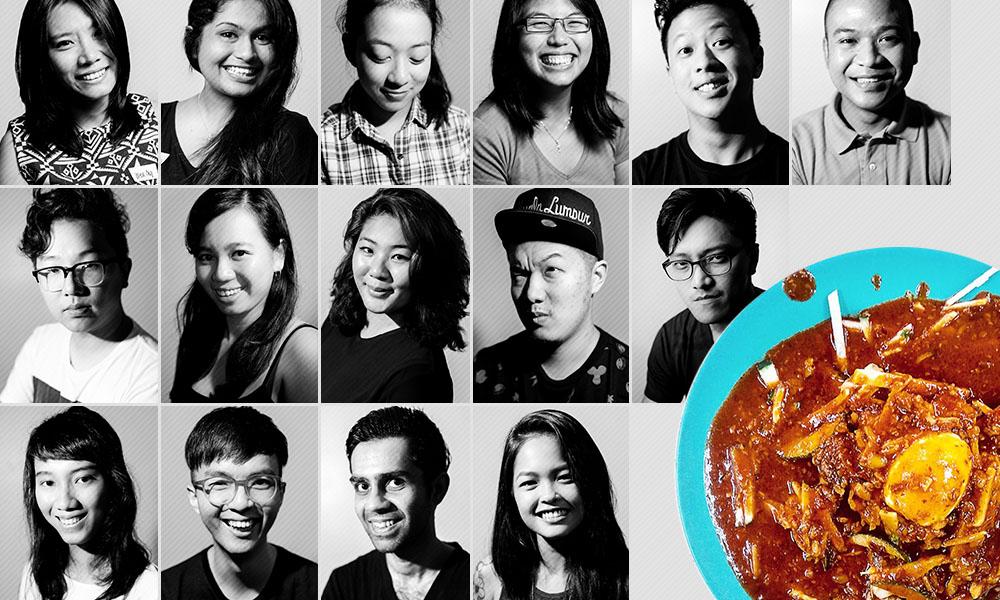 So, Lim set out to come up with her own solution to spread the message of unity and combat the negativity online. Her ideas eventually evolved into The Rojak Projek.
The Rojak Projek - spelled with a 'k', insisted Lim - is an art installation that aims to highlight Malaysian unity in all its rich diversity, drawing upon the unlikely combination of food and art to paint the colours of the ethnic groups in Malaysia in all their gastronomic glory.
She gathered a group of like-minded people to kick off the project, where they use local foods and kuihs like muruku, kerepek ubi, nasi lemak, char koay teow, and roti canai to create portraits of everyday Malaysians.
These artworks are then uploaded on their official Facebook page .
Malaysiakini sat down with Lim and two others from The Rojak Projek - Rachel Lee and Jonathan Cool - to talk about their idea of showcasing Malaysian unity using food, the mutual love of which has often been said to be the one single factor that truly unites all Malaysians.
In their own words, this is their story:
LIM: CLOSE TO THE END OF 2014, THAT WAS THE TIME WHEN A LOT OF NEGATIVITY WAS SPREADING. It was one devastating scenario after another and it felt like the whole country was shaking.
A lot of negativity was spreading on Facebook and social media. It annoyed me very badly, it bugged me.
I remember praying about it and asking, 'Is there anything I can do?', at that time with what I have and who I am, to show that hey, our country is not as stupid or lousy as we think it is. We are actually one of the most unique countries in the world.
WHAT IS THE ONE THING THAT EVERY SINGLE MALAYSIAN CAN BE PROUD OF? I asked myself that, and the answer was food. It has never changed back then and it has never changed now.
SO THIS IS FOOD ART; so what? But this is a concept that has to do with Malaysian people and Malaysian culture. That (the food) is just the element we use to show that.
LEE: THE MESSAGE IS UNITY, to inspire people and remind them that we are a very united people. We don't even realise it sometimes; we take so much of it for granted. We just really wanted to capture that element.
LIM: FOR ME, IT'S NOT JUST THE MESSAGE THAT IS IMPORTANT, it is also a journey of self-reflection. We talk too much, we act too little. We point fingers at other people, but what are we doing?
We say our country is hopeless yet we also say our country has a lot of potential. We're not the type to tell anyone off but we hope and pray to God that we can somehow show part of that potential.
NO ONE IS PERFECT, but we can always try our best...why can't we make things from worse to better? Why (do) we say we cannot, before we (even) try?
If Malaysian people used their potential and put their heart into it, they can do more than what we (Projek Rojak) are doing now.
WE'RE SO TIRED OF HEARING ALL THE NONSENSE. I think it's time to challenge what is important. We are one of the most unique countries in the world and we are just not seeing it.
LEE: ANOTHER THING WE REALLY WANT TO ACHIEVE IN THIS PROJECT is to get Malaysians to be proud of being Malaysian. Even for myself, I was proud to call myself a Malaysian after this project.
COOL: IT WAS REALLY NICE TO SEE. Everyone is really beautiful in their own way.
Malaysians are one of a kind so we interviewed our very Malaysian Rojak Team just to see what being Malaysian truly is to some. Here's to ending this amazing year on a very Malaysian note and to ease our way into the New Year!Watch this space for awesome things coming your way real real soon!#therojakrojek @therojakprojek
Posted by The Rojak Projek on Wednesday, 30 December 2015
LIM: BASICALLY, I STARTED WITH ME. When the idea came about, one by one, I called in friends I knew who might give it a shot. Some of them are childhood friends, some are high school friends, and one of them I know from work.
It's not just about talent but about whether they have the heart. Everyone just came in bit by bit.
COOL: IT STARTED VERY SMALL, about five to six of us. We decided, let's just do it and that's how we started. We just experimented with every single thing.
LEE: HOW I GOT HOOKED IN was because every time she talks, she always go on about this idea that she really wanted to do.
What I saw was a lot of passion, so I think that was the thing that really drew me to this project and I was really excited to join because I believe that you will always pull through if you have the passion.
COOL: WHEN WE HAD OUR FIRST ROJAK PARTY, we had no idea how to start. We just thought of getting everyone together in one rojak party.
No one knew what we were doing. When we had the party, we just said to them, 'hey guys, we're just going to do some artwork, it's going to be colourful, we can't tell you much but you just have to trust us' and they were like, 'yeah, whatever'.
LIM: EVERYTHING WE DID WAS AN EXPERIMENT though our aim was to make 60 portraits within the year.
We undertook to make more than 60 portraits but we didn't end up finishing all of them, because some of the portraits we wanted to do we cannot complete as food we chose doesn't turn out to be a suitable medium whereas for some others, they were perfect.
WHEN WE STARTED MAKING THE PORTRAITS we were very slow. We took a very long time to get it right. Towards the end, we got so much better and faster.
COOL: EVEN THOUGH I'M THE PHOTOGRAPHER , after a while, once you see how they do it (the food portraits), I also got involved with making the art.
LIM: THERE'S A LOT OF PLANNING THAT NEEDS TO BE DONE and everyone has sort of solidified their roles within the project (but) everyone gets a chance to do the artwork.
We're all from different working backgrounds, that's how rojak we are. Not everyone is from a creative background.
The most important thing is to emphasise that they tried. It's the effort and small gestures and the "heart" work that is important.
COOL: THE BIGGEST CHALLENGE IS NOT TO EAT THE FOOD, especially the kuih lapis.
LIM: WE DON'T JUDGE ANYONE WHO EATS IT AFTERWARDS. Everyone just eats with their hands. We cannot resist the kuih. Jon packs the most home.
COOL: BECAUSE you should never waste food.
LEE: I ALSO HAVE A DOG AND MY DOG IS VERY HAPPY after we're done.
LEE: AT THE MOMENT, WE'RE SUSSING A LOT OF THINGS OUT. We're strategising some future steps. If we can, hopefully, there's a lot more to come. It's really hard to tell because it depends on several things and a lot of us are getting busier.
TO KEEP IT SUSTAINABLE , we do have to find a source of income one way or another but the social aspect is the most important. We are looking at certain ways to generate income so we can focus on this work.
WE'VE GOT OTHER SURPRISES COMING UP. We don't like to give away everything because if we said it and it doesn't work out, what's the point?
MALAYSIANS KINI is a series on Malaysians you should know.
Previously featured
Poster girl for diversity? No thanks, says novelist Zen Cho
M’sian int’l hackathon champ shows computer games good for you
Pianist bears no grudge over concert cancellation due to Bersih 2
Facing possible jail time, Lena's main worry is dad finding out
This Malaysian youth has helped 10,000 Syrian families and counting
'Cat-man' quits day job to save 80 feline friends
Teen writer aspires to outdo Harry Potter
This Malaysian youth has helped 10,000 Syrian families, and counting
'Cat-man' quits day job to save 80 feline friends
Engineer, activist, kampung rebel - Yati starts her 50th year anew
Facing possible jail time, Lena's main worry is dad finding out
What if Hang Jebat never stood up to the sultan?
'Am I going to die?' - student journo reports from conflict zone frontlines
Snubbed by Masterchef, M'sian youth wins over refugees in Greece


Are you sure you want to delete this comment?
This action cannot be undone.